
Dodge Cummins Best and Worst Years: Which Used Rams I’d Shop
A used Cummins Ram can feel like the truck you will keep forever. Then you start looking at listings. One has a spotless body and no service records. Another has a mountain of miles and a folder of receipts.
Both sellers call theirs “the best year.” Which one deserves your money?
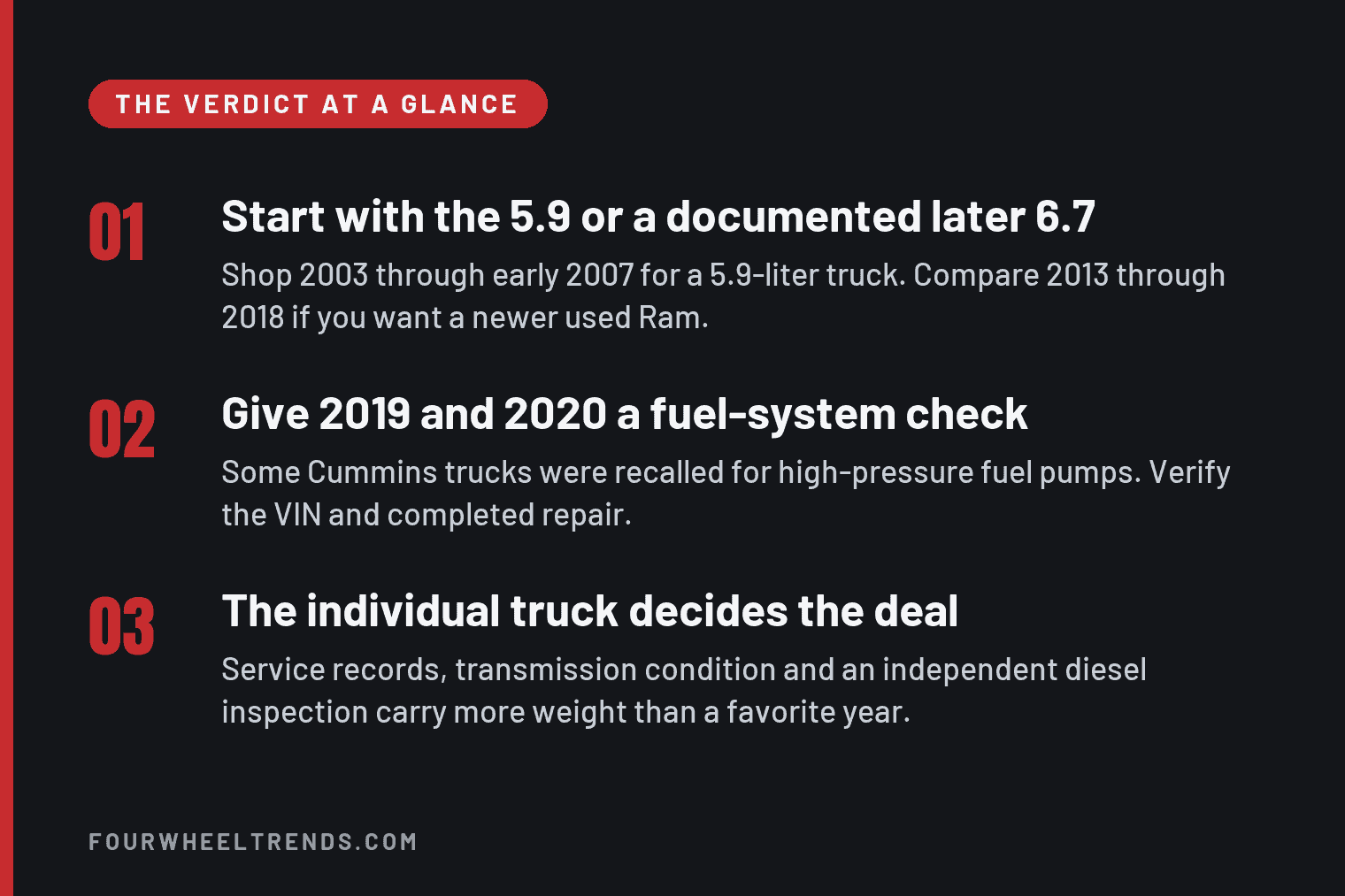
I would start with a well-kept 2003 through early-2007 Ram 2500 or 3500 if I wanted the 5.9-liter Cummins. For a newer work truck, I would shop 2013 through 2018 6.7-liter trucks, with extra attention to their emissions-system history.
I would give 2019 and 2020 6.7-liter trucks the closest scrutiny because some were recalled for a high-pressure fuel pump that could fail and cause a loss of power. A documented repair and a thorough inspection can change the call on an individual truck.
What are the best and worst Dodge Cummins years to buy used?
For most buyers, the best starting points are a documented 2003-to-early-2007 5.9-liter truck or a well-kept 2013-to-2018 6.7-liter truck. The years I would scrutinize hardest are 2019 and 2020 because of the fuel-pump recall. The truck’s VIN, repair history and condition can change that verdict.
| Used-truck years | Why they make the list | What decides the purchase |
|---|---|---|
| 1989 to 2002, 5.9-liter | Older trucks may suit a buyer seeking a project or a simpler work truck. | Age, rust, modifications and overall condition make these specialized purchases. |
| 2003 to early 2007, 5.9-liter | Common-rail injection arrived for the 2003 model year, and the 5.9-liter continued until the mid-2007 change to the 6.7-liter. | Age, maintenance, modifications, transmission condition and the inspection matter more than a favorite year on a forum. |
| 2007.5 to 2012, 6.7-liter | The 6.7-liter arrived with additional emissions equipment. | Examine the exact equipment, repair history and your tolerance for an older diesel’s upkeep. |
| 2013 to 2018, 6.7-liter | These give a buyer a more recent truck and the 6.7-liter powertrain. The 2013-era engine brought selective catalytic reduction, or SCR. | Check the VIN for the emissions software recall and two safety recalls in this range. Ask about the extended warranty and inspect the full exhaust and DEF system. |
| 2019 to 2020, 6.7-liter | The redesigned heavy-duty truck is appealing. Some Cummins-equipped examples were included in a high-pressure fuel pump recall. | Require a VIN-specific recall result and proof of the repair before paying a premium. Some 2019 trucks are also in the emissions software recall. |
| 2021 to 2024, 6.7-liter | These are newer used choices, with less age-related wear to evaluate than a twenty-year-old truck. | Some 2021 to 2023 trucks were recalled for an intake heater grid relay fire risk, and some 2022 trucks for an engine computer fault. Check the exact VIN and repair record. |
This is an editorial shopping guide based on equipment changes and documented issues. It does not rank failure rates.
Cummins’ own engine history dates common-rail injection to the 2003 model year and the 5.9-to-6.7 change to the middle of 2007. It also places SCR in the 2013-era 6.7-liter engine. Check a 2007 truck’s engine identification because that model year straddles the change.
Why would I start with a 5.9-liter truck?
The attraction is easy to understand. A 2003-through-early-2007 truck gives you a common-rail 5.9-liter Cummins. The 6.7-liter arrived with a diesel particulate filter and a NOx adsorber catalyst, as Cummins’ 2007 report describes.
That is a real difference in what a buyer will own and maintain. The older truck still needs a serious inspection and a repair budget.
The truck wrapped around the engine is the big question. Inspect for rust, leaks, steering and suspension wear, cooling problems, sloppy shifting and evidence of hard towing or power modifications.
Ask for service records and have a diesel-capable shop assess the engine and transmission together. A clean 2006 5.9-liter with credible records could be a good purchase. A neglected 2006 with a worn transmission is a different proposition.
The early 2007 and later 2007 trucks should never be treated as identical. Cummins says the 6.7-liter arrived during that year, and its replacement-engine catalog lists a 2007 5.9-liter pickup engine and a separate 2007.5 6.7-liter one. Verify the engine from the truck’s documents and equipment before using any advice that depends on displacement.
What changes with a 2013-through-2018 Cummins?
This is where I would start if I wanted a newer used Cummins without paying for the most recent truck. The 6.7-liter offers a different power and ownership experience from the older 5.9-liter.
Cummins describes SCR as a 2013-era change. It uses diesel exhaust fluid, or DEF, as part of the emissions system. That system belongs in the inspection and budget, along with fuel filters, the transmission and the truck’s service history.
There is also an important paperwork check. The EPA says all U.S. 2016-through-2018 Cummins Ram 2500 and 3500 diesels are eligible for an emissions software recall under the Cummins settlement. So are some 2013-through-2015 trucks and 2019 trucks built on or before October 1, 2019.
The recall is a software update. An extended warranty covers specified affected systems after the update, with terms that vary by model year. Ask for the VIN-specific recall status, completed-work record and exact warranty terms.
This recall addresses emissions compliance. It gives no failure-rate estimate for these engines.
Two safety recalls also reach into this range. Some 2013 through 2017 trucks were recalled for a water pump that could leak coolant and raise the risk of an engine-compartment fire. Some 2013 and 2014 trucks were recalled for diesel fuel heater connectors that could overheat and leak fuel.
One attractive listing can still lose on value. Compare its asking price with trucks of similar equipment and condition. Then account for the repairs your inspection identifies.
A lower payment does little good if the truck needs a transmission or emissions-system repair soon after purchase. A seller’s claim that “these run forever” is no substitute for records.
Which Cummins years deserve the most caution?
Why do 2019 and 2020 need extra scrutiny?
Ram’s NHTSA filing for recall 21V-880 says some 6.7-liter Ram 2500 and 3500 trucks built during the suspect period had a high-pressure fuel pump that could fail. Debris from the pump could starve the engine of fuel and cause an unexpected loss of power.
The filing identifies affected production periods. A model year alone cannot tell you whether a truck is involved. Check the VIN, obtain the repair invoice and have the fuel system assessed if its history is unclear.
Should I avoid earlier Cummins years?
I would slow down around a 2007.5-through-2012 6.7-liter if my reason for shopping was a simpler diesel. The 6.7-liter’s arrival brought new emissions equipment. Verify the exact system and its repair history.
A 1989-through-2002 Cummins may be rewarding for someone who wants an older project or work truck. Its age makes it a more specialized purchase, even when the engine has a devoted following. I would judge one by condition and purpose because complaint totals cannot establish a universal worst year.
Do newer Cummins Rams still need recall checks?
Yes. Recall 23V-060 covers certain 2021-through-2023 Cummins-equipped Ram heavy-duty trucks with an intake heater grid relay that could cause an engine-compartment fire.
Two earlier recalls, 21V-163 and 21V-798, covered the same relay concern on some 2021 and 2022 trucks. A separate 2022 recall, 22V-642, covers an engine control module that could lose internal communication and cut drive power.
The affected population depends on the installed relay and production period. Confirm the VIN and completed remedy before assuming a newer truck is clear.
Is a new Cummins automatically the best choice?
No. The 2025 Ram Heavy Duty introduced an updated 6.7-liter Cummins and a new eight-speed automatic. Ram now lists 2027 Ram 2500 and 2027 Ram 3500 models with that engine and transmission.
A recent design has less long-term ownership history.
If you are comparing new and used, get written prices for the exact trucks. Weigh the new truck’s warranty and equipment against the used truck’s condition, remaining coverage and likely repair needs. The answer depends on how long you expect to keep it and what work it must do.
Before you get distracted by a maximum tow rating, match the specific truck’s configuration and weight labels to your trailer and passengers. A 2500 and a 3500 with the same engine can be very different tools.
For a broader look at the truck itself, see our Ram 2500 reliability guide. Use the exact truck’s documents and inspection to settle the purchase.
What to check before you buy
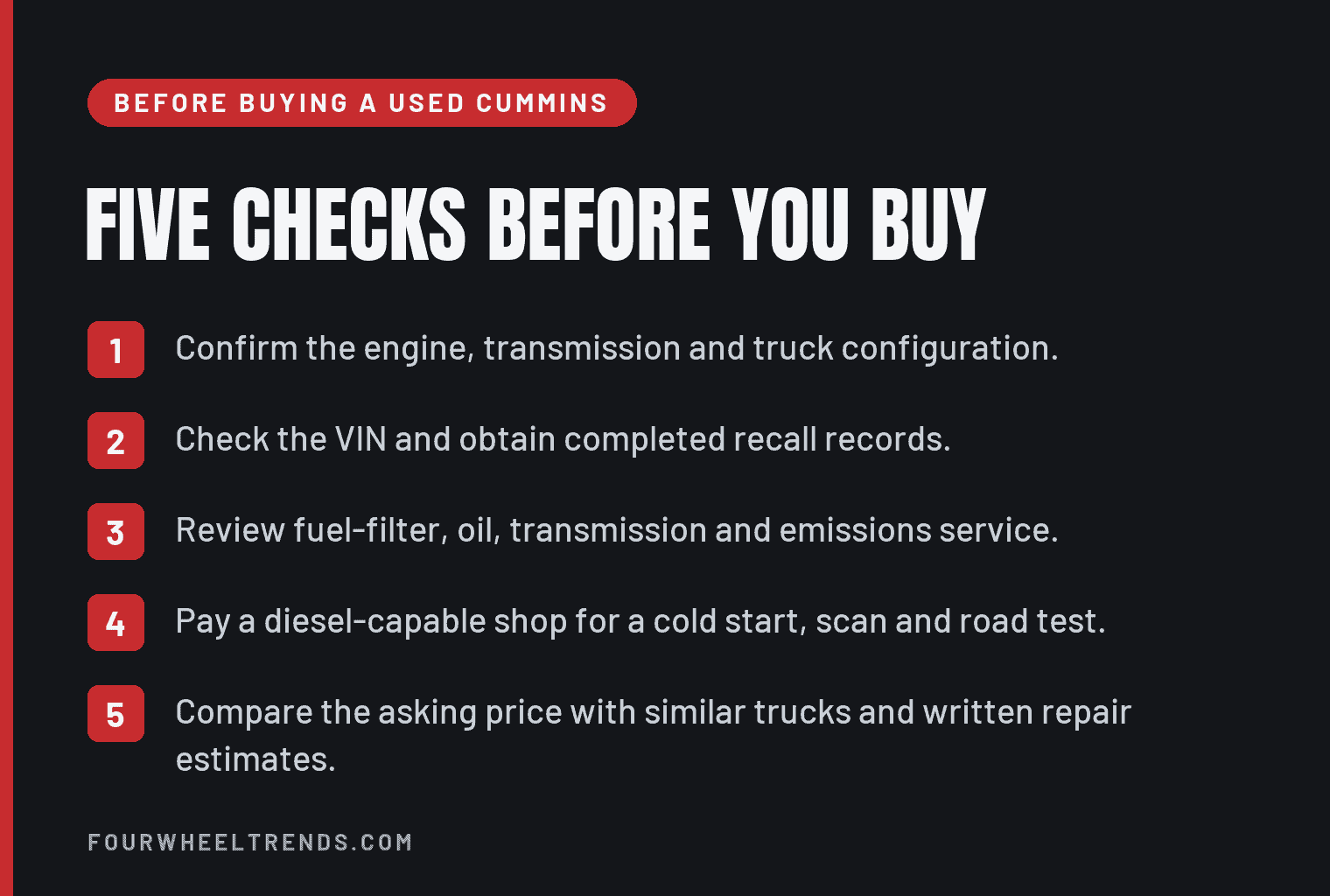
- Identify the engine and configuration. Confirm whether a 2007 truck has the 5.9 or 6.7, and record whether you are buying a 2500 or 3500, its transmission and its towing equipment.
- Run the VIN. Check current recall status through NHTSA or Ram, then ask for invoices showing completed work. NHTSA notes that its VIN lookup has limits for older recalls, so seek dealer or manufacturer records too.
- Read the service history. Look for fuel-filter, oil, cooling-system, transmission and emissions-system work applicable to that engine. Ram’s diesel maintenance plan includes scheduled fuel-filter replacement.
- Pay for a diesel inspection. Request a cold start, diagnostic scan and road test. Have the shop examine leaks, fuel and exhaust systems, transmission behavior, chassis wear and signs of tuning or emissions modifications.
- Price the whole truck. Compare similar local examples and get written estimates for identified work before deciding what you can afford to offer.
NHTSA’s recall lookup explains what its VIN search shows and omits. Ram’s 2022 diesel maintenance plan is an example of why the schedule for the exact year matters.
If emissions equipment has been removed or disabled, investigate before buying. The EPA says tampering with emissions controls is prohibited.
Questions buyers still ask
Is the 2006 Dodge Cummins a good year?
A 2006 5.9-liter belongs on my shopping list. Its condition, transmission, maintenance and modifications determine whether I would buy a particular one. I found no sound basis for calling every 2006 both a top pick and a year to avoid.
Should I avoid every 2019 or 2020 Cummins?
No. Some trucks in those years were affected by the high-pressure fuel pump recall, and the risk deserves serious attention. Check the VIN and repair documentation. A completed remedy and a clean independent inspection can change the purchase decision.
How many miles will a Cummins last?
There is no dependable mileage promise for the used truck you are considering. Engine life, transmission life and repair cost depend on use, maintenance and condition. I would trust documented care and an inspection more than a claimed 350,000- or 500,000-mile lifespan.
My call
Shop the truck, then the year. My first calls would be on documented 2003-through-early-2007 5.9-liter trucks and 2013-through-2018 6.7-liter trucks that fit the job and budget.
I would give 2019 and 2020 a tougher fuel-system check and verify recall work on every newer candidate. If the seller cannot show what has been maintained and repaired, there will be another Cummins to look at.
This article provides general educational information. It does not provide personalized financial advice. I do not know your financial situation, goals or obligations. Ownership and resale estimates are not guarantees.
Sources
- Cummins, “Follow the Liter: The Evolution of the Cummins 5.9L to the 6.7L Pickup Engine,” April 12, 2016.
- Cummins, remanufactured 5.9L and 6.7L pickup-engine applications.
- Cummins, 2007 Sustainability Report, p. 15, Dodge Ram diesel particulate filter.
- U.S. EPA, Cummins settlement nationwide recall program and affected model years.
- NHTSA, safety recall 21V-880, 2019 to 2020 Ram high-pressure fuel pump.
- NHTSA, safety recall 23V-060, 2021 to 2023 Ram intake heater grid relay.
- NHTSA, safety recall 21V-163, 2021 Ram intake heater grid relay.
- NHTSA, safety recall 21V-798, 2021 and 2022 Ram intake heater grid relay.
- NHTSA, safety recall 22V-642, 2022 Ram engine control module.
- NHTSA, safety recall 17V-562, 2013 to 2017 Ram Cummins water pump.
- NHTSA, safety recall 14V-635, 2010 to 2014 Ram Cummins fuel heater connector.
- Ram, 2025 Ram 2500 and 3500 Heavy Duty announcement, January 7, 2025.
- Ram, 2027 Ram 2500 model and powertrain page and 2027 Ram 3500 model and powertrain page.
- NHTSA, recall lookup and VIN-search limitations.
- Ram, 2022 Ram 2500/3500 diesel maintenance plan.
- U.S. EPA, air-enforcement guidance on emissions-system tampering.
I bought a 2005 4door 3500 new and liked it a lot until at 110,000 miles something happened and lost all the oil quickly. Rebuilt engine install came to 10K. It was no longer in my good graces and will never buy another one. Back to Ford who gave me great service through the years. Am 87 and still love trucks. Ford 67 was a great year.
Oh man! I hate to hear that about your 3500. I agree, the Ford 67 is a great truck. I helped pull one out of the woods for a buddy to restore. I was very jealous once he was done with it.
It was great when vehicles could be fixed with a set of hand tools and a free weekend. Thanks for your comments. It definitely helps other in the community learn.
I am about to buy a 2007 with 320 k or 198m mechanic said the only issue was the A C, anything to look out for? Thanks Brian
I hyave a ’94 Ram 2500 with a Cummins and 3000,000+ miles. The Odometer broke at 336,000 about 10years ago. It still tows my 26ft triple axle race car trailer & gets about 20MPG while doing so. WHile it certainly is no rocket towing at 60-65mph isn’t impossible and uphill towing through Az. is about 40mph. It’s automatic has been rebuilt twice so even that has proven pretty durable. If anything it lacks HP & toque for me. The interior is typical Dodge flimsy plastic but the seats are just fine. WIth the simple 12v Cummins it’s far less complex than newer Cummins so I’ll keep it around a bit longer, thank you