
Toyota Tacoma Years to Avoid (2005 to 2025): The Ones I’d Skip and the Ones I’d Buy
Ask around about the Tacoma and you’ll hear the same line every time: buy any of them, they never die. Mostly, that’s true, but there are Toyota Tacoma years to avoid, as strange as it sounds. There are four years I’d walk away from, though, and on two of them the reason is hiding where you can’t see it without a flashlight and a screwdriver.
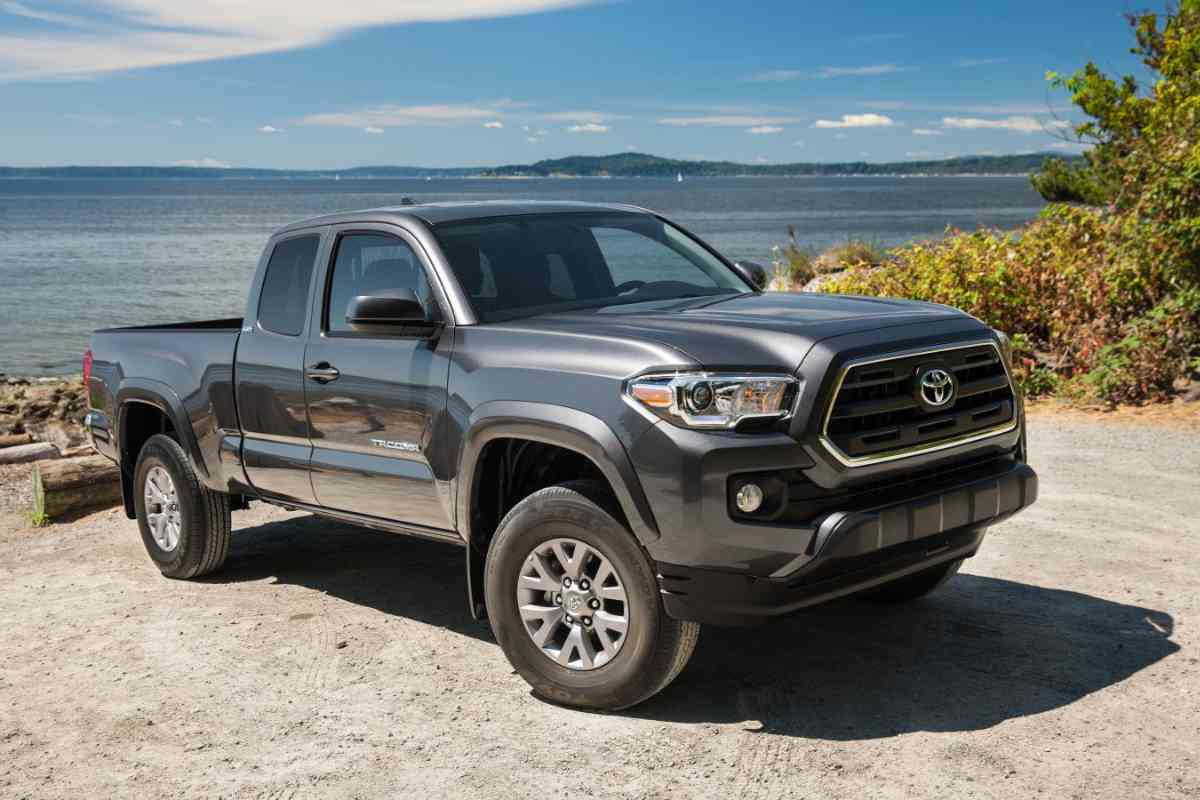
So, what are the Toyota Tacoma years to avoid? It’s best if you skip the 2005, 2006, 2016, and 2017. The best used buys are the 2013, 2014, 2015, and 2020. Let’s find out why.
Toyota earned its reliability reputation the hard way, over decades of trucks that kept running long after the loan was paid off. The years below are the exceptions inside that record.
I’m walking through what owners actually reported to the government so you get the complete picture rather than the short version, because a Tacoma that keeps running for 250,000 miles and a Tacoma with a rotted frame can sit on the same lot for the same money.
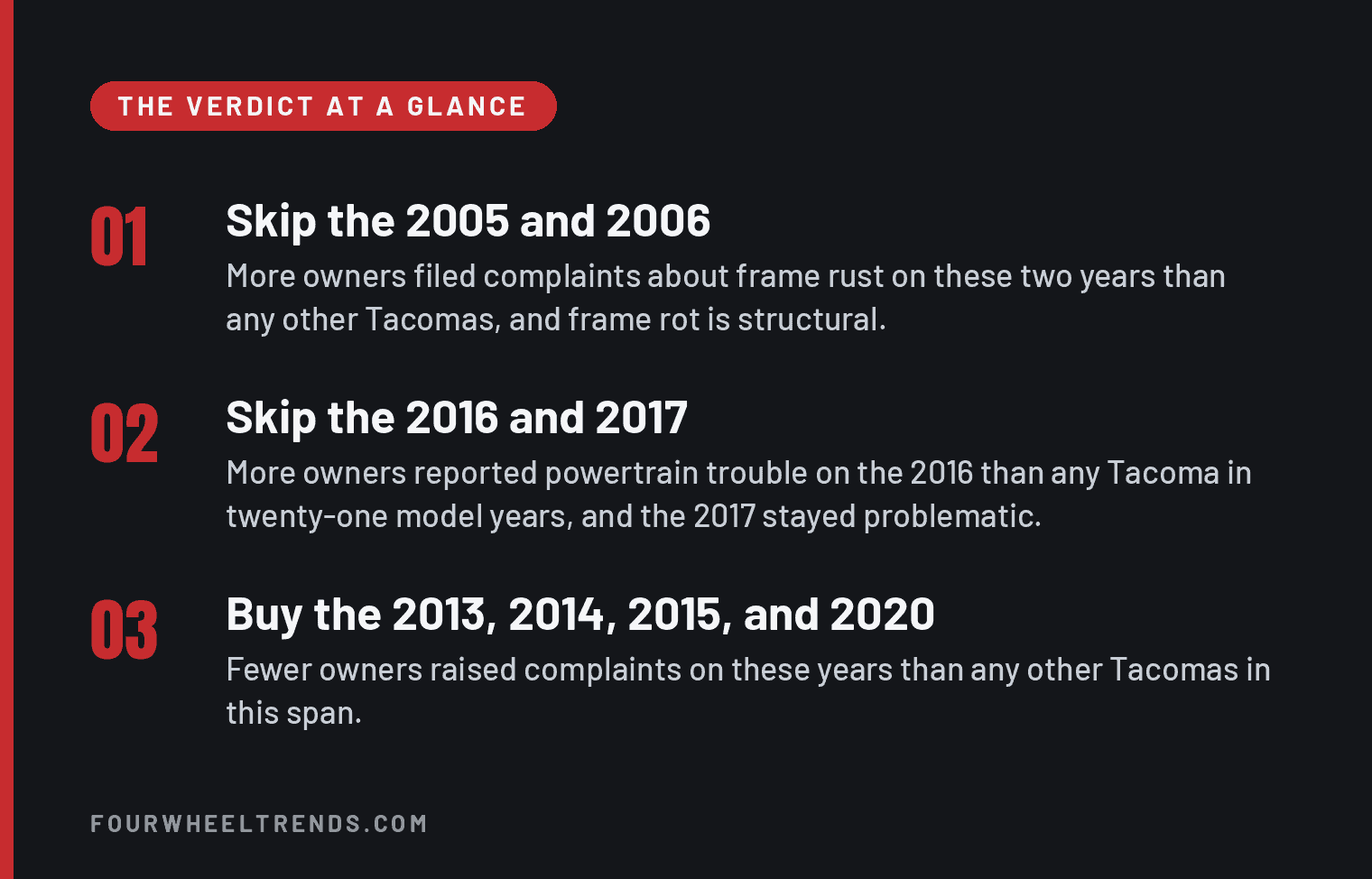
Why 2005 and 2006 Are The Toyota Tacoma Years To Avoid: The Frame Years
These two are the reason “check the frame” became a Tacoma rule. More owners filed complaints about the 2006 than any other Tacoma year in the records, and the 2005 sits right behind it. So, if you’re considering one, these are the two Toyota Tacoma years to avoid.
The single biggest group of reports on both trucks was the structure of the truck itself, which on a Tacoma of this era means rust in the frame rails. Frame rot is a structural problem. The frame holds the suspension, the bed, and the cab together. When it goes far enough, the truck is done, and no amount of new brakes or fresh tires changes that answer.
Suspension complaints came in second on both years, and more than a hundred owners of the 2006 filed reports in the throttle and cruise control area. These are also the most-recalled Tacomas of the bunch, ten recalls on the 2005 and eleven on the 2006.
Here’s the part people get wrong. You cannot judge a frame by looking at it in a parking lot.
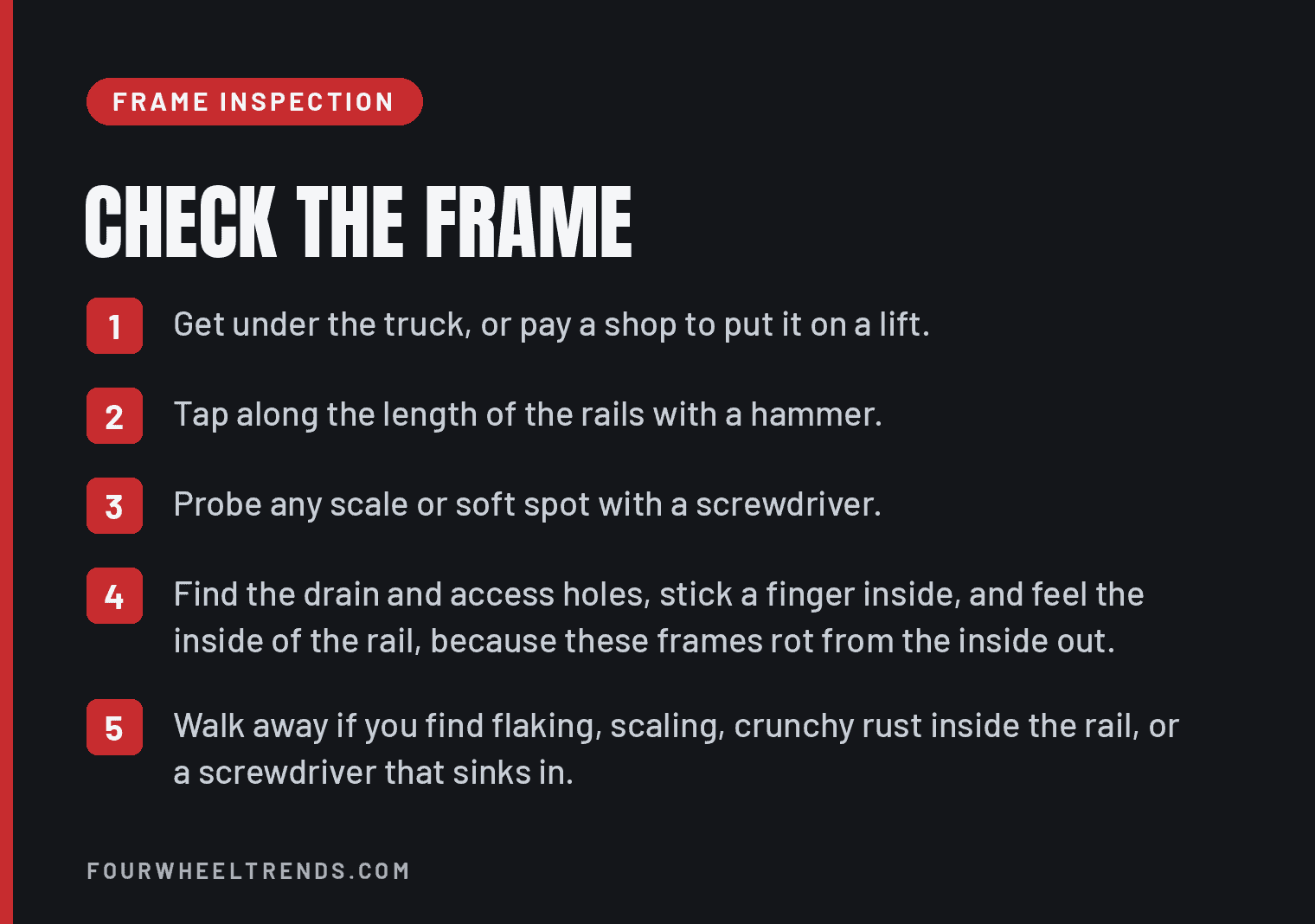
Get under the truck, or pay a shop to put it on a lift, and go after the rails with a hammer and a screwdriver. Tap along the length of them. Probe any scale or soft spot. Then find the drain and access holes, stick a finger inside, and feel the inside of the rail, because these frames rot from the inside out.
Flaking, scaling, crunchy rust inside the rail, or a screwdriver that sinks in means you walk away. Don’t negotiate a discount on a bad frame. The rust you can see is the smaller part of the problem.
The 2007, 2008, and 2009 aren’t in my list of Toyota Tacoma years to avoid, but they’re not clean either. Suspension complaints led all three years, structure reports were still showing up, and the 2009 collected dozens of complaints about the exterior lights on top of that. Buy one, sure, with the same trip under the truck.
2016 and 2017: The Powertrain Years
The 2016 kicked off a new generation, and new generations tend to come with a shakedown period. This one came with a big one. More owners reported powertrain trouble on the 2016 than on any Tacoma in the twenty-one model years I looked at, and it wasn’t close.
Powertrain covers the parts that get engine power to the ground. When something in there goes, the bill runs into four figures fast, and on a truck this age you’d be paying it out of pocket.
The 2017 got better and stayed problematic. Powertrain was still the top complaint area, with brake complaints and structure reports behind it. Owners on both years described a truck that drew far more safety-related reports than the 2013, 2014, or 2015 did over a longer time on the road, so this makes them options for Toyota Tacoma years to avoid.
If you’re set on a third-gen and a 2016 or 2017 is the one in your price range, get it on a long test drive that includes stop-and-go traffic and a highway on-ramp rather than a quick lap around the block. Pay attention to how it shifts under light throttle. Then have a shop pull the service history and check for powertrain work already done. A truck with paperwork showing the work was done is a safer buy than one with no history at all.
One honest caveat, and it matters. Complaints come only from owners who had a problem. The person whose 2016 has done 140,000 uneventful miles never filed anything. A bad year tells you the odds. It doesn’t tell you what’s wrong with the specific truck in front of you. I’m telling you the odds are worse here, and there’s no way to spot which specific truck drew the short straw by looking at it.
2012: Worth Knowing About
Overall complaints on the 2012 are moderate, so it doesn’t make the skip list. Dig into what those complaints are about and engine issues dominate.
Close to ninety owners filed engine-related reports, more than any other Tacoma year in this span. If you’re looking at a 2012, an oil-consumption and compression check at a shop is money well spent before you buy. Does this make it one of the Toyota Tacoma years to avoid? Not really, but you should perform as thorough check as any, and not take anything for granted.
2024 and 2025: Too Early to Call, and Not Quietly
The newest Tacomas have drawn complaints at a faster clip in their first couple of years than any older year in these records. Powertrain reports lead the 2024 by a wide margin, with brake complaints next. On the 2025, structure and powertrain reports sit at the top of a shorter list.
Early-life complaints on a brand-new generation are normal to a point, and a truck under factory warranty means somebody else pays. So I’m not calling these Toyota Tacoma years to avoid. I am saying the record is young and owners are already filing at a fast rate, and if you buy one I’d want the warranty coverage in place.
Before You Pick a Year, Sit in One
When Bernardo and I were comparing notes for this piece, he told me about test driving a Tacoma he was ready to buy. The screen and the controls he liked. The wide center section over the transmission almost ended the deal.
He’s 6 foot 4, and that hump pushed his leg over toward the steering wheel. Not cramped, closer to uncomfortable in a way you feel by mile ten.
The rest of the drive sold him on the truck. He said the acceleration was flat-out fun and the ride wasn’t bumpy the way he expected from a midsize pickup.
That’s the thing about picking a model year off a chart. You can nail the year and still buy a truck you don’t want to sit in. If you’re tall, drive it for thirty minutes before you talk numbers.
The Years I’d Actually Buy
So, we’ve discussed the Toyota Tacoma years to avoid, but there are some years that I’d actually buy.
2014. Fewer owners raised complaints on this one than any Tacoma in the twenty-one years I looked at, and it drew only four recalls. What did show up most? Structure again. That means the frame inspection applies here too, even on a truck this much newer than the 2006. The other catch is age and miles. A 2014 is a used truck with used-truck maintenance ahead of it.
2013. Right there with the 2014 for how few owners reported trouble, with powertrain, suspension, and steering complaints in small numbers spread thin. The downside is the same as any second-gen at this point: you’re buying miles, and those miles are wear the truck has already taken. Two identical 2013s are not worth the same money if one has 90,000 and the other has 190,000.
2015. The last year of the second generation, and owners reported few problems, the same as they did on the 2013 and 2014. Structure and airbag complaints show up in small numbers. Being the final year of a generation is generally good news, since the obvious bugs got sorted by then. The catch is price. Clean 2015s hold value stubbornly, so you may pay more than the year suggests.
2020. The best of the third-gen years by a wide margin. Complaints dropped hard from the 2019, and it carries a single recall. Powertrain, fuel system, and brake reports all show up in small numbers, so the third-gen weak spots still turn up, just rarely. The catch is cost. A 2020 is the most expensive truck on this list, and you’re paying newer-truck money for a truck already out of factory warranty.
2021 and 2022 deserve a mention. Owners reported few problems on both, and the 2021 carries no recalls at all in these records. They cost more than the 2020, which is the whole objection.
Tacoma Complaints and Recalls by Model Year
Recommended years are in bold. Data as of July 25, 2026.
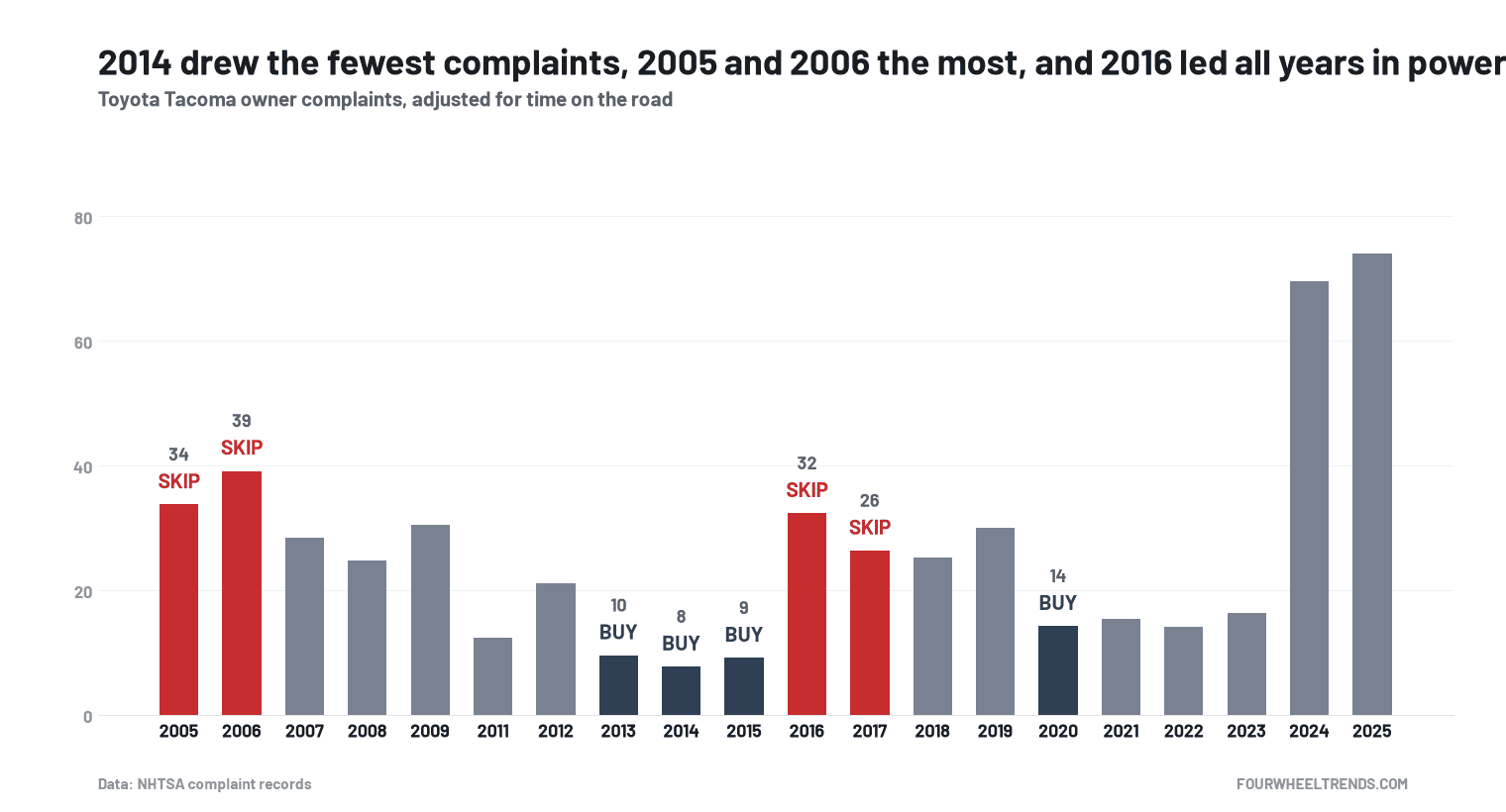
| Year | Complaints | Recalls | Complaints per year on market | Serious complaints | Main problem area |
|---|---|---|---|---|---|
| 2005 | 707 | 10 | 33.7 | 55% | Structure (frame) |
| 2006 | 782 | 11 | 39.1 | 52% | Structure (frame) |
| 2007 | 540 | 10 | 28.4 | 53% | Suspension |
| 2008 | 445 | 11 | 24.7 | 42% | Suspension |
| 2009 | 518 | 13 | 30.5 | 45% | Suspension |
| 2011 | 184 | 9 | 12.3 | 43% | Suspension |
| 2012 | 294 | 7 | 21.0 | 68% | Engine |
| 2013 | 124 | 6 | 9.5 | 63% | Powertrain |
| 2014 | 92 | 4 | 7.7 | 67% | Structure (frame) |
| 2015 | 100 | 4 | 9.1 | 54% | Structure (frame) |
| 2016 | 323 | 4 | 32.3 | 71% | Powertrain |
| 2017 | 237 | 5 | 26.3 | 75% | Powertrain |
| 2018 | 202 | 3 | 25.2 | 67% | Brakes |
| 2019 | 210 | 4 | 30.0 | 77% | Fuel system and powertrain |
| 2020 | 85 | 1 | 14.2 | 69% | Powertrain and fuel system |
| 2021 | 77 | 0 | 15.4 | 65% | Brakes |
| 2022 | 56 | 3 | 14.0 | 73% | Powertrain |
| 2023 | 49 | 4 | 16.3 | 71% | Airbags and steering |
| 2024 | 139 | 4 | 69.5 | 76% | Powertrain |
| 2025 | 74 | 4 | 74.0 | 74% | Structure and powertrain |
The 2010 isn’t in there. The records I’m working from didn’t give a clean read on that year, and I’d rather leave a row out than guess at it.
The Money Side of Picking the Wrong Year
So, what does it really mean when we discuss the Toyota Tacoma years to avoid? Go back to that powertrain repair on a 2016 for a second, because that single bill is what wrecks the math on a cheap truck.
Save two grand on the purchase, eat a four-figure drivetrain repair a year later, and you paid more than the guy who bought the clean 2015. That’s the whole argument for skipping problem years, and it has nothing to do with brand loyalty.
I’ve spent more than 20 years as a financial advisor, and I treat a truck the way I treat any five-figure decision. Three numbers decide whether you won: what you paid, how much value you burned while you owned it, and what you got back when you sold. The monthly payment hides all three. Focus on the total, and let the payment follow from that.
How Warranty Coverage Plays A Part In The Toyota Tacoma Years To Avoid
Now the coverage ladder, because people blur these constantly. A factory warranty comes only on a brand-new vehicle, roughly 3 years or 36,000 miles. A factory-backed extended warranty is a separate thing you can add, either with a new purchase or on a late-model used vehicle that’s still young enough to qualify. I bought one on my 2023 Sequoia the day I brought it home, and I bought one on Ashley’s 2023 Yukon when we picked it up used at under 3 years old with 19,000 miles. Aftermarket plans from third parties are a different animal, and plenty of them aren’t worth much.
For a Tacoma, that ladder points two directions. If you want factory-backed coverage, you’re shopping a recent truck like a 2023, and you’re paying recent-truck prices for peace of mind on a generation whose record is still young. If you’re shopping a 2013 through 2015, no factory-backed plan is available at any price, and your margin of safety is a lift, a mechanic, and an hour spent on the frame rails before you hand anybody money.
Fuel is a real line item too, with regular gas averaging just over $4 a gallon nationally as of July 20, 2026. It’s the smaller worry. One drivetrain repair costs more than a year of the difference between a thirsty truck and an efficient one.
None of this is personal financial advice, and I don’t know your budget. It’s how I’d think it through if you asked me in my driveway. If you’re weighing a Tacoma against something else in the lineup, our coverage of Toyota trucks and SUVs is a good next stop, and the best years to buy guides work the same way for other models.
Who This Truck Fits
So, you’re searching for the Toyota Tacoma years to avoid, it means you’re interested in buying one. The question then becomes, what kind of buyer are you? It’s something not a lot of people ask themselves.
Shopping on a real budget and willing to do the homework. The 2014 or 2015 is your truck, and the frame inspection is not optional. Pay a shop to put it on a lift and probe the rails before you talk price.
Buying a first truck for a new driver. Skip the problem years entirely. A cheap 2016 stops being cheap the first time the powertrain acts up, and a new driver has no business learning about drivetrain repair bills.
Wanting the newest thing with a safety net. Shop a late-model truck that still qualifies for a factory-backed extended plan, and understand you’re paying up for that. If you’d rather keep the money, the 2020 or 2021 drew the fewest complaints of any third-gen year in these records.
Buy It If, Skip It If
Here’s another way to look at it.
- Buy it if you’re looking at a 2013, 2014, 2015, 2020, or 2021 and you’re willing to get under it and check the frame first.
- Buy it if you found a 2016 or 2017 with documented powertrain work already done and paperwork to prove it.
- Skip it if the truck is a 2005 or 2006 and the seller won’t let you put it on a lift.
- Skip it if a screwdriver sinks into the frame rail anywhere, at any price, on any model year.
- Skip it if you’re 6 foot 4 and that center hump pushes your leg toward the wheel. You’ll hate it by mile ten.
FAQ: The Toyota Tacoma Years To Avoid
What is the worst year for the Toyota Tacoma?
The 2006. More owners filed complaints about it than any other Tacoma model year from 2005 through 2025, and the largest group of those reports involved the structure of the truck, meaning rust in the frame. It also carries eleven recalls. The 2005 is close behind for the same reason.
These are the two top candidates for the Toyota Tacoma years to avoid. Always proceed with caution with them.
Is the 2016 Tacoma reliable?
It’s the weakest of the third generation. More owners reported powertrain problems on the 2016 than on any other Tacoma year from 2005 through 2025, and powertrain repairs run into four figures. Plenty of 2016s have gone six figures on the odometer without drama, since only the owners who had trouble file complaints. The odds are worse on that year, and you can’t tell a good one from a bad one by looking at it.
Do newer Tacomas still have frame rust problems?
Frame complaints thinned out a lot after the 2005 to 2009 trucks, but structure reports were still the top complaint area on the 2014 and 2015, and they show up again on the 2025. Check the frame no matter the year. Tap the rails with a hammer, probe any scale with a screwdriver, and reach a finger through the drain holes to feel inside, because these frames rot from the inside out.
While it shouldn’t be an obvious problem, it pays to look at history. If the Toyota Tacoma years to avoid have strong rust issues, then it’s a good starting point for other models.
Should I buy a 2024 or 2025 Tacoma?
Both have drawn complaints faster in their first couple of years than any older Tacoma in the records, with powertrain reports leading the 2024 and structure and powertrain topping the 2025. Early complaints on a brand-new generation aren’t unusual, and a truck still under factory warranty means the repair bill isn’t yours. If you buy one, I’d want that coverage locked in rather than assume the generation is sorted.
What years of Tacoma are the safest bet used?
The 2013, 2014, and 2015 drew the fewest owner complaints of any years in this span, and the 2020 drew the fewest of the third generation and carries a single recall. The tradeoff is straightforward. The 2013 to 2015 trucks cost less and come with more miles and no coverage available, while the 2020 costs the most and is already past its factory warranty.
Sources
- NHTSA owner complaints and recall records, Toyota Tacoma 2005 through 2025. Data as of July 25, 2026.
- U.S. Energy Information Administration, U.S. average regular gasoline price of $4.001 per gallon, July 20, 2026.
i disagree with the 2004 tacoma – i had mine for 14 years (2005-2019) and put 200k miles on it – only regret i have is selling it – truck was a beast and had minimal problems – no rust or engine issues
(I loved my 2005 Tacoma; I regret selling it after 13 blissful years. However, I realize its lack of rust may have been an anomaly.)
Thank you for this excellent article; it was by far the best of several I read. Especially as I embark on the adventure of buying a used Tacoma, I appreciate the real-world, actionable advice!