
Ford Writes Off $19.5 Billion. We Explain Why.
Ford’s gamble hasn’t paid off and now it must pay the price as EVs lose plenty of traction.
It finally happened. Not quietly, not gradually, but in one massive accounting move. Ford writes off $19.5 billion tied to its EV program, and while that number is shocking on its own, what matters more is why it happened.
This wasn’t just about slower EV demand. It was about price, timing, and a hard lesson Ford learned the expensive way.

“Drive Past Myths: Get the Real Deal on Car Buying!”
🚘 Uncover 13 Car Buying Misconceptions with Our FREE Newsletter!
Plus you will get our quick tips, expert advice, and myth-busting insights delivered straight to your inbox.
Subscribe now and make informed decisions without the detours.
“Experts Hate This! Learn the Car Buying Secrets They Don’t Want You to Know. Free Subscription!”
Ford’s EV ambitions were bold from the start. Billions went into new plants, dedicated platforms, and battery partnerships, all built around the assumption that Americans would rapidly move into electric vehicles, including electric trucks.
According to Reuters, this write-down reflects impaired assets tied to battery manufacturing and EV capacity that Ford no longer expects to fully utilize as planned. In simpler terms: Ford built for a future that arrived slower, smaller, and far more price-sensitive than expected.
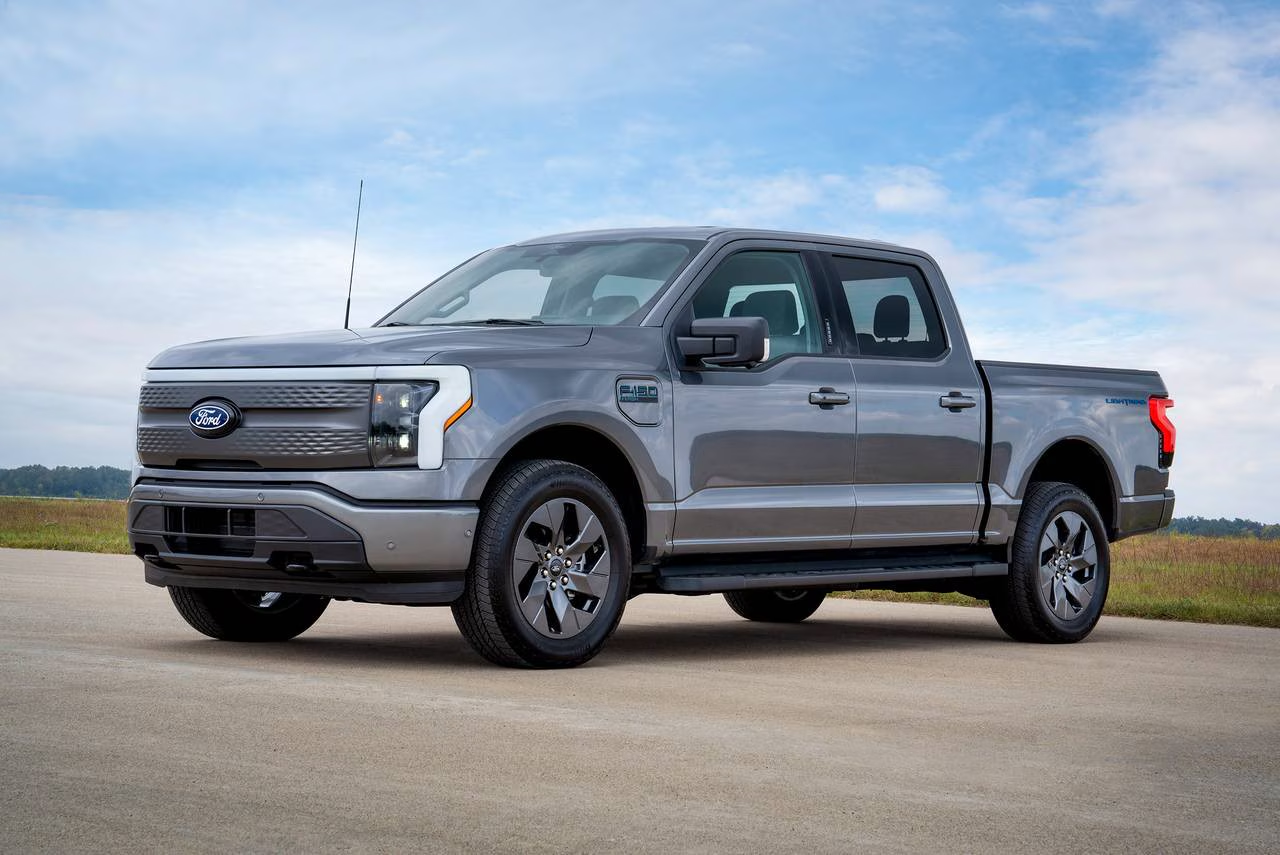
The EV Lightning Is Why Ford Writes Off $19.5 Billion
The biggest miscalculation was the electric pickup. Ford assumed that its loyal truck buyers would make the leap to EVs without hesitation. The Lightning proved there was interest, but also revealed a ceiling.
Plus, hats off to Tyler Hoover, who made one of the best real-life tests with the Lightning. If you don’t remember, here it is.
Prices for these vehicles was too high. High-end trims priced north of $70,000 moved slowly, incentives piled up, and inventory lingered. The company was forced to rethink not just volumes, but the entire economics of electric trucks.
Jim Farley admitted as much, and quite bluntly. Speaking about Ford’s EV strategy, he acknowledged that a $70,000 electric pickup “wasn’t selling.” That line alone explains a good chunk of why Ford writes off $19.5 billion. Ford chased margin before scale, and the market pushed back.
The pivot is already underway. Farley has made it clear that the future of Ford EVs won’t be defined by premium pricing. Instead, the company is now focusing on smaller, cheaper electric vehicles—especially trucks—targeting a price closer to $30,000. Electrek reports that Ford believes affordability, not range bragging rights or luxury features, will ultimately drive EV adoption.
Farley’s Explanation Doesn’t Add Up
Carscoops went a step further, pointing out the irony of Ford’s realization. After years of pushing expensive EVs as the only option, the company “just realized” that $55,000 electric trucks don’t sell at scale.
The lesson? Ford priced itself out of its own core audience. Truck buyers are pragmatic. They care about capability, durability, and total cost of ownership. Asking them to spend luxury-car money on an electric work vehicle was always going to be a tough sell.
This is where the write-down becomes more than an accounting footnote. It’s a strategic reset. Ford isn’t abandoning EVs, but it is abandoning the idea that EVs must start at the top and trickle down.
The new plan emphasizes a skunkworks-style EV team, simplified platforms, fewer variants, and aggressive cost control. Ford wants to build EVs the way it once built the Model T—cheap enough to scale, simple enough to mass-produce.
There’s also a broader industry takeaway here. Ford isn’t alone. Automakers across the board overestimated how fast mainstream buyers would adopt expensive EVs. Early adopters came and went. What’s left is a market that wants value, not experiments.
That’s especially true in the truck segment, where buyers are already dealing with inflated prices on gas-powered models.
Ironically, Ford’s mistake may end up helping it long-term. The company still has strong EV name recognition, real-world data from Lightning and Mach-E owners, and manufacturing assets that—while overbuilt—can be repurposed.
The $19.5 billion write-off hurts, but it also clears the slate. Those losses are now on paper, not lurking in future earnings.
In the end, this wasn’t a failure of technology. It was a failure of pricing discipline and market timing. Ford believed its brand loyalty would carry $70,000 electric trucks into the mainstream. The market said no. Now, Ford is listening—and paying for the lesson upfront. It also makes us wonder how long Farley will have a job.
Ford Writes Off $19.5 Billion. We Explain Why.
See the full article for details.