8 Reasons the Ford Bronco Gets Bad Reviews, and Why I’d Still Consider One
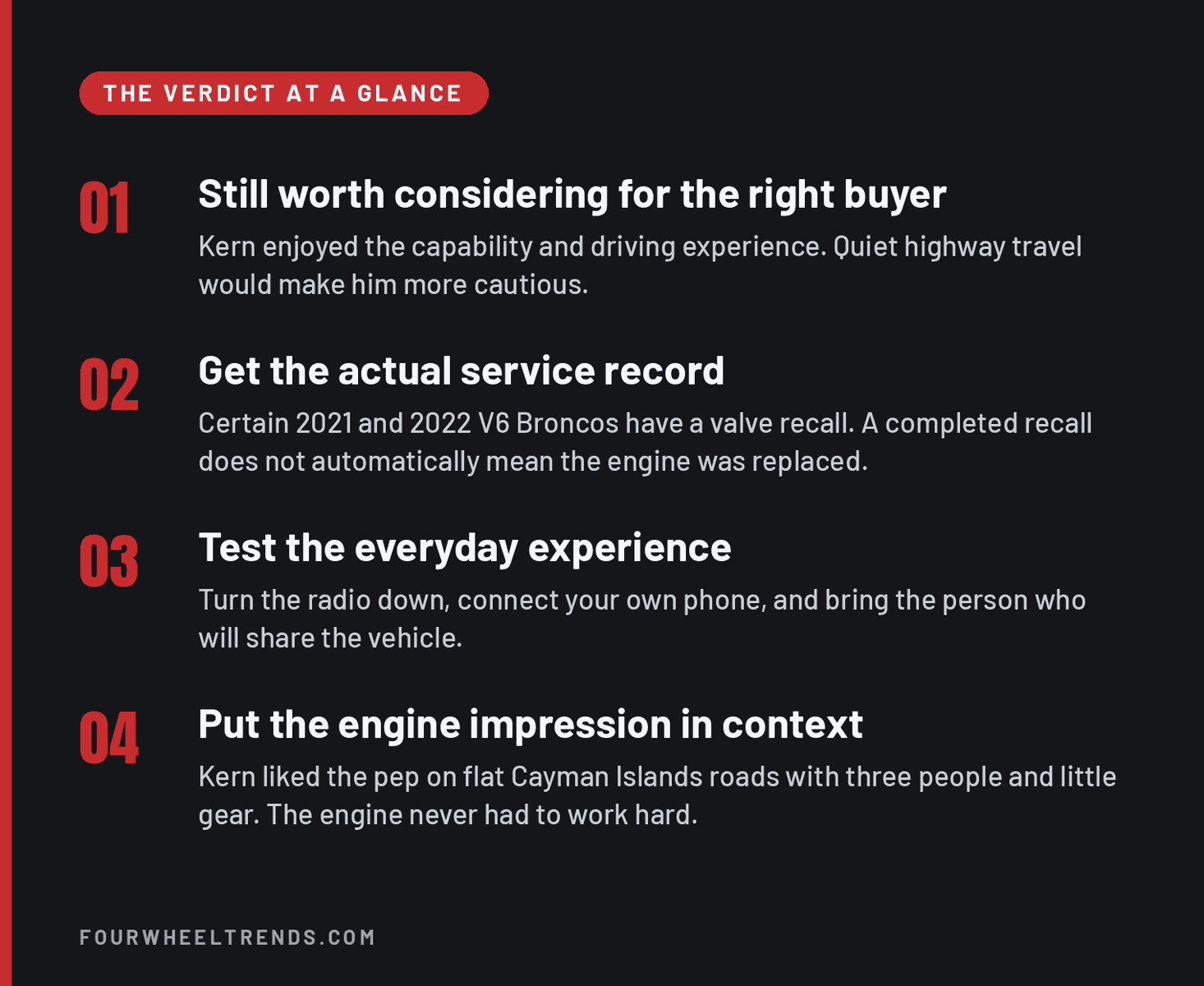
I’d still consider a Ford Bronco for its off-road ability and the enjoyment I got from driving one. I’d be more cautious if quiet highway travel were my main priority, and I’d want the specific vehicle’s repair history before spending my money.
I rented a black-on-black 2.3-liter Bronco for a week on vacation in the Cayman Islands. The hardtop had noticeable wind noise, the cloth seats were firm but comfortable, and the four-cylinder had good pep. I had already put my name on the list to buy a Bronco and backed out because the wait was too long.
So I understand the appeal. I also understand why someone could buy one, spend a month commuting in it, and wonder whether they made an expensive mistake.
The important question is which complaints would bother you every day, and which point to a problem that needs fixing. Here are eight things I’d work through before buying the full-size Bronco. The smaller Bronco Sport is a separate vehicle, covered in our Bronco versus Bronco Sport comparison.
1. Roof noise, water leaks, and loose glass need different responses
When I’d check a Bronco’s roof, I’d separate three concerns: the wind noise I heard myself, water leaks covered by Ford’s repair guidance, and a rear-glass safety recall. Similar symptoms can have different causes, so it matters which problem you’re dealing with.
Start with the everyday noise. It stood out during my rental. Whether that would wear on you over several years is something a proper highway test drive can help answer. Turn the radio down and drive at the speed you normally travel.
If water is getting into the cabin, the question changes from whether you can live with it to what needs repairing. Ford’s service message SSM 53814 identifies leaks around the front pillars, overhead console, or sun visors on some 2021 through 2024 Broncos. It directs technicians through a diagnosis and identifies a revised header seal when replacement is needed. That is a reason to investigate dampness, not shrug it off as part of owning a Bronco. See Ford’s leak guidance.
That inspection should also include the rear quarter glass, where a separate attachment problem can cause noise or leaks. Recall 24V-142 covers improperly attached glass on certain 2023 and 2024 Broncos. Ford’s notice says noise, rattling, or a leak can precede glass separation. This is a safety issue requiring a recall check, distinct from the header-seal repair above. The glass recall notice explains the concern.
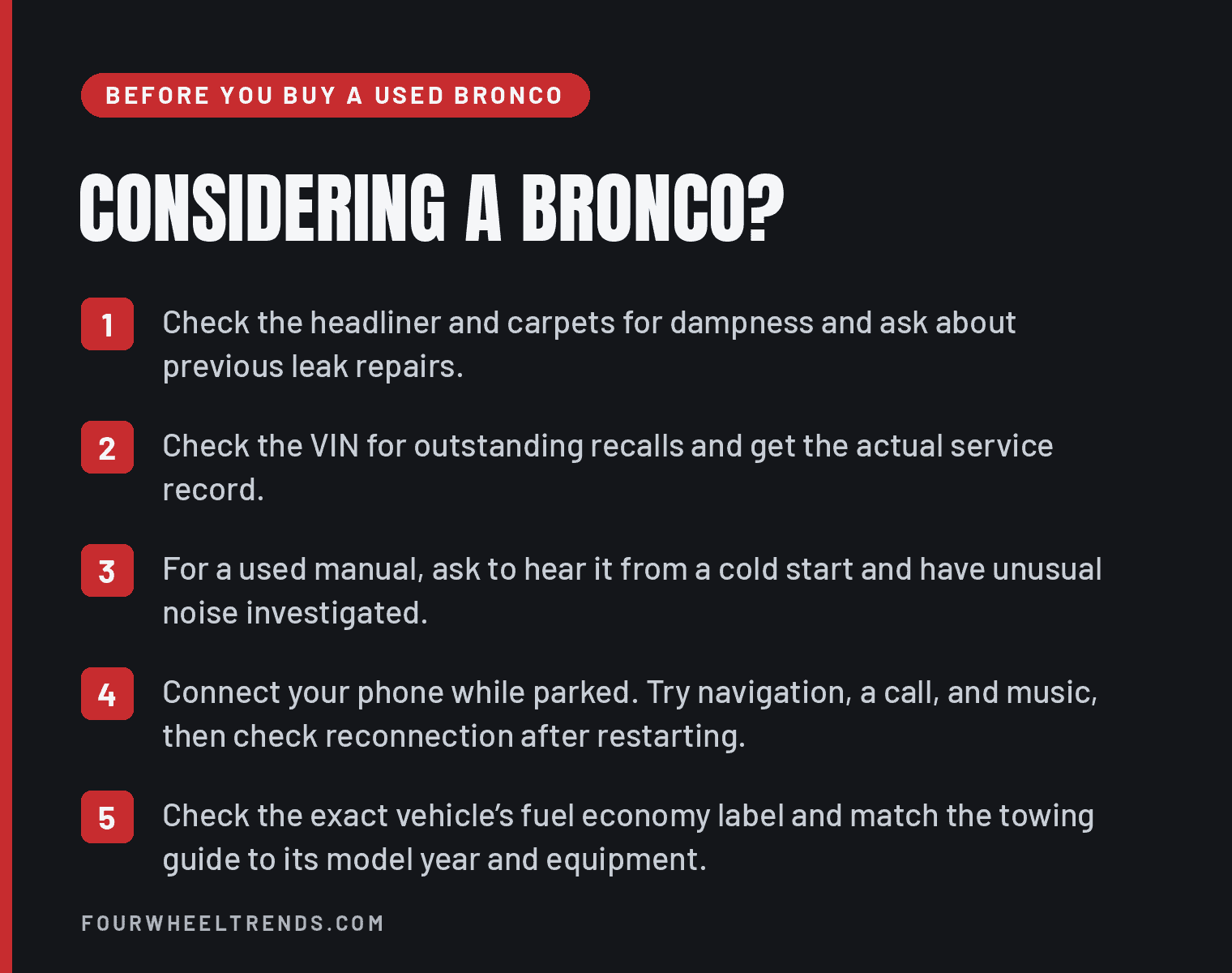
I’d check the headliner and carpets for dampness, ask about previous leak repairs, and have suspicious noises inspected. “They all do that” would not be enough of an explanation for me.
2. The early V6 engine concern has a specific recall behind it
Certain 2021 and 2022 Broncos fall under recall 24V-635, Ford campaign 24S55. Ford’s recall report lists Broncos built from May 1 through October 30, 2021, with the 2.7-liter or 3.0-liter V6. An intake valve can break and cause engine failure and loss of drive power. The recall remedy includes an engine-cycle test and engine replacement when necessary. That makes the repair paperwork especially important on an affected vehicle. NHTSA’s recall acknowledgment identifies the defect and remedy.
The 2.3-liter I drove gave me little reason to wish for more engine during that week. It also sits outside this particular valve recall. That makes it worth considering, without pretending one recall can tell us which engine will cost less to own over the next ten years.
My week does need some context. The Cayman Islands roads we drove were flat, with no hills to climb. We had three people aboard and weren’t loaded with gear, so the Bronco never had to work hard. I liked its pep in those conditions. That tells you much less about how it would feel on a long grade with your family and luggage aboard.
And yes, the 2.3-liter is sold in the United States: Ford lists it as standard on the 2026 Bronco Base. My rental’s model year and exact specification aren’t established here, so I’d still drive the particular U.S. vehicle I was considering before deciding it had enough power for my needs.
If you prefer the V6, ask a Ford dealer to check the VIN and explain any applicable campaign work. A completed recall does not automatically mean the engine was replaced. Get the actual service record.
3. A manual-transmission noise deserves attention
The transmission choice brings its own questions. Ford bulletin 23-2019 documents a scraping noise in some 2021 through 2023 Broncos with the MT88 manual transmission. It can occur in neutral, first, or second gear with the clutch pedal released, especially when cold, and can diminish as the transmission warms.
The bulletin identifies the fifth- and sixth-gear synchronizer rings as a possible cause and describes a repair. It concerns that manual transmission, so it should not be used as evidence against the automatic. Ford’s manual-transmission bulletin gives the applicable conditions.
For a used manual, I’d ask to hear it from a cold start and have a technician investigate an unusual noise. A service bulletin describes a known condition and repair guidance. Ask the dealer separately whether the specific vehicle has coverage for the work.
4. A glitchy screen can spoil an otherwise good drive
I experienced a map-display hang in the rental Bronco. I’ve also seen map glitches in our GMC and my F-150, which makes me reluctant to pin every problem on one vehicle.
My suspicion was that the phone connection or Apple CarPlay might be involved. That remains a suspicion. Similar symptoms across different vehicles do not identify the cause.
Before buying, connect your own phone while parked. Try navigation, a call, and music. Then see whether the system reconnects after you shut the vehicle off and restart it. If something misbehaves, have the seller address it before you accept a promise that an update will fix it later.
5. Everyday comfort may matter more than the equipment list
I found the rental’s cloth seats firm but comfortable. Someone else might sit in the same seat and dislike it immediately. Bring the person who will share the vehicle and give them time to decide for themselves.
Model year matters here, too. For 2025, Ford announced extra sound insulation and dedicated second-row air-conditioning vents on four-door Broncos. Those changes are worth comparing when you shop, although an equipment update does not tell you how comfortable you’ll find the vehicle. Ford’s 2025 update announcement spells out the changes.
Check rear-seat access, load the things you normally carry, and spend some time on the roads you actually use. A vehicle can be impressive on a trail and still be the wrong fit for your family’s ordinary week.
6. Fuel economy depends on which Bronco you buy
The engine badge alone won’t give you the answer. The EPA’s 2025 guide lists the 2.3-liter Bronco 4WD with the automatic at 20 mpg combined. The 2.3-liter Badlands automatic is listed at 18 mpg combined, as is the guide’s 2.7-liter Bronco 4WD automatic entry. These are specific 2025 configurations, not ratings for every Bronco carrying those engines. The EPA guide’s Bronco entries let you compare the details.
Here’s a simple way to put that difference into your budget. At an assumed 12,000 miles a year and $3.50 a gallon, getting 18 rather than 20 mpg costs about $233 more annually. That is an illustration using fixed assumptions, not a prediction of your mileage or local gas price.
I’d decide whether the equipment I wanted was worth the additional cost. Then I’d check the exact vehicle’s fuel-economy label instead of shopping from a number attached to the Bronco name generally.
7. Off-road ability does not tell you how much it can tow
A Bronco can look ready for anything and still be a poor match for your trailer. Ford’s 2025 towing chart lists many configurations at a maximum loaded trailer weight of 3,500 pounds, some at 3,460 pounds, and the Raptor at up to 4,500 pounds when properly equipped.
Those numbers depend on the configuration and required equipment. Ford also specifies loaded-vehicle, combined-weight, and tongue-load limits. Start with the towing guide for the relevant model year and match it to the vehicle.
If towing is a major reason you’re buying, establish that requirement before choosing the SUV. I would rather find out a vehicle doesn’t suit my trailer while I’m still shopping.
8. The price can make the compromises harder to accept
I would be more forgiving of a noisy cabin in a reasonably priced weekend vehicle than in an expensive daily driver. The purchase price changes what I expect to get back from the experience.
For a Bronco, I’d compare a new example with a used one that has the equipment I actually want. Use written out-the-door quotes. Then consider mileage, condition, financing, remaining coverage, and any work the used one needs. A low advertised price can lose its appeal once those differences are clear.
Depreciation belongs in that comparison, but I wouldn’t pretend to know the future selling price. As a hypothetical, paying $50,000 and later selling for $35,000 means losing $15,000 to depreciation. Paying $40,000 and selling for $30,000 means losing $10,000. Those are examples of the calculation, not Bronco market forecasts.
Work through several possible resale values over the same ownership period. Add financing costs, insurance, fuel, maintenance, and repairs. If you buy coverage, read what it includes, what it excludes, and what you still pay yourself. A warranty should earn its place in the budget.
There is also room for wanting something because you enjoy it. I’d just want to know what that enjoyment costs before agreeing to the payment.
What the Bronco got right during my week with it
My family and I took the rental onto a muddy national-park road. I had no recovery kit with me. The Bronco’s four-wheel drive and low range helped us get through, and that experience gave me a reason to appreciate what it could do.
I keep recovery gear in my own vehicles. Going without it in the rental was a mistake I wouldn’t want to repeat. I’d be careful about turning a successful trip into confidence that the vehicle can get me out of any situation.
Still, that week explains why I can read the complaints and remain interested. I enjoyed the engine, found the seats comfortable, and used the capability. Those are worthwhile things to get from a vehicle, provided the price and everyday compromises work for you.
Who should still consider a Bronco?
I’d keep it on the list if you want its off-road ability and find the everyday driving experience enjoyable enough to justify the cost. My week in the 2.3-liter gave me a good starting point for shopping. I would compare individual vehicles from there, rather than automatically paying more for the V6 or choosing a year from a blanket avoid list.
If your priorities are a quiet commute, low fuel bills, or towing a particular trailer, use those needs to narrow the choices first. You may find that a road-focused SUV or a vehicle with more suitable towing capacity serves you better. If you’re uncertain about living with the Bronco, renting one could answer more than a short dealership drive.
Before buying used, get an independent inspection, examine the service records, and check the VIN for outstanding recalls. NHTSA’s VIN lookup is a starting point, and the dealer can help establish what work was completed. The campaigns discussed here are examples to investigate, not a complete recall list for every Bronco.
I’d be happy to consider one again. I’d want to enjoy the ordinary drive home almost as much as the reason I bought it.
Sources
Technical sources checked October 6, 2026. Personal driving impressions come from my week-long 2.3-liter Bronco rental. Fuel-economy and towing examples are explicitly for the 2025 model year.
- Ford U.S.: 2026 Bronco Base standard 2.3-liter EcoBoost engine.
- Ford SSM 53814: water-leak diagnosis for certain 2021 through 2024 Broncos.
- Ford recall 24S10 / NHTSA 24V-142: rear quarter glass on certain 2023 and 2024 Broncos, March 2024 notice.
- Ford Part 573 Safety Recall Report 24V-635, August 23, 2024: affected Bronco engines and production dates.
- NHTSA recall 24V-635 / Ford 24S55: engine intake valves, August 30, 2024 acknowledgment.
- Ford TSB 23-2019: MT88 manual-transmission scraping noise, June 8, 2023.
- Ford: 2025 Bronco comfort and equipment updates.
- U.S. Department of Energy and EPA: 2025 Fuel Economy Guide, printed page 28.
- Ford: 2025 Bronco towing selector and limitations.
- NHTSA: vehicle recall search and VIN lookup limitations.
Ford’s pathedic quality control,tons of recalls and cheap parts would make poor Henry Ford roll over in his grave….