
GMC Yukon Years to Avoid (2005 to 2025): The Years I’d Skip and the Ones I’d Buy
The whining noise showed up on a normal Tuesday drive to the office. Two weeks later the transmission in our 2019 Yukon let go less than a mile from the house, engine revving with nothing on the other end of it. It felt like pedaling a bike with no chain, only slightly more frustrating.
The quote to fix it was $10,000 on an SUV worth about $28,000. That is the kind of bill that can make anyone hesitate about buying a GMC Yukon. Fortunately, you don’t have to buy one to find out if there are any unpleasant surprises. We bring you which model years are worth your money and which ones are the GMC Yukon years to avoid.
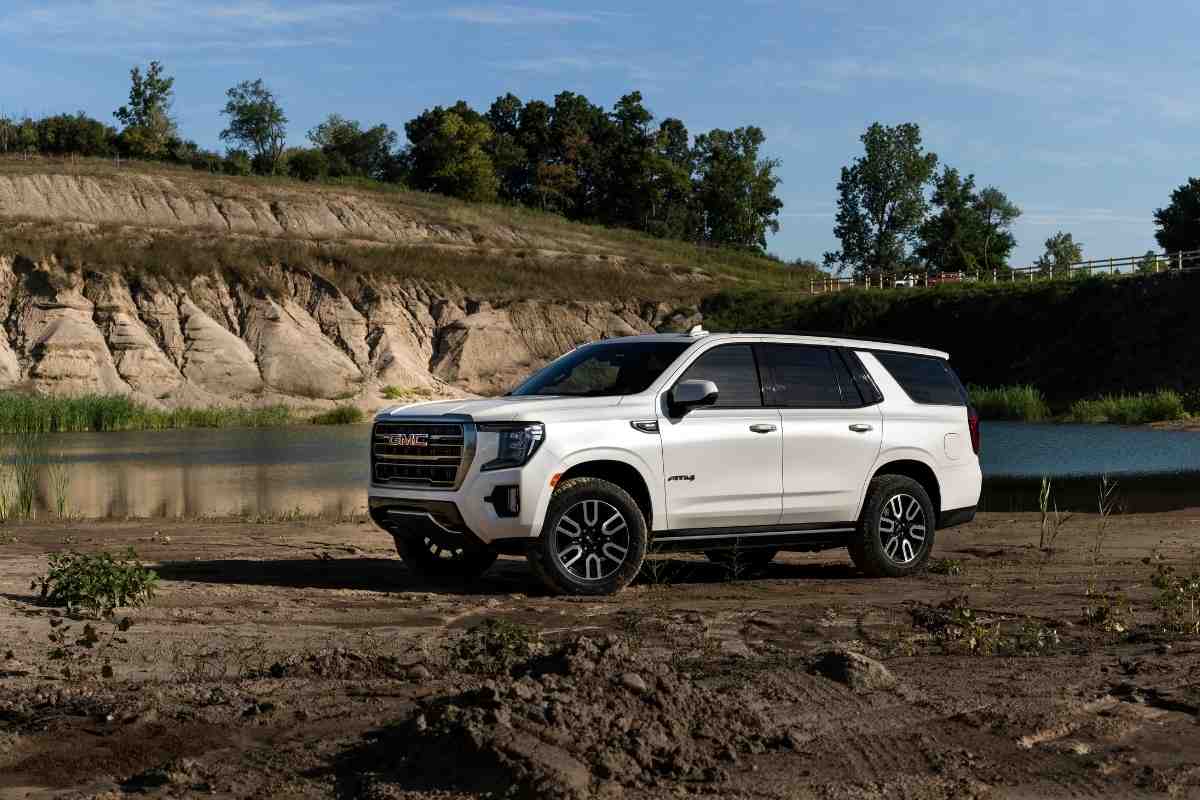
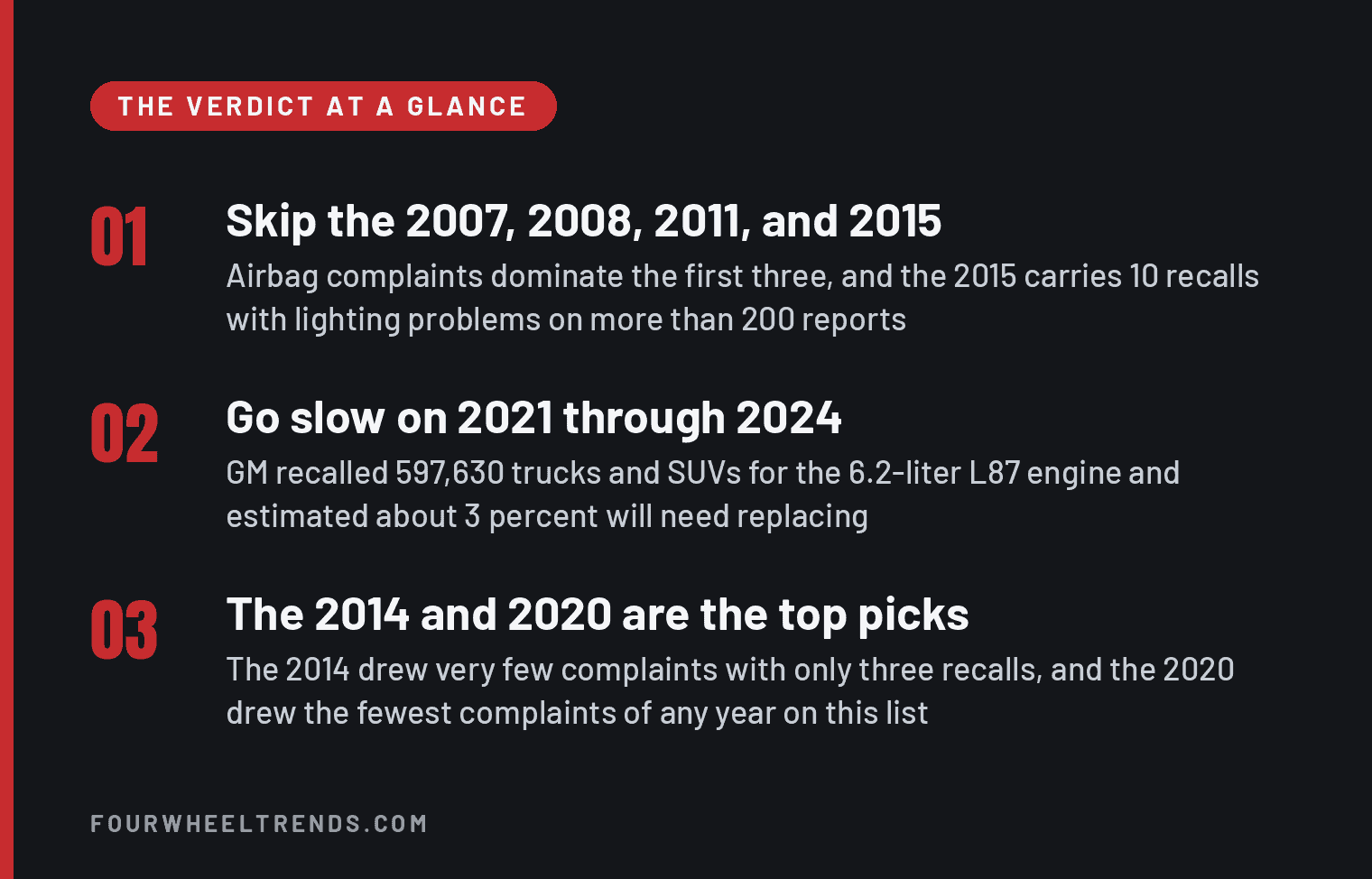
The list of GMC Yukon years to avoid is longer than some people expect. Skip the 2007, 2008, 2011, and 2015, and go slow on the 2021 through 2024 Yukons. The 2014 and 2020 are the two I’d shop first.
What’s The Verdict At A Glance On The GMC Yukon Years To Avoid
Where GMC actually stands on this one
Nobody buys a Yukon the way people buy a Land Cruiser, meaning nobody hands GM the benefit of the doubt on reliability. That skepticism is fair, and the complaint records back it up in specific places.
However, at the same time, some Yukons run past 200,000 miles with nothing but brakes and fluid, and I know owners who love theirs and plan to keep them forever. So, how do you know which one to choose?
The catch is that the good years and the GMC Yukon years to avoid sit right next to each other on the same lot. Two Yukons a model year apart can carry very different odds, and the price tag will not tell you which is which.
2007, 2008, and 2011: the airbag complaint years
The general agreement is that 2007 is number one choice in the GMC Yukon years to avoid. There’s a clear reason for this.
The 2007 is the worst Yukon of the twenty-one years here. More owners filed complaints on it than any other year, and hundreds of those reports were about airbags, with body structure problems and electrical trouble filling in behind them. Roughly three out of four complaints on the 2007 involved a crash, an injury, a fire, or a warning serious enough that NHTSA flagged it.
The 2008 and 2011 tell the same story with a smaller crowd. Airbags led the complaints on both, and the 2011 drew almost as many reports as the 2008 despite being three years newer.
Here is why that matters when you are standing in a driveway with cash in your pocket. An airbag system you cannot trust is not a thing you find out about on a test drive. Before you buy any 2007 through 2011 Yukon, run the VIN through the free recall lookup on NHTSA’s site and confirm the airbag work was actually completed.
And on a body-on-frame SUV this old, get under it. Tap along the frame rails with a hammer, probe any scale or soft spot with a screwdriver, and find the drain holes so you can feel inside the rail with a finger. Frames rot from the inside out, so the rust you can see is the small problem. If a tool sinks in or the inside feels crunchy, walk away and do not try to negotiate the price down.
2015: a flood of lighting complaints and 10 recalls
The 2015 is another of the GMC Yukon years to avoid because it has collected more complaints than any Yukon since the 2007, and most of them point at one thing: exterior lighting. Owners reported headlight and taillight problems over and over, more than 200 times on that year alone.
I’ll be honest about what that means. Lighting is annoying and it can be a safety issue at night, and it is not drivetrain money. The 2015 also has the lowest share of serious complaints of any year on this list, which tells you the volume is real but the severity is lower than the raw count suggests.
What keeps it off my shopping list is the recall count. The 2015 carries 10 recalls, more than any Yukon of its era, and that many separate fixes on a first-year design means a lot of chances for a previous owner to skip one. If you love a specific 2015 anyway, check every recall on the VIN and test every light, front and back, in the dark before you buy.
2016 and 2017: better, not clean
These are two years that we don’t necessarily pin as the some of the worst GMC Yukon years to avoid. However, their problems are plenty.
The 2016 kept drawing lighting complaints, along with electrical and powertrain reports. The 2017 saw lighting complaints drop, and powertrain complaints moved up to share the top spot with lighting at 44 apiece.
Neither year is a disaster. Both sit in the middle of the pack, and both are the kind of buy where a pre-purchase inspection earns its fee. If the same money puts you in a 2018, take the 2018.
2021 through 2024: the 6.2-liter engine years
This is the group people ask me about most, and the complaints are consistent: engine problems, on every single year from 2021 forward. Engine reports lead the list on the 2021, 2022, 2023, 2024, and 2025.
The 2007 still holds the highest complaint total, but complaints are landing faster on the 2024 than on any other year here, with the 2023 right behind it. The 2021 holds a different record: 13 recalls, more than any Yukon on this list.
The real number to know is GM’s own. GM recalled 597,630 of these trucks and SUVs from the 2021 to 2024 model years over the 6.2-liter L87 V8, and while fighting a class action it estimated about 3 percent of those engines will need replacing. That works out to roughly 17,929 engines. NHTSA is also looking into L87 failures outside the recall, so the story is not finished.
Read that 3 percent the honest way. Ninety-seven out of a hundred of these engines are expected to be fine, and you only ever hear from the owners whose engine came apart, because the ones that just work never file anything. A 3 percent chance of a full engine replacement is still a gamble I am not willing to take without coverage behind it.
What I did with our 2019, and why it changed how I buy
Ashley’s 2019 Yukon SLT is the vehicle that taught me all of this. She loved it and planned to drive it forever. In fact, even as you read this article, you’ll see that it’s not one of the GMC Yukon years to avoid.
As we say, go slow on this one. Here’s what happened to ours. Early on it had electrical gremlins. The radio glitched, electronics cut out while she was driving, and one day it flat died on the road. The cause turned out to be embarrassing: after the dealership disconnected the battery, nobody tightened the negative lead back down. I snugged it up and the electrical problems mostly went away.
Then came the whine at 73,000 miles. I told her to drive straight home because it sounded like the transmission, and about two weeks later it gave out for good in rush hour traffic. The light cycle opened a gap big enough to cross three lanes and coast into a parking lot, where we called AAA.
$10,000 to fix, against a trade value around $28,000. One repair worth a third of the whole vehicle. We disclosed the problem, sold it as-is, and aimed that repair-sized money at the replacement instead.
The replacement was a 2023 Yukon Denali with the 6.2-liter L87, the exact engine the internet swears will strand you. I bought it on purpose at 19,000 miles because it was still young enough to qualify for GM’s maximum factory-backed extended warranty, out to about 84 months and 84,000 miles. It also hit Ashley’s whole list: light interior, room for two teenagers and two dogs, and the hard-to-find color combo she actually wanted, which is why I drove 4 to 5 hours each way to a Facebook Marketplace seller outside Washington DC to get it.
About 20,000 miles in, no major problems.
What that 2019 taught me is that a thin complaint record does not make a vehicle bulletproof. The 2019 drew very few complaints, and ours still lost a transmission before 75,000 miles.
The years I’d actually shop
Well, that’s enough about the GMC Yukon years to avoid. There are some years that are worth buying.
The best years to buy across the trucks and SUVs we cover usually sit late in a generation, after the engineers have fixed the launch problems, and the Yukon follows that pattern almost perfectly.
2014 is the best year on this list. Complaints dropped off a cliff compared to the 2011 and 2013, and only three recalls landed on it. The catch is that it is the last year of an older design, so you are buying a twelve-year-old SUV with older tech and whatever the last owner did or did not maintain. Miles matter more than the model year at this point, because the odometer tells you how much of the vehicle’s life is already used up.
2020 drew the fewest complaints of any Yukon on this list. It is the last year before the 6.2-liter engine complaints took over, and powertrain and engine reports on it are counted in the dozens, not the hundreds. The catch is that our 2019 drew few complaints too, and it still needed a transmission, so budget as if a big repair is possible instead of hoping it is not.
The 2012 and 2018 are the honorable mentions. Both drew few complaints for their age, and both are cheap enough now that the inspection is a rounding error against the price. On the 2018, engine and powertrain lead its short complaint list, so pay attention to how it shifts and how it sounds cold.
Every model year at a glance
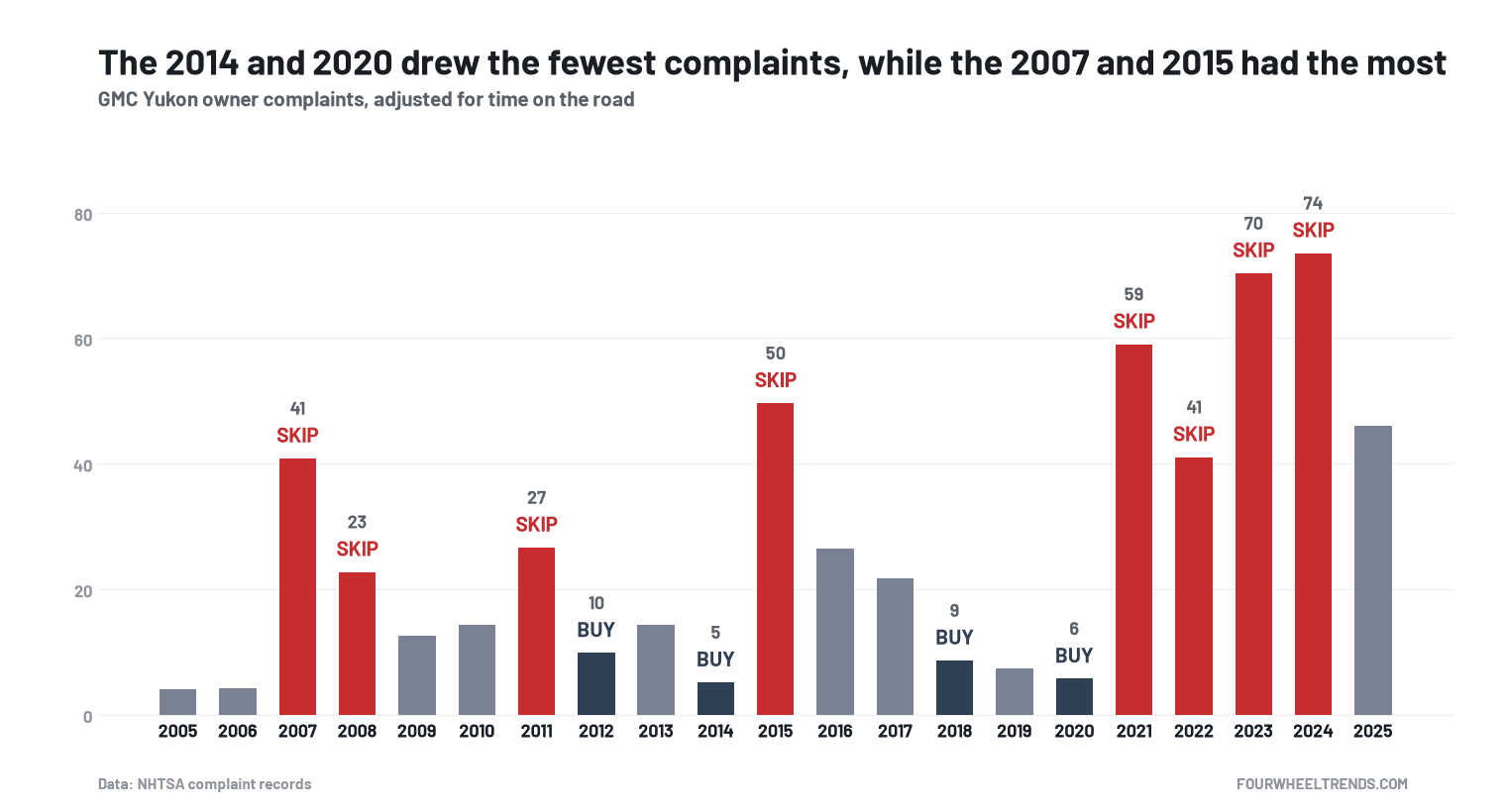
| Model year | Complaints | Recalls | Complaints per year on the road | Biggest problem area |
|---|---|---|---|---|
| 2005 | 85 | 5 | 4.0 | Electrical system |
| 2006 | 83 | 3 | 4.2 | Brakes |
| 2007 | 776 | 4 | 40.8 | Airbags |
| 2008 | 409 | 4 | 22.7 | Airbags |
| 2009 | 212 | 5 | 12.5 | Airbags |
| 2010 | 229 | 4 | 14.3 | Airbags |
| 2011 | 399 | 5 | 26.6 | Airbags |
| 2012 | 137 | 3 | 9.8 | Other or unspecified |
| 2013 | 186 | 4 | 14.3 | Airbags |
| 2014 | 61 | 3 | 5.1 | Other or unspecified |
| 2015 | 546 | 10 | 49.6 | Exterior lighting |
| 2016 | 265 | 5 | 26.5 | Exterior lighting |
| 2017 | 195 | 3 | 21.7 | Powertrain and lighting (tied at 44) |
| 2018 | 69 | 3 | 8.6 | Engine |
| 2019 | 51 | 2 | 7.3 | Engine |
| 2020 | 34 | 4 | 5.7 | Powertrain |
| 2021 | 295 | 13 | 59.0 | Engine |
| 2022 | 164 | 5 | 41.0 | Engine |
| 2023 | 211 | 4 | 70.3 | Engine |
| 2024 | 147 | 3 | 73.5 | Engine |
| 2025 | 46 | 2 | 46.0 | Engine |
The money side of picking the right year
Go back to that $10,000 transmission quote for a second. What stung was that one bill equaled a third of the vehicle’s trade value, which is the point where you have to decide whether the Yukon is still worth keeping.
I have more than 20 years as a financial advisor, and I treat a vehicle like any other five-figure decision: a price paid, depreciation eaten, and a resale number at the end. Win those three and the monthly payment sorts itself out.
Most buyers do the opposite and shop the payment, and they end up buying one of the GMC Yukon years to avoid. That’s exactly how a cheap 2015 or a bargain 2007 turns expensive.
Know the coverage ladder, because the words get abused. A factory warranty only comes on a brand-new vehicle, usually about 3 years or 36,000 miles. A factory-backed extended warranty is the play on a late-model used buy, and it only works if the vehicle is still young enough and low enough on miles to qualify, which is exactly why I bought the 2023 at 19,000 miles. Aftermarket plans are a different animal and most of them deserve real suspicion before you hand over a dollar.
On the 2021 through 2024 Yukons, I treat that coverage as prepaying for one major repair I hope never comes. I also do not plan to keep ours past the extended coverage, because this generation carries a lot of sensors and electronics that can go wrong. Selling with about a year of transferable coverage left means the next buyer pays a premium and moves fast.
Then there is the part nobody escapes. This is a big V8 SUV, and the national average for regular gas sat right at $4.00 a gallon in late July 2026. Whatever year you land on, the fuel line item is real money every month.
None of this is personal financial advice. It is how I’d think it through if you called me from the seller’s driveway.
Who this Yukon fits
If you want a big family hauler and you want the lowest odds of a surprise, shop a 2014 or a 2020 and spend the savings on a pre-purchase inspection. Those two years drew the fewest complaints of the modern bunch, and buying one with lower miles matters more than the model year.
If you need three rows for kids and dogs and you want the newest thing you can get, a 2021 through 2024 can absolutely work, the way ours does. Buy it young enough and low enough on miles to qualify for GM’s factory-backed extended coverage, and go in knowing about 3 percent of those engines are expected to need replacing.
If you are buying a cheap third vehicle for a new driver, skip the GMC Yukon years to avoid completely. A bargain 2007 with airbag complaints in its history is not a bargain, and a 2015 with a light out in every corner is likely to annoy you into a shop bill anyway.
Buy it if, skip it if
So, we’ve been discussing the GMC Yukon years to avoid from a data perspective. But, it also pays to see the analysis from a real perspective. We like to ask ourselves, “who will buy this car?”
- Buy it if you can find a well-kept 2014 or 2020 with reasonable miles and a clean inspection.
- Buy it if you want a 2021 through 2024 and it still qualifies for a factory-backed extended warranty.
- Buy it if a 2012 or 2018 is priced right, shifts clean, and sounds right cold on the test drive.
- Skip it if it is a 2007, 2008, or 2011 with unfinished recall work on the VIN.
- Skip it if it is a 2015 and you cannot confirm all 10 recalls were handled.
- Skip it if the frame has scale you can flake off or feels soft when you probe it.
- Skip it if a big repair would wreck your budget, on any year here.
This way, you can combine data, and use the information we found on the GMC Yukon years to avoid with a case-by-case scenario.
FAQ
What is the worst year for the GMC Yukon?
The 2007 is the number choice in GMC Yukon years to avoid. It drew more owner complaints than any other model year from 2005 through 2025, airbags led those complaints by a wide margin, and about three quarters of them involved a crash, injury, fire, or serious safety warning.
Which GMC Yukon years are the safest used buy?
The 2014 first, then the 2020. The 2014 drew very few complaints for its age with only three recalls, and the 2020 drew the fewest complaints of any year on this list. The 2012 and 2018 are solid backups.
Is the 6.2-liter L87 engine in the 2021 to 2024 Yukon going to fail?
Probably not on yours, but the risk is real enough to plan around. So, while it’s not a clear choice of the GMC Yukon years to avoid, the 6.2L engine is worthy of some attention.
GM recalled 597,630 of these 2021 to 2024 trucks and SUVs and estimated that about 3 percent of the engines will need replacing, roughly 17,929 of them. NHTSA is also investigating L87 failures outside that recall, so buy one with factory-backed extended coverage in place.
Is the 2015 GMC Yukon a bad SUV?
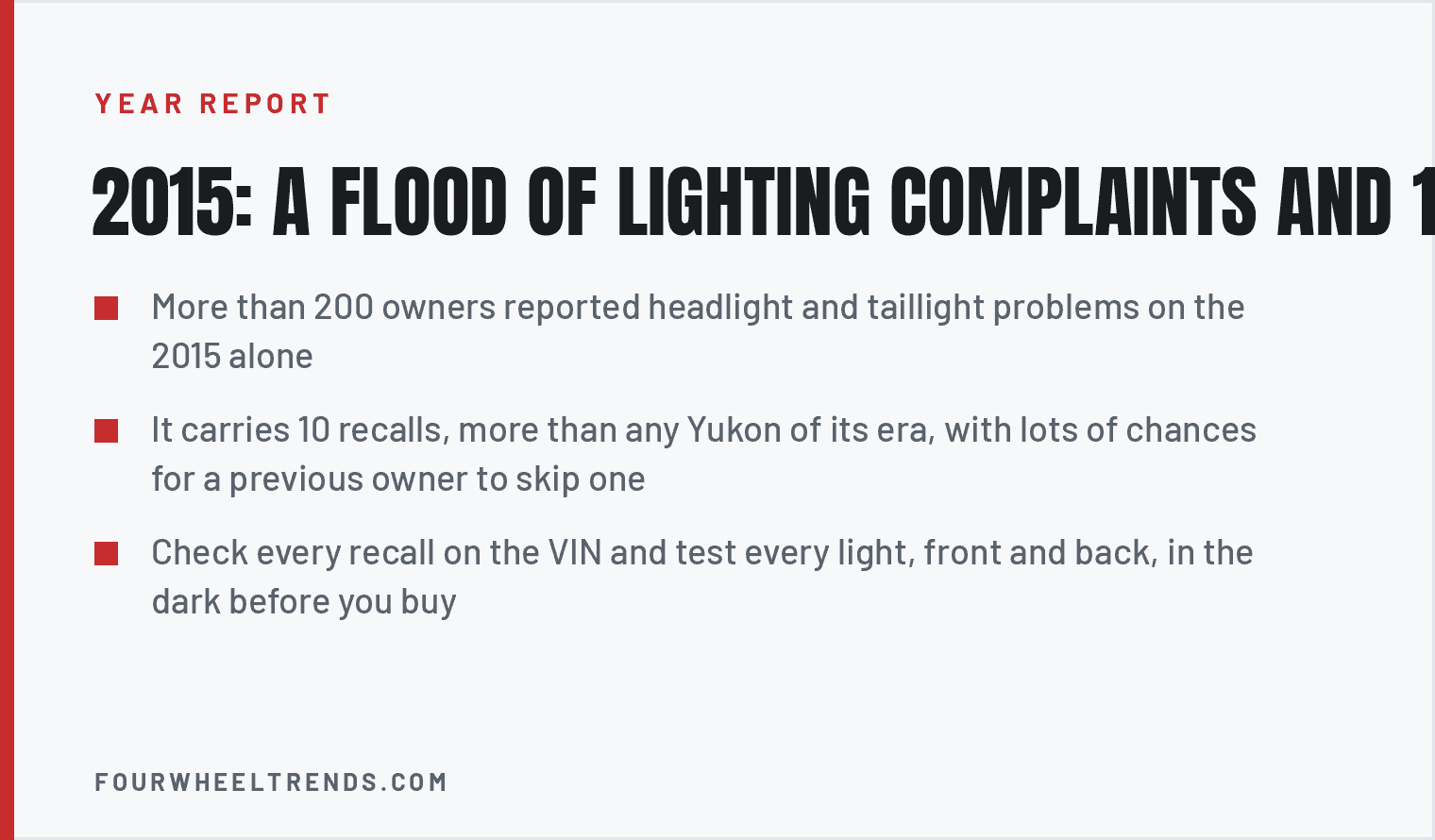
It drew more complaints than any Yukon since the 2007, and most of those reports are about the headlights and taillights rather than the engine or transmission. It also carries 10 recalls, more than any Yukon of its era. If you buy one, confirm every recall on the VIN and test all the lights at night.
Do I need to worry about the frame on an older Yukon?
On any body-on-frame SUV that is a decade or two old, yes. Get under it, tap the frame rails with a hammer, probe soft spots with a screwdriver, and feel inside the rail through the drain holes, because frames rot from the inside out. Crunchy rust inside the rail means you walk away instead of trying to negotiate the price down.
Sources
- NHTSA complaint and recall records, GMC Yukon 2005 to 2025. Data as of July 26, 2026.
- U.S. Energy Information Administration, national average regular gasoline price, week of July 20, 2026.