Ford Bronco vs Jeep Wrangler: Which Fits Your Real Life?
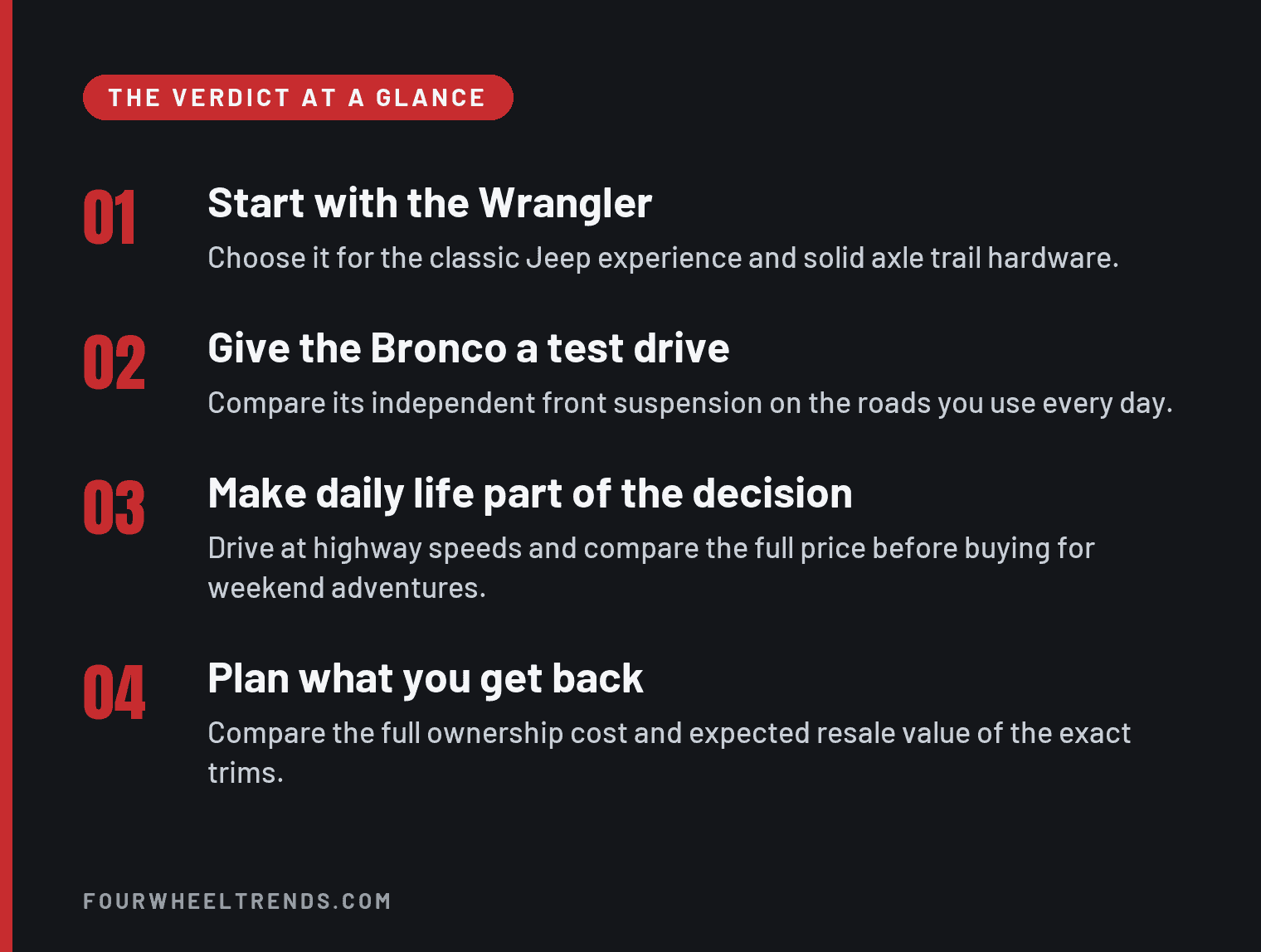
Choose the Jeep Wrangler if the classic Jeep experience and solid-axle trail hardware are what you want. Put the Ford Bronco first on your test-drive list if you want removable doors and a roof with independent front suspension. If long-distance comfort is your main priority, I would shop beyond both. Either can be a great purchase. The harder question is whether you will enjoy it enough on ordinary days to justify buying it for the extraordinary ones. Resale value and what it costs to own through your expected sale date belong in that decision, too.
I have owned or driven every Wrangler generation since the change from the CJ, and I currently own a 1993 YJ and a 2006 LJ. I have also rented and driven the Bronco during a week-long vacation. I would be excited to own either a modern Wrangler or a Bronco, but excitement has to survive the price and the drive home.
What changes the Bronco vs Wrangler decision?
This comparison covers the two-door and four-door Ford Bronco and Jeep Wrangler, with current specifications drawn from U.S. 2026 models. My perspective includes driving the modern Wrangler, years behind the wheel of earlier Jeeps, and renting and driving the Bronco.
| Buying priority | Ford Bronco | Jeep Wrangler |
|---|---|---|
| Front suspension | Independent front suspension | Solid front axle |
| Rear suspension | Solid rear axle | Solid rear axle |
| Open-air driving | Removable doors and roof options. Body-mounted side mirrors stay in place when the doors come off. | Removable doors and roof options. Choose the roof system you will actually use. |
| My buying advice | Try it first if you want an alternative to the traditional Jeep front suspension layout. | Try it first if owning a Wrangler is part of the appeal, especially with trail use in mind. |
The hardware differences come from Ford’s 2026 Bronco technical specifications and Jeep’s Wrangler capability information. Those differences give you something meaningful to compare on a drive. They do not settle which seats, tires, or roof you will find more comfortable.
Why did I walk away from buying a new Wrangler?
I went to the dealership intending to buy a JLU, the four-door Wrangler, with a manual transmission. I drove the modern Jeep and came away with a good overall impression, but the feedback to the driver felt lacking, and visibility felt more restricted than in my older Jeeps.
I started thinking I would probably buy the automatic instead. That hurt my soul a little as a die-hard manual Jeep guy. I had gone in wanting a particular kind of driving experience, and now I was reconsidering the transmission before I had even bought the vehicle.
Then I looked at a loaded Rubicon purchase approaching $60,000. Taken together, the driving impressions, the move toward an automatic, and the price changed my entire buying mindset.
For essentially the same money at the time, I would rather have bought a Lexus GX 460. My priorities had shifted toward practicality, comfort, and my confidence in Lexus ownership. I also had two Wranglers at home that I absolutely loved driving, at a price point that did not stress me out.
I could already enjoy a Jeep without asking it to handle every trip or justify a much larger purchase. A new Wrangler had to offer enough to make me want it over both the GX and the Jeeps I already owned.
The Bronco tempted me, too. I put my name on an early list, but I did not think I would be high enough on it to get one soon. Paying a markup over MSRP was more than I could bring myself to do.
Those are past shopping experiences. The price approaching $60,000 applied to the fully equipped JLU Rubicon I was considering. For today’s numbers, start with the current Bronco builder and current Wrangler lineup, then compare written prices for the actual vehicles you want, including destination, options, fees, and taxes.
For me, a higher price raises the expectations. A vehicle I buy mainly for fun can have quirks I happily forgive. When that purchase also has to be my daily driver, I care much more about what it asks me to tolerate.
Which holds its value better, the Bronco or Wrangler?
The trim matters enough that I would research it before settling for the cheaper version. I have spent 20 years as a financial advisor and am still in active practice. A vehicle’s price gets your attention at the dealership. What you recover when you sell helps determine what owning it actually cost.
I often favor a premium trim when buyers continue paying for its equipment years later. The financial question is how much of the extra purchase price comes back, and whether that covers the extra ownership costs.
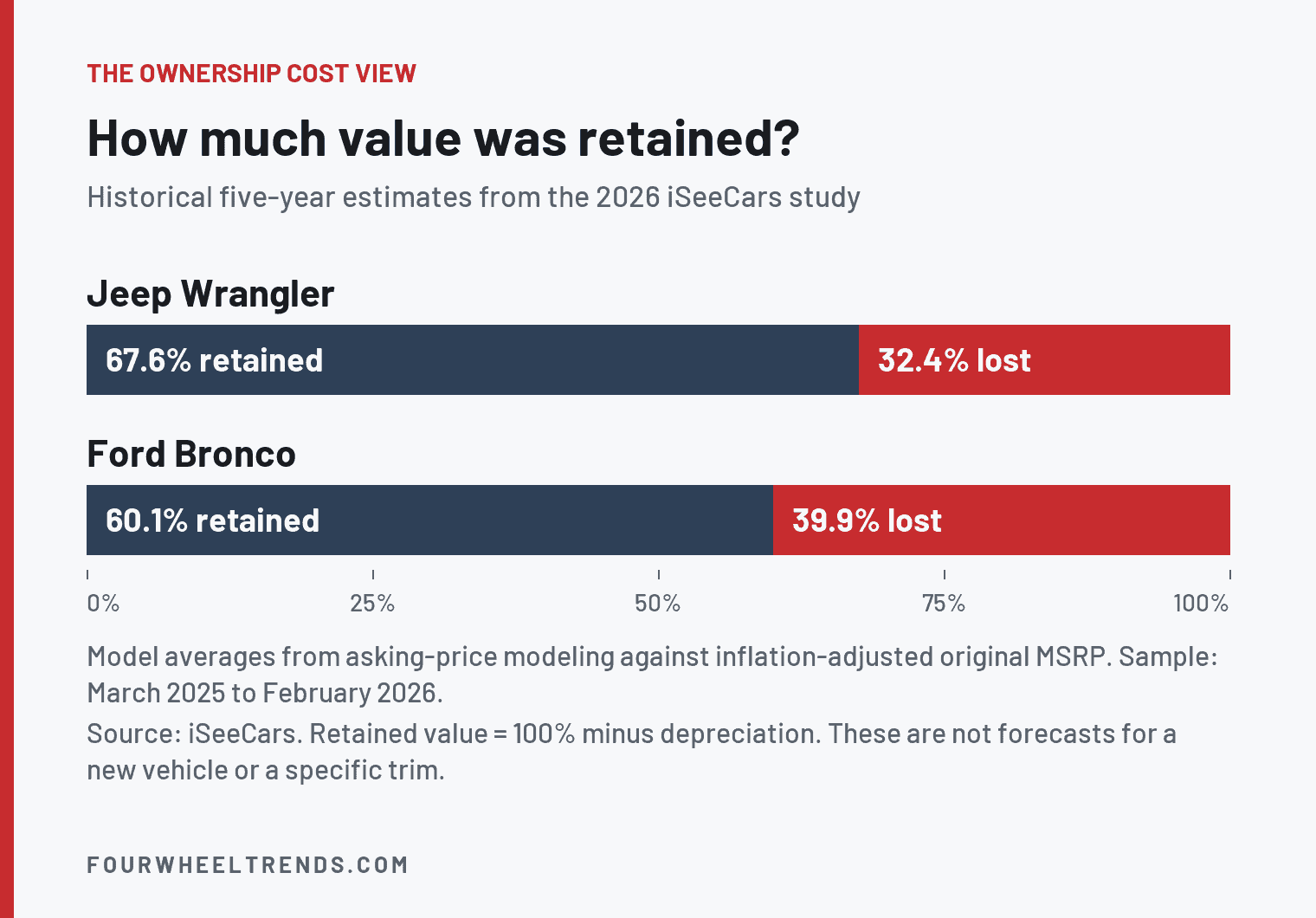
At the model level, iSeeCars’ 2026 five-year depreciation study estimated that the Wrangler retained 67.6% of its value and the Bronco retained 60.1%. Its March 2025 through February 2026 sample used modeled asking prices against original MSRPs adjusted for inflation. That historical result favors the Wrangler, but it does not identify the best trim or forecast the sale price of a new one.
Does buying a Rubicon or Badlands recover more of your money?
The 2021 four-door models provide a useful look at roughly five-year-old vehicles. The following figures come from Kelley Blue Book’s Wrangler Unlimited and Bronco national pricing tables, accessed October 7, 2026. They pair each style’s listed original MSRP with its current typical-condition dealer purchase estimate.
| Trim | Original MSRP | Used dealer estimate | Retail value relative to MSRP |
|---|---|---|---|
| Wrangler Sport S | $40,915 | $23,800 | 58.2% |
| Wrangler Rubicon | $48,960 | $31,400 | 64.1% |
| Bronco Big Bend | $37,375 | $25,100 | 67.2% |
| Bronco Badlands | $46,085 | $29,300 | 63.6% |
The Rubicon result is exactly why I would look beyond the starting price. Its original MSRP was $8,045 higher than the Sport S, while its used retail estimate is $7,600 higher. The difference between those two premiums is just $445. On this retail measure, buyers still attach substantial value to the Rubicon.
The Badlands result is different. Its original premium over Big Bend was $8,710, while the used retail premium is $4,200. The remaining $4,510 makes that upgrade harder to justify through value retention alone.
These are modeled valuation estimates for typical vehicles. Mileage, engines, options, condition, and the original negotiated deal can change the result. Dealer retail also includes a dealer’s margin. You cannot treat these used purchase prices as what you will receive when trading in or selling privately.
The Raptor is another useful example of my thinking. In KBB’s 2021 F-150 SuperCrew table, the 5.5-foot-bed Lariat lists an original MSRP of $54,425 and a used dealer estimate of $34,200. The equivalent-body Raptor lists $65,840 and $51,300. That is about 62.8% versus 77.9% of original MSRP. The Raptor cost $11,415 more new, and its used dealer estimate is $17,100 higher, so its premium has grown by $5,685 on this measure. Its fuel, insurance, and maintenance costs still belong in a complete ownership comparison.
What do real five-year ownership estimates show?
For the new-vehicle decision, the table below uses Edmunds’ published estimates for actual 2026 trims. All four are four-door 4WD models. Within each brand, the comparison holds engine and transmission constant. The Wranglers use the 3.6-liter V6 and six-speed manual, and the Broncos use the 2.3-liter turbo four and seven-speed manual. An automatic needs its own calculation. These estimates exclude aftermarket upgrades and their effects on running costs and resale.
The calculator was set to Raleigh, North Carolina, ZIP 27601, as a common comparison location. Edmunds’ published calculation assumptions specify five years, 15,000 miles annually, clean condition at private sale, 10% down, a 60-month loan, and above-average credit. Its fuel estimate uses EPA ratings and state fuel prices, while insurance, maintenance, and repairs use its own models. These are sourced estimates. Your own dealer and insurance quotes can differ.
| Cost or value | Wrangler Sport S | Wrangler Rubicon | Bronco Big Bend | Bronco Badlands |
|---|---|---|---|---|
| Total cash price, including initial taxes and fees | $47,229 | $56,628 | $47,176 | $62,983 |
| Implied private-sale value after five years* | $23,988 | $31,174 | $30,211 | $37,133 |
| Depreciation | $21,780 | $23,603 | $15,433 | $23,857 |
| Taxes and fees over ownership | $1,605 | $1,995 | $1,676 | $2,137 |
| Financing interest | $9,561 | $11,464 | $9,550 | $12,750 |
| Fuel | $14,117 | $14,117 | $17,636 | $19,714 |
| Insurance | $3,609 | $3,818 | $4,027 | $4,022 |
| Maintenance | $3,552 | $3,964 | $3,765 | $3,712 |
| Repairs | $1,319 | $1,319 | $967 | $967 |
| Estimated five-year ownership cost | $55,543 | $60,280 | $53,054 | $67,159 |
*Calculated from Edmunds’ total cash price, less the initial taxes and fees in its first-year breakdown, less estimated depreciation. It assumes 75,000 miles added over ownership. This is the resale value implied by the model, before any separate selling expense. Sources: 2026 Wrangler costs and methodology and 2026 Bronco costs and methodology.
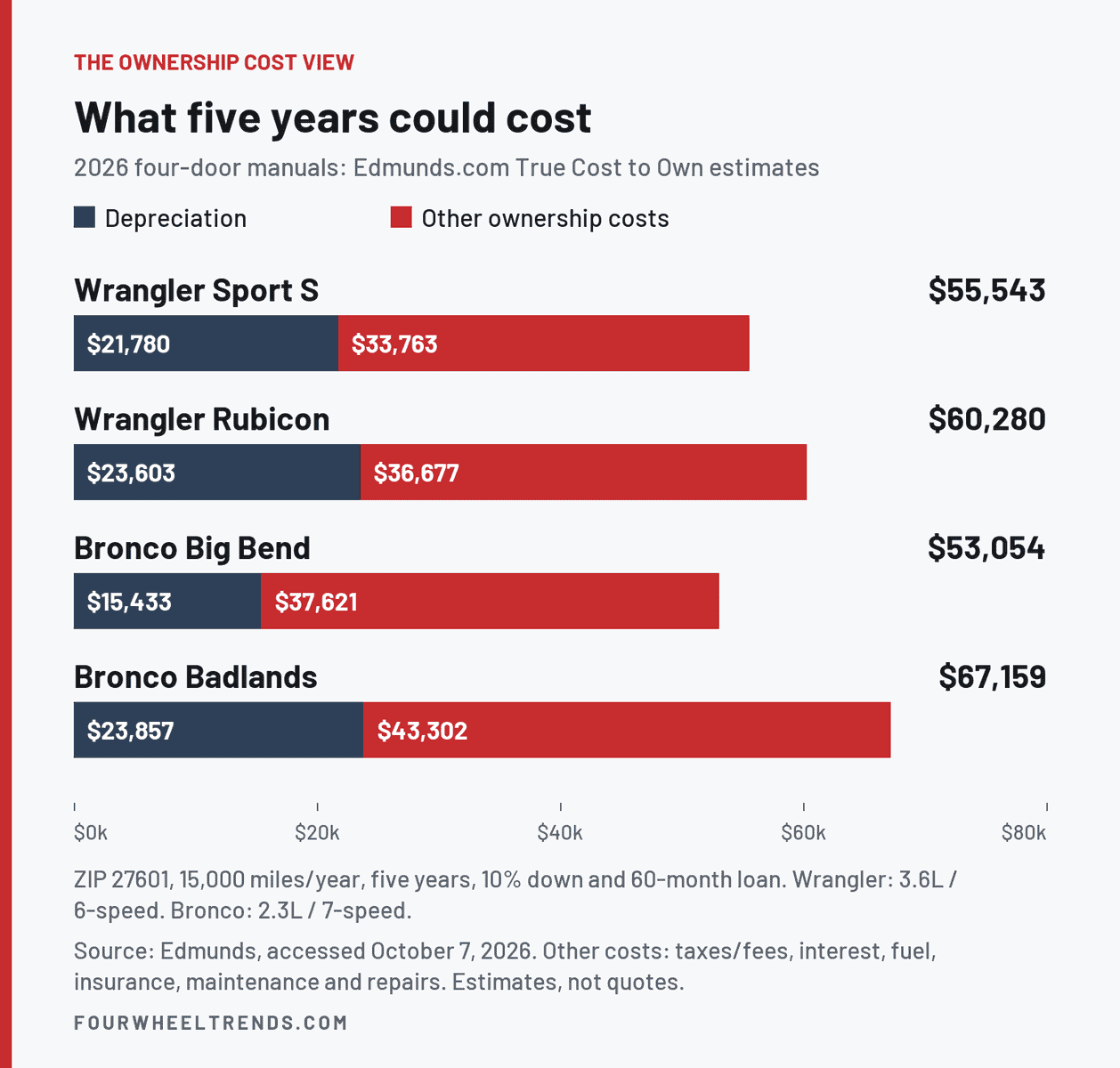
The purchase price and exit value explain depreciation. They are not added again to the ownership total. Loan principal is already represented by the vehicle’s price, so the financing line counts interest. The CFPB’s auto-loan guide explains that distinction.
Which trim would I put on the financial shortlist?
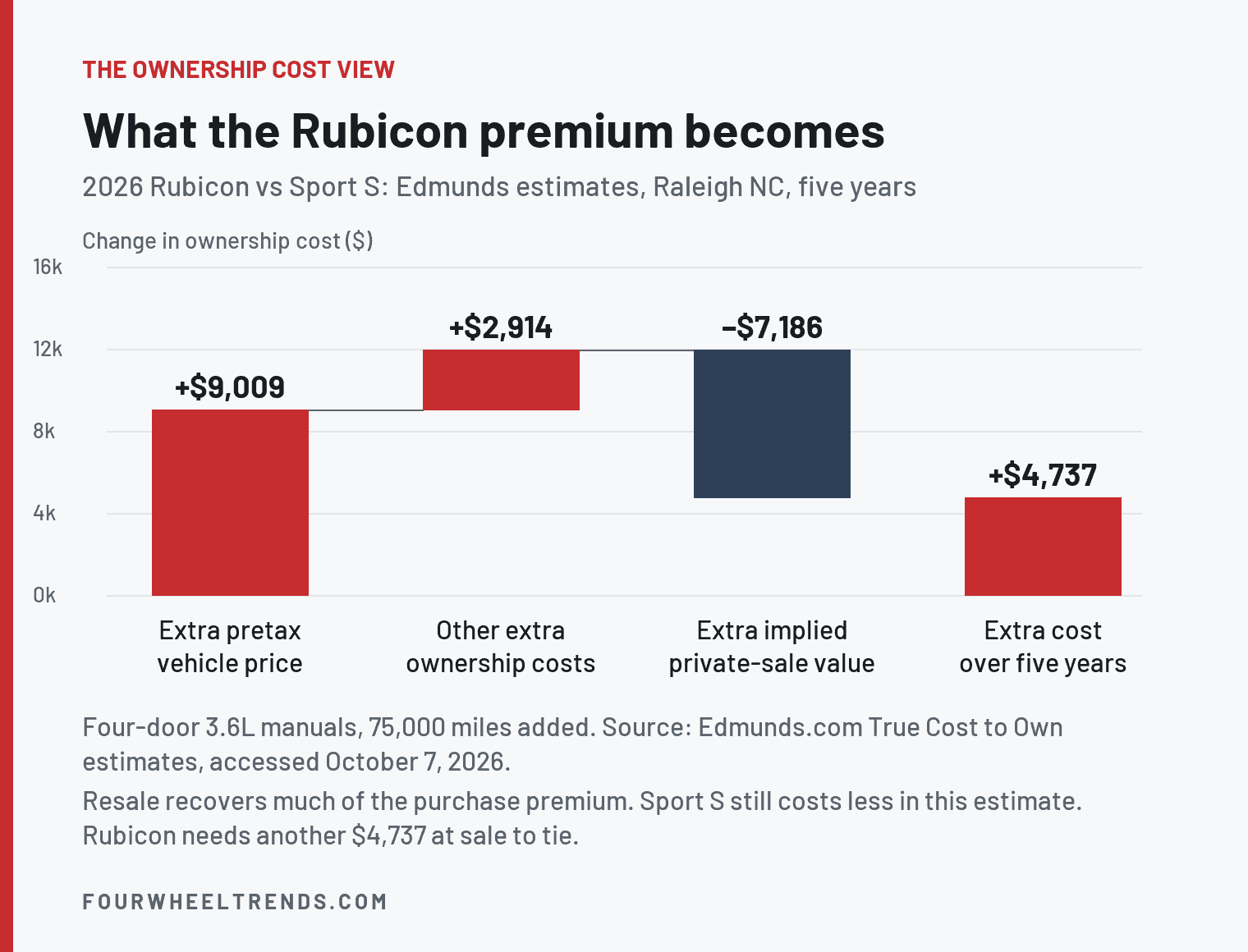
I would give the Rubicon a serious look if I wanted its trail equipment. In the 2026 estimate, its vehicle price before initial taxes and fees is $9,009 above Sport S, but its implied resale is $7,186 higher. The extra depreciation is $1,823. Add $2,914 in other ownership costs and the five-year premium becomes $4,737, about $79 a month averaged over ownership. That average is separate from the loan payment.
The Rubicon retains about 56.9% of the model’s pretax vehicle price versus 52.4% for Sport S. Its retained-value advantage makes the equipment less expensive to own than the purchase premium suggests. This estimate still puts Sport S ahead on total dollars spent. To reverse that result through resale alone, the Rubicon would need another $4,737 at sale, with other inputs unchanged.
That comparison assumes you leave both Jeeps unmodified. The Sport S is capable on its own, but a Rubicon gives you more trail equipment from the factory. Jeep’s trim guide lists its front and rear locking differentials, electronic sway-bar disconnect, aggressive off-road tires and rock rails. If that is the equipment you want, price the factory package against what you would actually build.
Among the Sport S owners I know, very few leave their Jeeps stock. Building your own Jeep is exciting and rewarding. I would still separate the fun of doing it from the money you expect to get back. Aftermarket parts can become a liability at resale. A buyer may want different equipment or wonder whether the installation was done properly. A stock Rubicon gives that buyer a familiar factory package to evaluate. Some modifications may hold their value. I still would not assume the next owner will reimburse my parts and labor.
If you would keep the Rubicon stock, the Sport S build needs another calculation. Add the installed upgrade costs and any added financing and running costs, then subtract the additional resale value you can support. If that net cost exceeds $4,737 over the same five years, it erases the Sport S advantage in this estimate. Get quotes for the upgrades you actually want and evidence for their resale contribution. Include any changes you would make to the Rubicon, too. If the stock Sport S already does everything you need, its lower estimated ownership cost still matters.
I would start the Bronco financial comparison with Big Bend. The published estimate gives Badlands a $14,105 higher five-year cost, about $235 a month averaged over ownership. Its greater assumed exit value does not cover the purchase premium and other costs. Badlands can earn that extra cost through equipment you use. On these numbers, Big Bend is the cheaper one to own.
Big Bend also has the lowest total in this four-vehicle estimate, despite the Wrangler’s stronger historical model-wide result. The two studies ask different questions. One looks backward across a nameplate, while the other estimates a specific current purchase and ownership period. I would use the trim calculation to compare actual offers.
Edmunds presents its tool as a way to compare five-year totals across vehicles. Its estimated purchase prices include typical options and broadly available rebates, and its loan rate is a modeled figure. Your lender’s quote sets your real rate. Personal insurance premiums, local charges, selling expenses, optional extended coverage, and the condition of your vehicle can change your cost. Replace those inputs with written offers before buying. A negotiated discount helps, but the amount that remains after taxes and financing needs to be recalculated.
That is how I would shop either vehicle. I would choose the equipment I want, examine what buyers pay for that equipment later, and price the years in between. A desirable trim can be worth paying more for. The value of that trim needs to show up in the numbers.
This article provides general educational information. It is not personalized financial advice, and I do not know your financial situation, goals, or obligations. Ownership and resale estimates are not guarantees.
Which is better as a daily driver?
I would give the Bronco the first test drive if you are approaching this without a strong Jeep preference. Its independent front suspension allows the front wheels to move independently, and its steering uses a rack-and-pinion layout. The Wrangler keeps a solid front axle, which links the front wheels across the vehicle. That is a meaningful difference in design, though the exact configuration still needs to earn your approval on your roads.
What I can tell you is that neither is as comfortable for my road trips as my F-150 or Yukon. I drive to college football games and make three-hour trips to the coast to go fishing. A Bronco or Wrangler would be a lot of fun once I got there. I also have to enjoy the hours getting there and back.
For a short commute, that compromise may be easy to accept. If you can drop the top for much of the year, the drive to work might become one of the reasons you bought it. A long highway commute gives you a different test to pass.
Drive each at the speeds you normally use, with the roof you intend to buy. Turn the radio off. Pay attention to noise, small steering corrections, seat support, and how it feels over patched pavement. Bring the people who regularly ride with you. Ten minutes around the dealership will not answer the same questions as a stretch of highway.
Which is better off-road?
For a buyer focused on technical trails, I would start by comparing a Wrangler Rubicon with an appropriately equipped Bronco. The equipment on the specific vehicles settles more than the badge does.
Jeep’s 2026 Rubicon hardware includes an electronic front sway-bar disconnect, and the lineup offers front and rear locking differentials. Ford offers electronic-locking differentials and different suspension packages across the Bronco range. Those features depend on the model and equipment. A base vehicle and a heavily equipped trail model are different purchases.
The Wrangler’s solid front axle is a clear reason for someone who specifically wants that layout to choose it. The Bronco makes a fair opposing case. It gives you a purpose-built open-air off-roader with independent front suspension. Pick the hardware for the terrain you will use, then drive the exact version before spending the money.
For weekend camping, fishing access, and the trails you realistically plan to tackle, ask what equipment the route calls for. I would rather see you buy a configuration that fits those trips and leaves room in the budget for training, recovery equipment, and travel than spend everything on the most impressive trim badge.
My Bronco experience included a week-long vacation in the Cayman Islands, with daily road driving and time on muddy trails in a natural forest. Those dirt roads had potholes and mud-filled sections where we needed four-wheel drive to make sure we did not get stuck. It gave me a chance to use the Bronco for both ordinary vacation driving and muddy off-road travel.
I liked the 2.3-liter Bronco’s power, but the terrain was flat, with three people aboard and little gear. The engine never worked hard. That experience does not tell you how it will feel loaded on a mountain grade or towing your trailer.
If a camper or boat is part of the plan, verify the exact vehicle’s towing and payload limits in its applicable owner’s manual and towing documentation. Count the passengers, equipment, and trailer tongue weight. A headline maximum for the model is not permission to tow that weight with every version.
Which makes top-down driving easier to enjoy?
Both offer removable doors and roof choices, so the answer starts with how you will use them. Ford’s Bronco exterior information confirms that the side mirrors are mounted to the body and remain in place when you remove the doors.
Jeep offers several open-air configurations, including the available Sky One-Touch power top. The Wrangler roof and door information is a better starting point than assuming every Wrangler has the same setup.
Have the salesperson demonstrate the exact roof you are considering. Think through where removed panels will go, whether you have storage at home, and how often you will take the time to use it. Follow the manufacturer’s instructions for roof and door removal.
My two Jeeps make that choice pretty clear. My 2006 LJ is lifted and modified for off-road use, and it is the one I drive most. The previous owner sold the hardtop and fitted a soft top. I would have preferred to keep the hardtop because I rarely take the LJ’s roof off and it mostly parks outside.
My nearly stock, low-mileage YJ stays in the garage with the top down all year. When I want top-down fun, that is the Jeep I take. Compared with modern vehicles, it feels like driving a go-cart. I have it set up much like the Jeep I had in high school, only the subwoofer is a little smaller!
For my LJ, the removable roof gets little use. For my YJ, open-air driving is a reason to take it out. Think about which pattern fits your life before paying for a roof configuration. Frequent open-air driving would make either a Bronco or Wrangler easier for me to justify.
Is the Bronco or Wrangler more reliable?
I would not promise you that either nameplate is the safer reliability bet across every year, engine, and configuration. My affection for my YJ and LJ does not prove a modern Wrangler will behave the same way. A Bronco rental does not establish long-term durability. If the Bronco is on your list, my breakdown of why the Ford Bronco gets bad reviews covers the roof leaks, the early V6 engine recall and the manual-transmission noise worth checking.
On a used example, I would want service records, an independent inspection, and a clear account of modifications and previous use. Check the VIN through NHTSA’s recall lookup, then have the dealer confirm applicable campaigns and show the paperwork for completed repairs.
I would also price manufacturer-backed extended coverage if I planned to keep either beyond its original warranty. That is my preference for managing repair risk. A service contract can still cost more than the repairs it ends up paying for.
Ford Protect and Stellantis-backed FlexCare offer vehicle service contracts. Compare the actual contract price, covered components, deductible, exclusions, eligibility, and expiration date. Ask how modifications and your intended use affect coverage. Mopar specifically states that the purchased plan provisions govern coverage.
I already have extended coverage on our 2023 Yukon. If I keep my 2025 F-150, I intend to buy coverage before its basic factory warranty expires. For another new vehicle, I would want the coverage decision settled as part of the ownership budget.
Should you buy new, used, or keep an older Jeep?
New is a good choice when you want a specific configuration, a documented starting point, and original warranty coverage, and the full purchase fits your budget. I would compare actual offers on both brands before paying extra just to get a particular vehicle immediately.
Used is worth shopping when the discount compensates you for the miles, condition, remaining coverage, and any work it needs. Get an inspection before assuming the lower price represents better value. Compare like-for-like equipment. Pricing a basic used vehicle against the loaded new one you really want makes the used deal look better than it is.
An older Jeep can be a good second vehicle for someone who enjoys maintaining it and has another comfortable vehicle for longer trips. That is why my YJ and LJ still make sense to me. I feel able to handle most of their repairs with an inexpensive set of tools. That is my comfort level with my own Jeeps. Every old Wrangler carries its own history.
If you pay a shop for everything, an older Jeep needs its own repair budget. It also needs a thorough condition inspection. Buying old works best when you understand what you are taking on.
My GX 460 alternative belongs in this decision, too. If a fixed roof and road-trip comfort better suit your life, drive a used GX alongside the Bronco and Wrangler you are considering. My confidence in Lexus helped shape my choice, but any particular used GX still has to pass the same condition and cost checks.
What should you check before buying either?
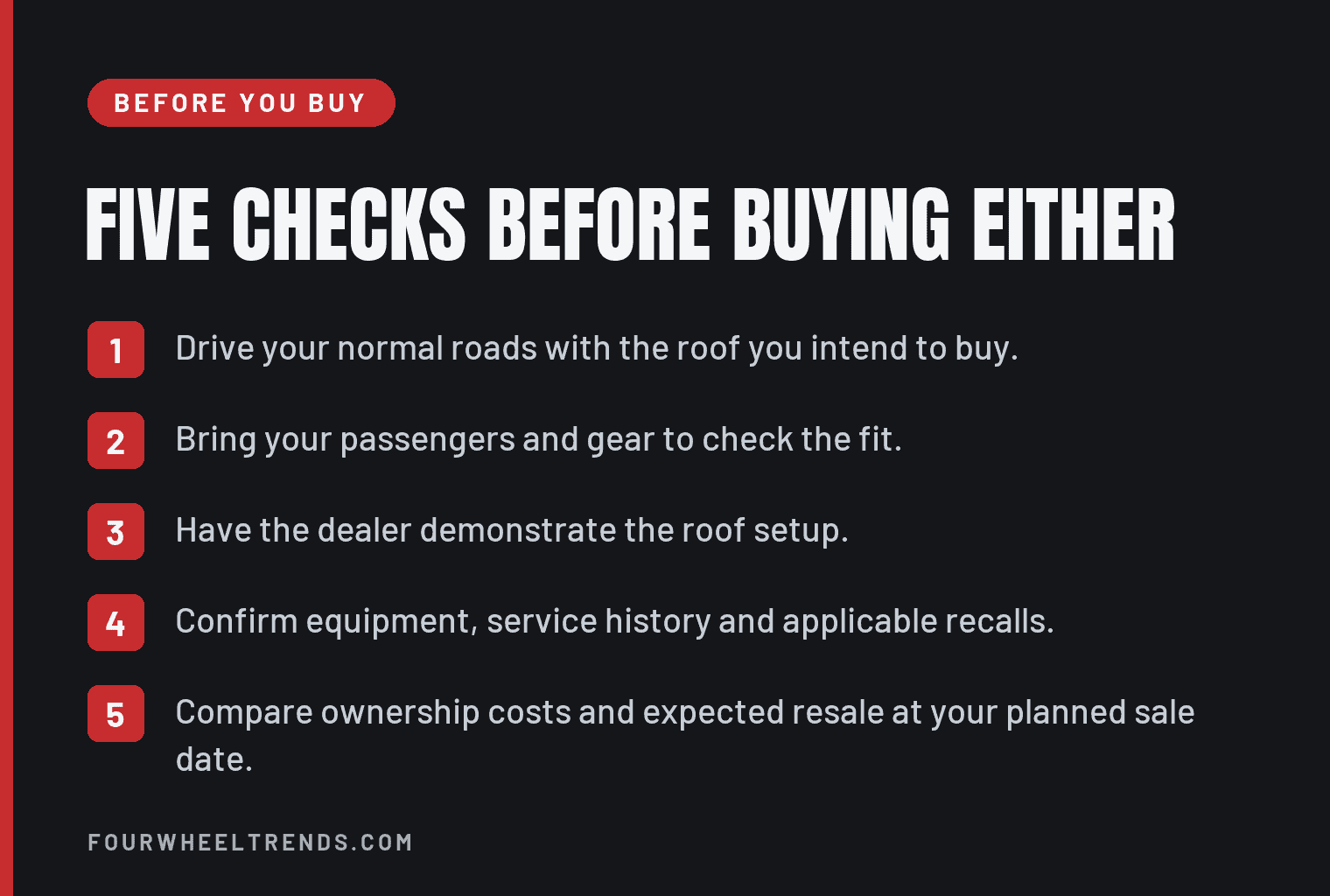
- Drive your normal roads. Include highway speeds and rough pavement with the roof you intend to buy.
- Bring your passengers and gear. Check seating, entry, visibility, and usable cargo space with your own needs in mind.
- Try the roof setup. Have the dealer demonstrate it and plan where removed pieces will be stored.
- Check the exact equipment and history. Confirm the engine, transmission, axle equipment, modifications, service records, and applicable recalls. Arrange an independent inspection for a used vehicle.
- Compare the full ownership budget. Choose your expected ownership period and mileage. Get written purchase prices, insurance and coverage quotes, fuel-economy information, and an evidence-based resale estimate. Include financing, maintenance, and uncovered repairs, then test a lower resale outcome.
Which one would I recommend to a friend?
I would be comfortable recommending either to someone who understands what they are buying. Start with the Wrangler if the Jeep experience and its solid-axle hardware are central to what you want. Start with the Bronco if you want that open-air adventure experience with a different front suspension layout. Let the drive, the equipment, and the ownership-cost calculation decide between the specific vehicles. The Rubicon’s retained-value advantage deserves a close look if you want its equipment. Among the four manual 2026 configurations priced here, Big Bend has the lowest estimated five-year cost. Let written offers and your own ownership plans test those results.
A short commute, plenty of top-down weather, or regular weekend adventures would make the case for either stronger. Long highway trips and a tight budget would make me widen the search.
I still love driving my Wranglers. That did not make a new Rubicon approaching $60,000 the right purchase for me. Before you buy a Bronco or Wrangler for where it can take you on Saturday, make sure you will be happy driving it home on Sunday.
Sources
- Jeep: Wrangler trim guide, factory Rubicon equipment, checked October 7, 2026
- Edmunds: published True Cost to Own calculation assumptions, checked against the current calculators October 7, 2026
- Kelley Blue Book: 2021 Wrangler Unlimited original MSRP and national used dealer estimates, accessed October 7, 2026
- Kelley Blue Book: 2021 Bronco original MSRP and national used dealer estimates, accessed October 7, 2026
- Kelley Blue Book: 2021 F-150 SuperCrew original MSRP and national used dealer estimates, accessed October 7, 2026
- Edmunds: 2026 Wrangler True Cost to Own and calculation methodology, accessed October 7, 2026
- Edmunds: 2026 Bronco True Cost to Own and calculation methodology, accessed October 7, 2026
- iSeeCars: 2026 five-year depreciation study, sample March 2025 to February 2026
- Consumer Financial Protection Bureau: auto-loan key terms, consulted October 7, 2026
- Ford: 2026 Bronco Technical Specifications, axles, suspension, steering, and roof configurations
- Ford: U.S. 2026 Bronco model and exterior information
- Ford: U.S. 2026 Bronco Build and Price lineup
- Jeep: U.S. 2026 Wrangler lineup
- Jeep: U.S. 2026 Wrangler capability and Rubicon equipment
- Jeep: U.S. 2026 Wrangler roof and door options
- NHTSA: vehicle recall lookup and search limitations
- Ford Protect: U.S. extended service plan options
- Mopar: U.S. FlexCare plan details and eligibility information
- Mopar: plan provisions and coverage disclaimer