Ford Maverick Best and Worst Years: What I’d Tell My Dad
My 77-year-old father is interested in a Ford Maverick. He has been following Mike at Outdoors With The Morgans, and a friend who owns one says he likes it. I understand the appeal. It is an economical daily vehicle with a bed for weekend chores, outdoor gear and the occasional messy load.
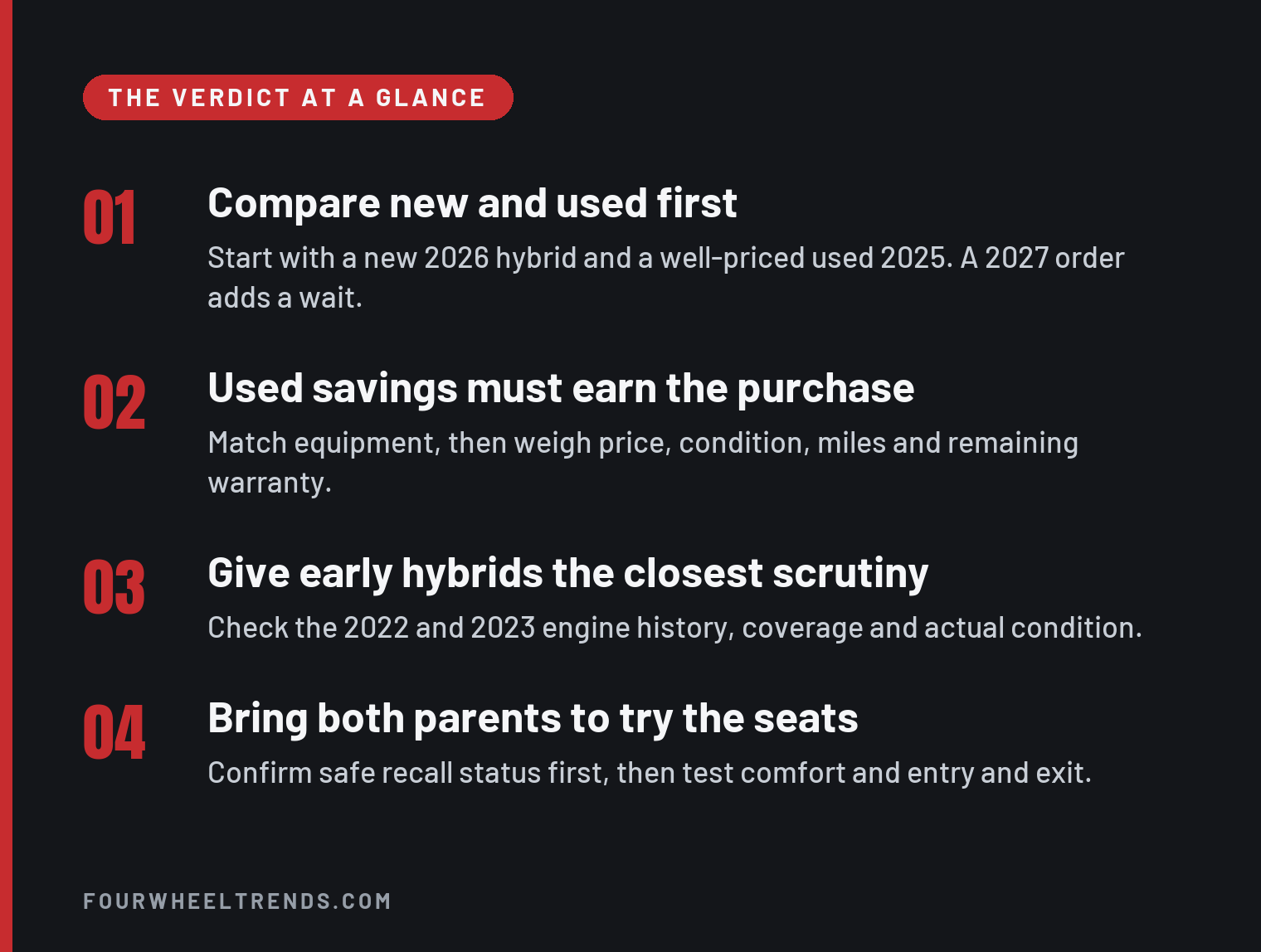
For Dad, I’d compare a new 2026 hybrid with a well-priced used 2025. The 2025 is my starting point for used trucks with the newer features. A 2024 hybrid is a value candidate if front-wheel drive works for him. The 2022 and 2023 hybrids need the closest scrutiny. A 2027 order belongs in the conversation too, if he is comfortable waiting.
This guide covers both new and used Mavericks. The model year helps narrow the choices, but price, remaining warranty, repair history and how comfortably Dad and Mom can get in and out will decide the purchase.
Which Ford Maverick years would I buy or approach carefully?
| Model year | My recommendation | What decides it |
|---|---|---|
| 2022 | Most cautious shopping choice, particularly the hybrid | Early hybrid engine concerns and a separate halfshaft program make repair records and inspection especially important. |
| 2023 | Consider only with a persuasive price and history | Certain hybrids share the early engine concern. A different model-year label does not resolve it. |
| 2024 | Used-value candidate | A documented, well-priced hybrid can make sense if front-wheel drive meets your needs. |
| 2025 | My first used shortlist for newer features | Hybrid AWD became available, with optional 4,000-pound towing and a larger screen. |
| 2026 | My starting point for a new truck available now | Compare an in-stock hybrid’s equipment and full warranty term with the savings on a used 2025. |
| 2027 | A new-order option if you can wait | Dealers are accepting orders. Confirm the build, equipment, price and delivery expectation before committing. |
I would pass on any year with unexplained vibration, warning lights, missing repair records, or an unresolved safety instruction that prevents driving it. A year recommendation gets a truck onto the shopping list. The individual vehicle still has to earn the purchase.
What about a new 2026 or 2027 Maverick?
A new Maverick deserves a serious look. Ford’s current 2026 model offers hybrid power and available AWD, and dealers list new 2026 trucks in inventory. Dad can shop one now, try the seats and compare a written purchase quote with a used truck.
As of October 11, 2026, dealers are also taking 2027 orders. Bowen Scarff Ford’s September 25 update says order banks opened August 17 and expects its first deliveries in late 2026 into early 2027. That is the dealer’s delivery expectation. Get the timing for your own order in writing.
The 2027 gives Dad another option if he wants a particular configuration and can wait. It has no long-term ownership record yet, and a newer year alone does not establish better reliability. For my parents, I’d settle the seat and access questions in an available truck before discussing an order, then confirm the ordered vehicle’s exact seats and equipment.
When is buying new worth the extra money?
The strongest case is starting with an unused truck, a known maintenance history and the full factory warranty term. Ford’s 2026 warranty guide lists three years/36,000 miles of bumper-to-bumper coverage, five years/60,000 miles for the powertrain, and eight years/100,000 miles for specified hybrid components. Each ends at the applicable time or mileage limit, whichever comes first. The longer hybrid coverage applies to specified components, so it does not cover the whole truck for eight years.
Ford generally starts the clock at delivery or first use, whichever happens first. A dealer demonstrator can already have time and miles against its coverage. The guide specifies a delivery-based exception for qualifying California sales. Ask for the warranty start date even when the listing says new. A genuinely unused leftover 2025 can be another new-truck option if its discount is convincing.
The tradeoff is paying for the early loss in value. Edmunds’ Raleigh, NC estimate for a new 2026 XL FWD hybrid shows a $30,957 cash purchase estimate, including $987 in initial taxes and fees. Its vehicle-price basis is therefore $29,970. Forecast first-year depreciation is $3,966, or 13.2% of that vehicle price, compared with $1,698 in year two. Those are estimates at 15,000 miles per year, with a clean-condition private-sale exit. They are not observed sale results or a dealer’s buyback promise.
For Dad, new becomes especially appealing when the used discount is small and the new truck has the seats and equipment he wants. Warranty coverage helps with eligible repair bills. Service visits can still interrupt his plans.
When does a used Maverick make more sense?
A used truck earns its place by leaving enough money in your pocket to compensate for its miles, wear and shorter remaining coverage. A 2025 keeps the important equipment update, while a 2024 can work for someone satisfied with the earlier cabin and a front-drive hybrid.
Used buyers may benefit from depreciation the first owner has already absorbed. That benefit only reaches Dad if it is reflected in the price he pays. The $3,966 forecast above is not a discount we can automatically assign to a used 2025. The model years, options, condition and selling channels differ. A dealer’s used retail asking price also includes a margin that a private-sale resale estimate does not.
Ford’s 2025 warranty guide confirms that a subsequent owner is eligible for remaining coverage. Buying it again does not restart the clock. Get the VIN’s original warranty start date, odometer reading and applicable coverage in writing. Review any certified-used warranty separately.
Compare the new and used trucks with the same trim, engine, drivetrain and useful options. Then check written out-the-door prices, insurance quotes, loan APR and total interest over the same term, plus an inspection and any immediate tire or service needs on the used truck. A lower payment on a longer loan can hide a more expensive purchase. Until those figures are available, neither purchase has earned a financial win. My preference is a clean 2025 at a meaningful discount, or the new 2026 when the price gap gives Dad little reason to accept somebody else’s miles.
Why does the 2025 lead my used-truck shortlist?
The 2025 update answers a practical question. Can I have the hybrid’s economy and all-wheel drive in the same truck? Ford made that combination available on XL, XLT and Lariat. Hybrid AWD also became eligible for the optional 4K Tow Package. The standard screen grew from 8 inches to 13.2 inches, with wireless Apple CarPlay and Android Auto. These are meaningful daily-use changes. Ford’s 2025 update announcement explains the equipment differences.
For Dad, I would begin with a hybrid XL or XLT and decide whether he needs AWD. I would also compare the seats and adjustments in the exact trucks available. A more expensive trim becomes interesting if it makes him more comfortable or adds equipment he will use.
Recall completion belongs on the shopping checklist too. Certain 2025 and 2026 hybrids are included in Ford’s integrated park-module recall because the transmission may fail to mechanically hold Park. The remedy is a software update. Have a Ford dealer confirm the specific truck’s status and applicable instructions. The 2025 earns its used-truck recommendation through the equipment update, with recall completion still part of the purchase check.
Is a 2024 Maverick a sensible used buy?
Yes, when the deal rewards you for giving up the newer equipment. A 2024 hybrid has front-wheel drive. Ford made the EcoBoost engine standard that year and offered the hybrid as an option, so confirm the engine on the listing and window sticker.
There is encouraging independent evidence. Car and Driver’s 2024 XLT Hybrid long-term test ended at 40,628 miles with $593 in service costs and no recorded repair expense. It averaged 34 mpg. A software update addressed a low-speed deceleration shudder, and the interior plastics scratched readily. That is the kind of ownership report I want alongside the service history of a truck we’re considering.
For a buyer who needs an economical daily vehicle and occasional bed space, an older screen and front-wheel drive can be acceptable compromises. I would want the savings to survive an independent inspection, tires or other immediate needs, and any difference in financing.
“All recalls done” also needs supporting paperwork. Ford issued a follow-up software recall for certain 2022 through 2024 Mavericks after an earlier remedy had been recorded with the wrong software installed. Ask the dealer to check the VIN’s current campaigns and completed work. A 2024 is a value candidate with its own checks to make.
Which Maverick years would I be most cautious about?
The 2022 hybrid is my most cautious choice, with affected 2023 hybrids close behind. Ford documented engine manufacturing problems in certain 2022 and 2023 hybrids that could cause premature failure and an underhood fire. That puts the engine’s repair history and remaining coverage high on my list.
Ford’s related engine program, 23N06, provides specified coverage for eligible vehicles and qualifying failures. Before buying, I would have the dealer explain the VIN’s eligibility, what repairs or software work were completed, and what coverage remains. I would want the invoices for any engine replacement. A recall repair and an engine replacement are different entries in that history.
Certain 2022 Mavericks also have a separate program for front halfshaft wear that can cause vibration during acceleration. It covers eligible vehicles under its terms and includes gasoline and hybrid configurations. If the truck vibrates, get a diagnosis before negotiating. A discount does not tell you what needs fixing.
This gives me a reason to put early hybrids lower on Dad’s shortlist. The engine concern applies to affected hybrids, so check the powertrain and VIN when evaluating an early Maverick. A clean inspection, convincing records, confirmed coverage and a substantial price advantage could change the recommendation. Without those, I would keep shopping.
What do Mike and other Maverick owners actually like?
Mike’s experience helps explain why Dad is interested. In “New SMALL Truck Brings BIG Smiles For Hunter,” he describes wanting a more practical vehicle for everyday trips than his F-350. He identifies the Maverick as a Lariat Hybrid and calculates roughly 39.6 mpg on one fill-up.
In “Why is Ford Doing This? Doesn’t Make Sense,” he reports about 4,500 miles over a couple of months and says the Maverick handles about 90% of his driving. He praises its room, ride and easier parking, and reports economy around 40 mpg. He also says he has not tried towing. His experience makes a useful case for the Maverick’s everyday economy, room and parking convenience.
The owner forums show what can make a Maverick satisfying to own and what can wear on an owner. In a 28-month review of a 2023 XLT Hybrid, blackb13 reports about 30,000 miles, roughly 40 mpg and never being stranded. Multiple repairs and unresolved concerns still led him to sell it. In the same thread, another owner reports three years and 35,000 miles with no problems in a 2022 hybrid.
Both accounts can be true. They show why I would ask an owner about service visits, unresolved symptoms and seat comfort on a longer trip. Dad’s friend saying he likes his truck is a good opening for those questions.
Does the Maverick’s small-truck idea hold up?
I like the concept. The styling does less for me, but I generally like how Ford lays out an interior, and the Maverick looks thoughtfully arranged to my eye. My next step is to find out whether those seats and controls work as well for my parents as they appear to on screen.
For economy, Ford lists the 2025 front-drive hybrid at 38 mpg combined and the AWD hybrid at 37 mpg combined. Those EPA estimates help explain the attraction. Mike’s roughly 40-mpg experience is one owner’s result, and Car and Driver’s 34-mpg average shows why I would leave room for different roads, weather and driving.
The bed measures 54.4 inches along the floor in Ford’s 2025 specifications. That is useful space for bags of mulch, outdoor gear and purchases you want to keep outside the passenger cabin. Long cargo needs an appropriate support and securement plan.
Towing requires particular care with the configuration. A 2025 front-drive hybrid is rated for 2,000 pounds. A hybrid AWD or ordinary EcoBoost AWD can reach 4,000 pounds with the 4K Tow Package. Tremor and Lobo are rated for 2,000 pounds. Confirm the factory equipment, loaded trailer weight and remaining payload for the actual truck.
For my parents’ priorities, I would start with an ordinary hybrid. The Lobo’s performance focus and Tremor’s off-road equipment would need a clear use to justify them. Neither belongs on the list just because it is the more interesting version.
Does paying for a higher trim make financial sense?
A comfortable seat can justify spending more. Future resale alone needs a closer look. This Edmunds.com True Cost to Own® comparison covers three new 2026 hybrids. It helps compare trims and is separate from the new-versus-used decision.
| 2026 hybrid | Purchase cash estimate* | Year-one depreciation | Derived resale estimate** | Five-year ownership cost |
|---|---|---|---|---|
| XL FWD | $30,957 | $3,966 | $19,027 | $34,776 |
| XLT FWD | $35,774 | $5,276 | $22,432 | $37,163 |
| Lariat AWD | $40,208 | $6,104 | $23,669 | $41,522 |
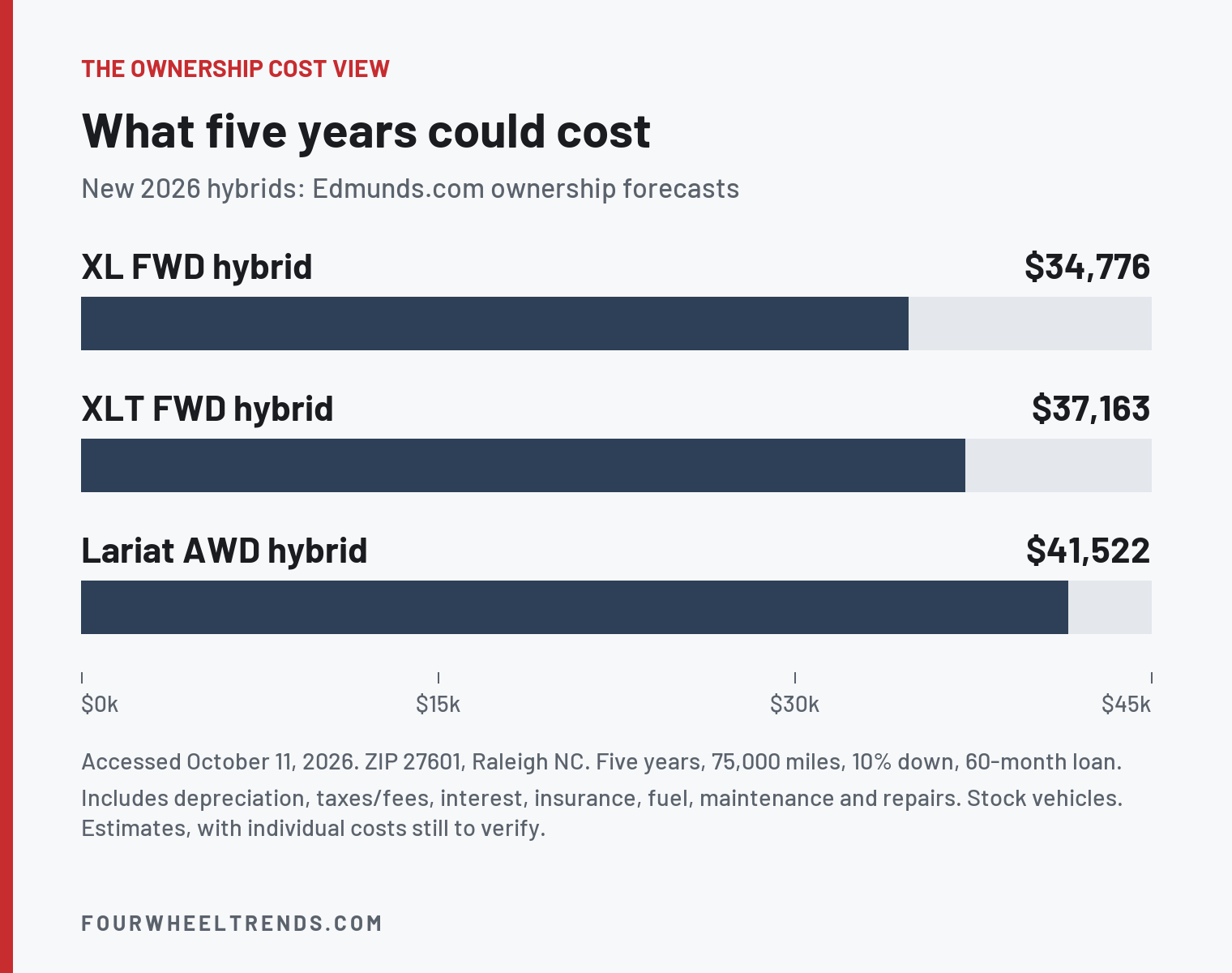
*Includes modeled initial taxes and fees of $987, $1,127 and $1,257, respectively. **Cash estimate less those initial taxes/fees and five-year depreciation of $10,943, $12,215 and $15,282. Resale assumes a clean-condition private sale before separate selling expenses. Ownership cost includes depreciation, taxes/fees, interest, insurance, fuel, maintenance and repairs. Stock vehicles, with no aftermarket upgrades. These forecasts are not purchase quotes.
The XLT’s vehicle price is $4,677 higher than the XL’s. Its other modeled costs add $1,115, and its estimated resale returns an additional $3,405. The arithmetic is $4,677 + $1,115 − $3,405 = $2,387 more to own the XLT over five years. It would need a $5,792 resale advantage to break even. Its equipment has to be worth the remaining cost to Dad.
The Lariat adds $4,359 over the XLT in modeled ownership cost. That pair also changes from FWD to AWD. Its higher projected resale does not cover all of the upgrade’s costs.
The Edmunds method assumes 15,000 miles annually, 10% down and a 60-month loan for above-average credit. The displayed estimates do not specify an APR. Insurance and repairs are modeled allowances. For a three-year hold, obtain a separate resale estimate. For eight years, reassess repairs and remaining coverage. The five-year table cannot settle either decision, and its total is separate from the monthly loan payment.
This article provides general educational information, not personalized financial advice. I do not know your financial situation, goals, or obligations. Ownership and resale estimates are not guarantees.
Should we try a Honda Ridgeline too?
Yes, if the Maverick feels cramped or Dad wants more truck capability. My gut feeling is that both appeal to people who want a useful pickup for everyday life. The dimensions and economy give us a concrete difference to test.
Honda lists the 2026 Ridgeline at 210.2 inches long, with AWD and 5,000-pound towing. Its combined EPA estimate is 21 mpg for most trims and 20 mpg for TrailSport. The ordinary 2025 Maverick measures 199.8 inches long, and its hybrid offers substantially better rated economy. This is a cross-shop comparison of those specific model years, with room and comfort still to be judged in person.
I would favor the Maverick when economy and a smaller footprint lead the decision. I would try the Ridgeline when space or towing makes the Maverick a compromise. If they barely use a bed, a compact SUV deserves a look too.
What should we check during the dealer visit?
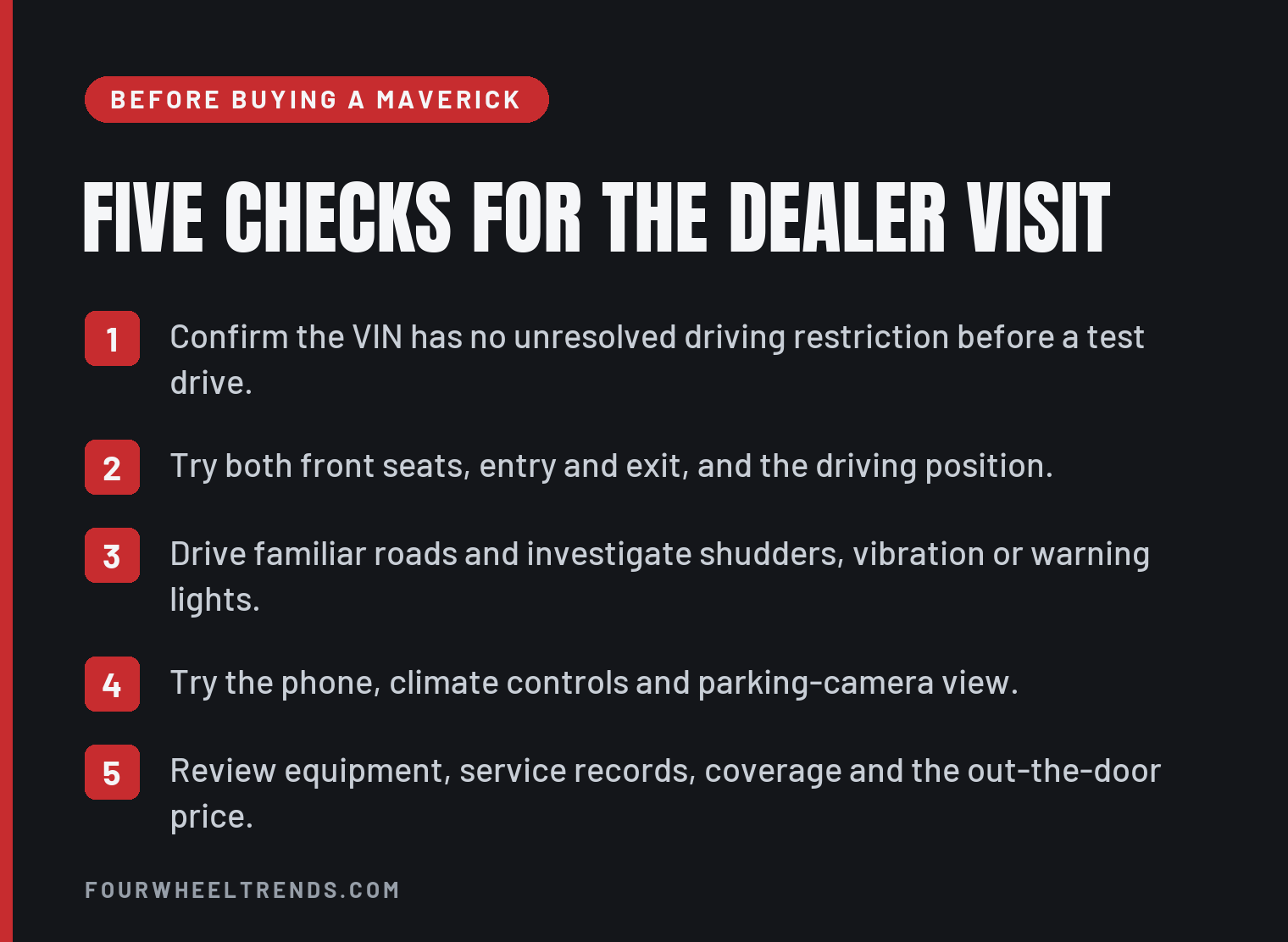
Before driving, have the dealer run the VIN for current recalls and driving restrictions. Ford’s 26S36 recall affects certain Mavericks across 2022 through 2026 and calls for owners of affected vehicles to stop driving until the front suspension joint inspection and any necessary repair are completed. Confirm this particular truck’s status before a demonstration.
Seat fit and access are high on our list. Dad is 5 feet 10 inches tall, so I want him to check legroom, pedal reach and his preferred driving position. Mom has had both hips replaced. Having to step up and down was one reason they passed on the F-150 he considered.
I expect the Maverick to be easier for them to enter and exit than my F-150 or his Sequoia. Trying both front seats will be one of our first priorities at the dealer. Mom’s comfort getting out matters just as much as Dad’s comfort driving it.
- Try both front seats. Check entry and exit as they feel comfortable doing so, with the seat adjusted to a position each can actually use.
- Set Dad’s driving position. Check legroom, pedal reach, steering-wheel reach, visibility and how easy it is to get out afterward.
- Give the seats a real drive. Include their usual roads and enough time to notice pressure points, ride quality and noise.
- Try low-speed braking and acceleration. Investigate shudders, vibration or warning lights before buying.
- Use their phone and the controls. Try navigation, a call, climate adjustments and parking-camera visibility.
- Read the paperwork together. Confirm engine, drivetrain, tow equipment, service history, remaining coverage and the final price. Get an independent inspection for a used truck.
My advice to Dad is to keep the Maverick on the list. Compare a new 2026 hybrid and a well-priced used 2025, with a 2027 order as an option if he can wait. A 2024 needs convincing savings, and an early hybrid needs convincing records and inspection. Then bring Mom. A truck they both enjoy getting into is worth far more to this decision than a trim badge.
Sources
- Bowen Scarff Ford: 2027 ordering status and expected local delivery timing, updated September 25, 2026
- Ford: 2026 U.S. warranty guide, coverage and warranty start date and 2025 U.S. warranty guide, including subsequent-owner coverage
- Ford: 2025 Maverick equipment changes, July 31, 2024
- Ford: 2025 Maverick technical specifications, dimensions, economy and towing
- Ford: 2024 standard EcoBoost and optional FWD hybrid, February 27, 2024
- Ford: current 2026 Maverick model and equipment
- Ford/NHTSA: early hybrid engine recall 23V380, certain 2022 and 2023 Mavericks and Ford: related engine coverage program 23N06, June 2024
- Ford: 2022 Maverick halfshaft program 25N09, September 2025
- Ford: follow-up software recall 25S16, certain 2022 through 2024 Mavericks, April 2025
- Ford/NHTSA: integrated park-module recall 25C69, certain 2025 and 2026 hybrids, revised February 2026
- Ford/NHTSA: suspension inspection recall 26S36 and do-not-drive instruction, May 2026
- NHTSA: check a vehicle’s VIN for open safety recalls
- Outdoors With The Morgans: New SMALL Truck Brings BIG Smiles For Hunter and Why is Ford Doing This? Doesn’t Make Sense
- MaverickTruckClub: individual 2023 hybrid review and contrasting 2022 owner reply, April 2025
- Car and Driver: 2024 XLT Hybrid 40,000-mile test, April 22, 2026
- Honda: 2026 Ridgeline specifications and fuel-economy ratings
- Edmunds.com True Cost to Own®: new 2026 Maverick trim forecasts and calculation methodology