
Jeep Gladiator Best and Worst Years: The Smart Shortlist
When I shopped for a modern Jeep, I went in wanting a manual. The price and the way it felt pushed me toward considering an automatic, which hurt my soul as a die-hard manual Jeep guy. A Gladiator buyer can face the same tug between the Jeep that feels special and the truck that makes the most sense to own.
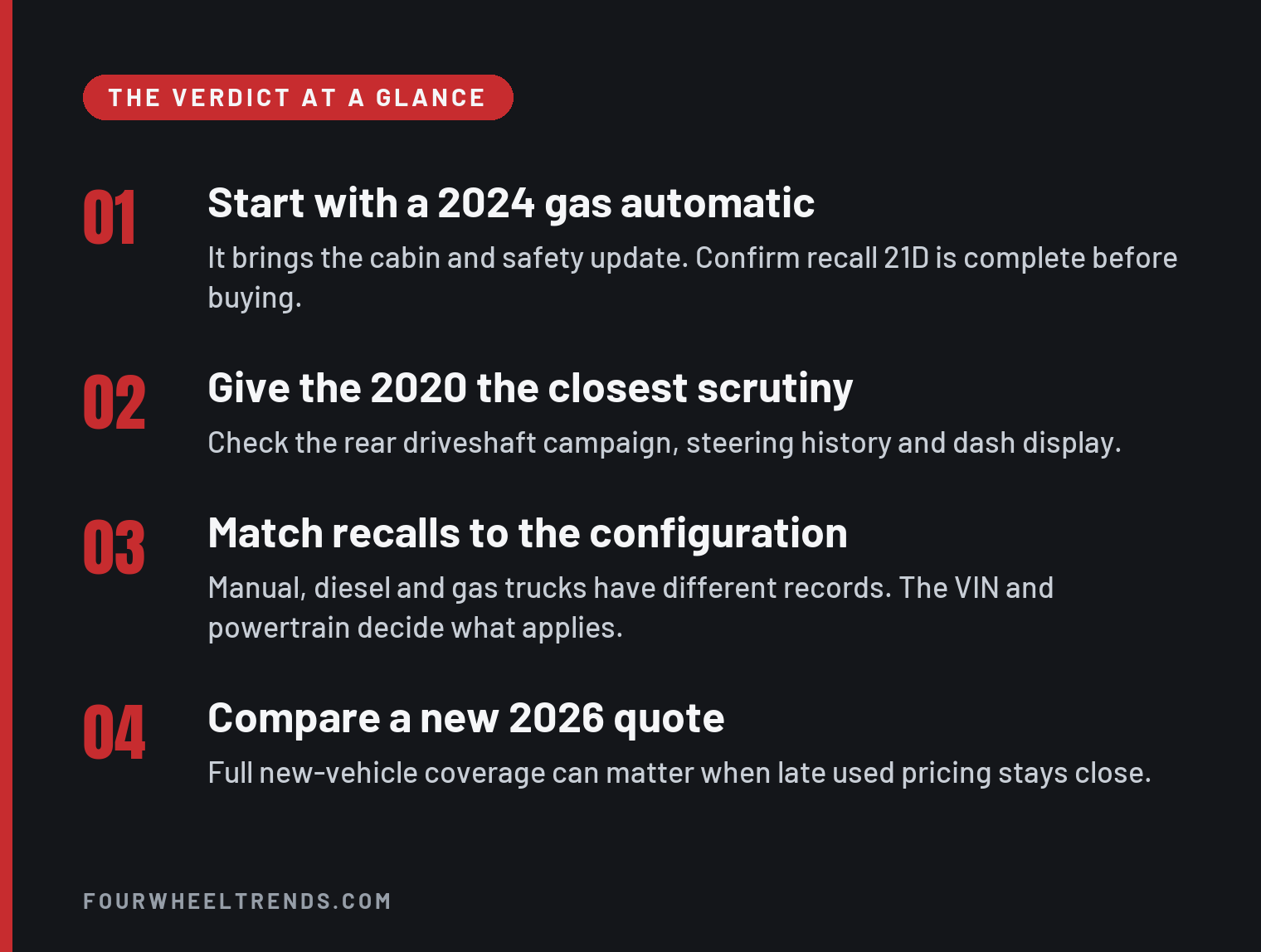
For most used buyers, I would start with a 2024 Gladiator with the 3.6-liter gas V-6 and eight-speed automatic. I would give the 2020 the closest scrutiny. A new 2026 also deserves a real price comparison. The 2024 received the major cabin and safety update. The 2020 combines first-year concerns with a specific steering bulletin, a rear-driveshaft recall and an open federal investigation into instrument-cluster failures.
That answer comes with one important warning. A broad 2026 fire-risk recall covers certain 2021 through 2025 Gladiators, and Jeep says affected owners should park away from buildings and other vehicles until the free remedy is completed. A year badge cannot replace a VIN check, repair invoices and a careful inspection.
Which Jeep Gladiator years would I buy or approach carefully?
| Model year | My view | What decides it |
|---|---|---|
| 2020 | Most cautious year | First model year. Check the rear-driveshaft recall, steering-gear history, manual-clutch campaign, cluster recall and investigation. |
| 2021 | Configuration matters | Gas or first-year EcoDiesel. The diesel fuel-pump recalls, manual-clutch campaign and current power-steering recall may apply. |
| 2022 | Configuration matters | Similar gas, diesel and manual checks to 2021. Price, repair history and current VIN status have to carry the case. |
| 2023 | Good pre-refresh candidate in the right setup | Final EcoDiesel year. Manuals fall within the clutch recall, and certain diesels fall within a fuel-pump recall. All powertrains need a current VIN check. |
| 2024 | My preferred used starting point | Gas-only lineup, standard side-curtain airbags and 12.3-inch screen. Confirm the power-steering recall is complete. |
| 2025 | Strong newer choice when priced well | Automatic only and the refreshed cabin. Certain trucks remain within the power-steering recall population. |
| 2026 | Best new starting point | Current gas and automatic lineup with full new-vehicle coverage. Long-term evidence is still limited. |
This is a shopping order. It cannot promise that every 2024 is good or every 2020 is bad. A stock 2020 with complete repairs and careful maintenance can be a better purchase than a damaged or poorly modified 2024. The individual truck still has to earn your money.
Why does the 2024 lead my used shortlist?
The 2024 refresh brought changes you can use every day. Jeep made first- and second-row side-curtain airbags standard, added a standard 12.3-inch Uconnect 5 screen, and offered power front seats on some configurations. The U.S. lineup used the 3.6-liter Pentastar V-6. A six-speed manual was standard and an eight-speed automatic was optional. The diesel was gone.
That makes a 2024 gas automatic the simplest used recommendation for a broad audience. It has the refreshed cabin, avoids the recalled 2020 through 2023 manual-clutch population, and avoids the 2021 through 2023 EcoDiesel fuel-pump recalls. Those boundaries come from the applicable records. They do not establish a blanket reliability win.
The 2024 Gladiator introduction and U.S. feature guide support those equipment and powertrain changes.
Recall 21D still matters. Jeep’s current notice says certain 2021 through 2025 Gladiators can have an electrical connection problem at the electric-hydraulic power-steering pump. The connection may overheat and create a fire risk, including while parked. The remedy is available. Certain 2024 trucks with a 3.5-inch instrument cluster also fall within recall 30B. I would require proof that every applicable campaign has been completed before bringing one home.
Why is the 2020 the Gladiator year I would scrutinize most?
The 2020 was the launch year for the modern Gladiator, and its record gives a buyer several specific things to investigate.
- Rear driveshaft. Recall 19V-636 covered certain 2020 trucks whose rear driveshaft monoblock joint may have been assembled without grease. The dealer remedy replaces the rear driveshaft.
- Steering feel. Stellantis bulletin 08-074-20 Rev. C applies to the 2020 Gladiator when a customer describes wander, pulling or excess play. The procedure replaces the steering gear and updates its software. A service bulletin is manufacturer repair guidance. It is not a safety recall and does not prove every truck has the condition.
- Instrument cluster. Recall 24V-652, also called 30B, covers certain 2020 through 2024 Gladiators with a 3.5-inch cluster that may go blank. The remedy replaces the cluster. NHTSA separately opened Preliminary Evaluation PE25014 in October 2025 after complaints alleging partial or complete display loss in 2020 Gladiators and Wranglers. An investigation evaluates a possible defect. It does not establish that every vehicle is defective.
- Manual clutch. Certain 2020 through 2023 manual Gladiators are covered by recall 23V-116. Dealers replace the clutch assembly and update the software. Confirm by VIN that the repair was completed.
None of those records gives us a failure probability for the 2020 Gladiator. They do give us a better test drive and paperwork list. I would drive it on the highway, pay attention to steering corrections, verify every gauge and warning light, and match the VIN to completed campaign records.
Should you avoid every 2021 through 2023 Gladiator?
No. These years need to be separated by engine and transmission.
A 3.6-liter gas automatic avoids the EcoDiesel high-pressure fuel-pump recalls and the manual-clutch recall because none of them applies to that configuration. It may still fall within recall 21D for the power-steering-pump electrical connection. A clean 2023 gas automatic can be a good value when the lower price compensates for missing the 2024 cabin and airbag update.
A 2021 through 2023 EcoDiesel needs additional documentation. Recall 22V-767 covers certain 2021 and 2022 diesel Gladiators after the high-pressure fuel pump was found capable of failing prematurely. The filing says fuel starvation may cause an unexpected loss of power. A second campaign, recall 23V-263, covers certain diesel Gladiators built from October 2021 through May 2023 with a high-pressure fuel pump that could fail prematurely. Both remedies replace the pump and inspect the rest of the fuel system, replacing other components when necessary.
Jeep introduced the EcoDiesel for 2021 and ended Gladiator EcoDiesel production after 2023. Recall 21D and ordinary used-diesel inspection apply to every diesel year. The extra torque can be appealing. I would buy one only when I specifically wanted the diesel, had complete service records and had a qualified shop inspect the fuel and emissions systems.
A 2020 through 2023 manual needs a VIN check and proof of recall 23V-116 completion. Stellantis’ repair procedure, revised in July 2024, lists the remedy as available for 2020 through 2023 Gladiators and specifies a new clutch assembly plus software updates. Ask the seller for the repair order and have a Jeep dealer confirm the campaign shows as closed for that VIN. I would also test clutch engagement, listen for abnormal noise and read any repair invoice. The 2024 manual falls outside the recall’s stated model-year scope and is the newer choice for someone committed to three pedals.
What does the 2026 power-steering recall change?
It changes the buying process for every affected 2021 through 2025 Gladiator. NHTSA recall 26V-363 covers certain Wrangler and Gladiator vehicles because the power-steering-pump electrical connection can overheat. The broader filing covers 1,076,999 U.S. vehicles across both nameplates and powertrains. That total is the recall population and does not represent a count of failed Gladiators.
Jeep’s current recall FAQ says the remedy is available. Dealers inspect the connection and replace wiring and the pump as needed. Jeep continues to advise affected owners to park away from structures and other vehicles until the remedy has been completed.
Before a test drive, run the VIN through the NHTSA recall lookup and Jeep’s system. Ask the seller for the final repair order. A screenshot saying an appointment was scheduled is not proof that the campaign was closed on that truck.
Is a new 2026 Gladiator worth comparing?
Yes, especially when a late used truck carries a high asking price. Jeep’s current U.S. site presents the 2026 as the buildable lineup and lets shoppers search inventory. The lineup uses a 3.6-liter V-6 and eight-speed automatic. Jeep lists the Sport at $39,820 plus a $1,995 destination charge before options, taxes and registration.
The new truck gives you an unused vehicle, a known maintenance starting point and the full factory-warranty term. A used Gladiator carries whatever coverage remains. Jeep says its new-vehicle limited warranty stays with the vehicle and can transfer to a second owner, subject to the applicable terms and restrictions. Ask for the original in-service date because buying used does not restart the clock.
The 2026 sits outside recall 21D’s stated 2021 through 2025 model-year scope. It has campaigns of its own, including a rearview-camera software update that Jeep lists for certain 2026 Gladiators, so run the VIN on a new truck too. Its short time on the road also prevents a confident long-term reliability verdict.
Jeep’s current page also shows a 2027 Gladiator Sarge as a preproduction limited edition. The page still describes the full 2026 lineup as the current build-and-inventory choice. I would shop the available 2026 and treat any 2027 as an order decision after the dealer supplies final equipment, price and delivery details in writing.
How much should retained value affect the decision?
Resale helps, but the purchase price is where you can protect yourself today. The current iSeeCars model-level study estimates 34.8% five-year depreciation for a new Gladiator and a $25,619 resale value. Its midsize-pickup benchmark is 30.2% depreciation. That is historical model-level analysis across vehicles. It cannot forecast the result for your trim, modifications, mileage or selling channel.
The useful lesson is simple. Do not assume the Gladiator automatically holds value like every other Jeep people admire. Compare a new 2026 quote with used asking prices for the same trim and useful options. Include sales tax, fees, APR, total interest, insurance, immediate tires or service, remaining warranty and an independent inspection. A heavily discounted new truck can compete with a lightly used one. A well-priced used 2024 can let the first owner absorb more of the early depreciation.
Modifications deserve their own line in the budget. In my Jeep circle, few Sport S owners leave them untouched. Building a Jeep can be half the fun, but buyers may want different parts or question the installation. I would not count on recovering the cost of a lift, wheels, tires, bumpers or lighting at resale. Compare the cost of the truck you actually plan to build with a stock Willys, Mojave or Rubicon that already has the factory equipment you need.
This article provides general educational information, not personalized financial advice. I do not know your financial situation, goals, or obligations. Ownership and resale estimates are not guarantees.
What should you buy if the Gladiator’s compromises do not fit?
A Wrangler deserves a look when the pickup bed is optional. You keep the open-air Jeep experience in a shorter vehicle and avoid paying for a bed you rarely use.
A Ford Ranger, Chevrolet Colorado or Toyota Tacoma makes more sense when the bed and everyday truck duties lead the decision. Drive them on the same highway loop. Compare seat comfort, steering, noise, payload sticker, tow equipment and the out-the-door price. The Gladiator earns its place when removable body panels, solid axles and Jeep trail hardware matter enough to accept its road manners and cost.
I would also be honest about the trim. A gas Sport S can be the smart foundation for ordinary use. A Willys adds useful factory trail equipment. A Mojave or Rubicon should solve a real terrain problem or deliver enjoyment you knowingly choose to pay for. The badge alone cannot create financial value.
What belongs on the Gladiator inspection checklist?
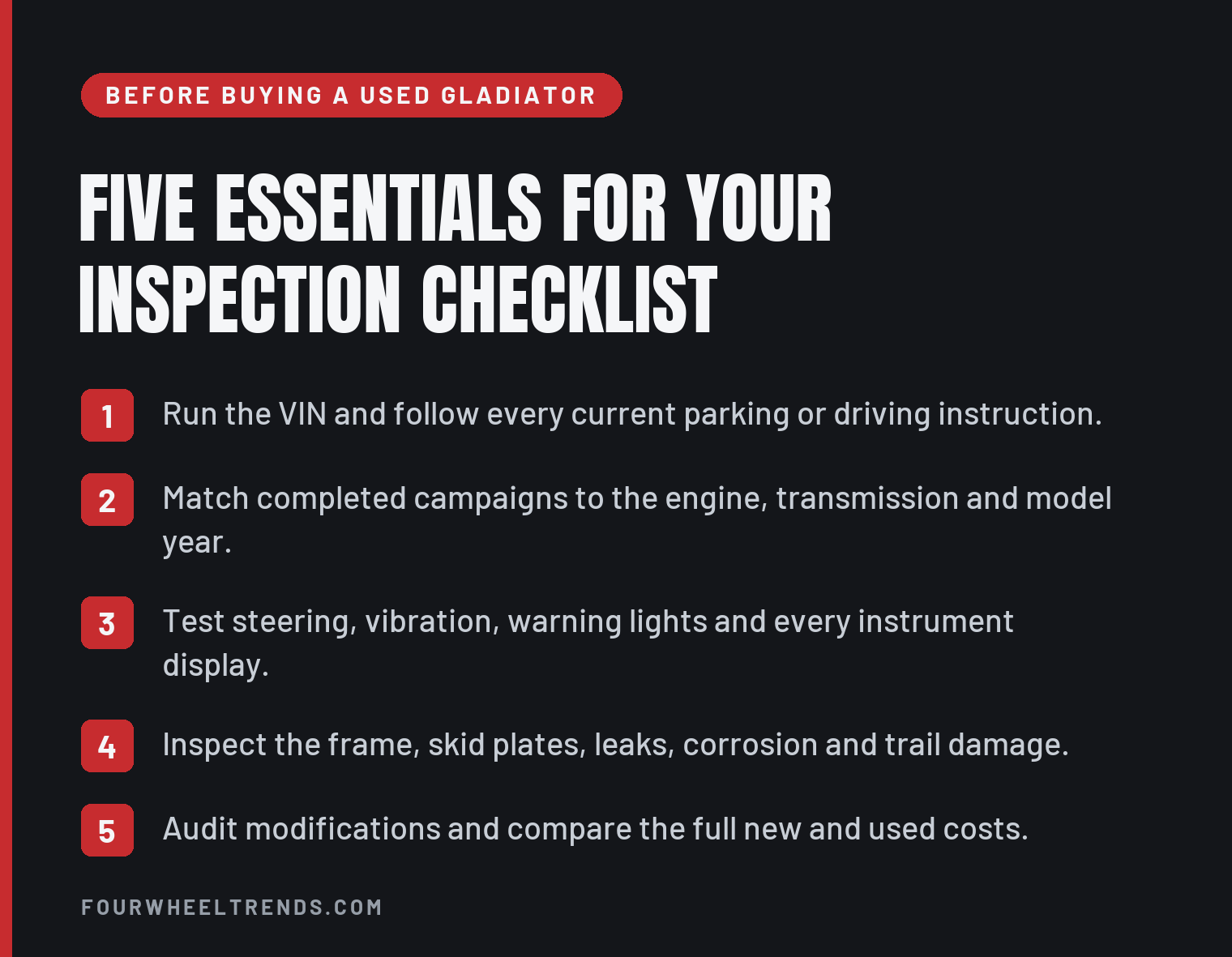
- Run the VIN before driving. Check NHTSA and Jeep for open recalls, then follow any parking or driving instruction that applies.
- Match the paperwork to the configuration. Look for 21D on affected 2021 through 2025 trucks, 19A on affected 2020 through 2023 manuals, Z96 or 01A on affected 2021 through 2023 diesels, and V95 on affected 2020 trucks.
- Drive it at city and highway speeds. Check steering corrections, vibration, clutch engagement, transmission behavior, warning lights and every instrument display.
- Inspect the Jeep underneath. Look for trail damage, leaks, corrosion, bent brackets, damaged skid plates and evidence of rushed repairs. Confirm axle, gearing, tire and tow-package details from the build sheet and labels.
- Audit every modification. Ask who installed it, get receipts, check alignment and tire clearance, and price any work needed to return the truck to a safe setup.
- Compare the whole deal. Put new and used quotes on the same page with warranty remaining, APR, insurance, immediate service and the equipment you would otherwise add.
My shortlist starts with a 2024 gas automatic, then a 2023 gas automatic when the price is clearly better. I would compare both with a new 2026. The 2020 stays at the bottom of the list until its records, condition and price make a strong case. A diesel or manual can move up the list for the buyer who specifically wants it and verifies the applicable repairs.
The Gladiator is one of those vehicles people buy with their heart. I understand that. The smart move is letting the heart choose the kind of Jeep, then making the VIN, inspection and numbers approve the particular truck.
Sources
- Jeep: current 2026 Gladiator lineup, pricing, inventory tools and preproduction 2027 Sarge notice
- Jeep: 2026 Gladiator Sport specifications, engine, transmission, MSRP and destination charge
- Stellantis: 2024 Gladiator refresh, September 13, 2023
- Stellantis: 2024 U.S. Gladiator feature availability and powertrains
- Stellantis: 2025 Gladiator automatic transmission and standard-equipment changes, September 18, 2024
- FCA US and NHTSA: power-steering-pump wiring recall 26V-363, certain 2021 through 2025 Gladiators
- Mopar: current recall 21D remedy and park-away guidance, plus rearview-camera recall 78D for certain 2026 models
- FCA US and NHTSA: 2020 Gladiator rear-driveshaft recall 19V-636
- FCA US: 2020 Gladiator improved-steering-feel service bulletin 08-074-20 Rev. C
- NHTSA: Preliminary Evaluation PE25014 for 2020 Gladiator and Wrangler instrument clusters, opened October 23, 2025
- FCA US and NHTSA: instrument-cluster recall 24V-652, certain 2020 through 2024 Gladiators with a 3.5-inch cluster
- FCA US and NHTSA: manual-clutch recall 23V-116 repair instructions, July 2024 revision, remedy available for 2020 through 2023 Gladiators
- FCA US and NHTSA: EcoDiesel high-pressure fuel-pump recall 22V-767, certain 2021 and 2022 Gladiators
- FCA US and NHTSA: second EcoDiesel high-pressure fuel-pump recall 23V-263, certain 2021 through 2023 Gladiators
- Stellantis: end of U.S. Gladiator EcoDiesel production after 2023
- Jeep: current limited-warranty overview and transfer guidance
- iSeeCars: current model-level Gladiator depreciation analysis and methodology link
- NHTSA: VIN recall lookup and recall-information guidance