
Will Hyundai Replace Your Engine? Check Coverage Before Paying
Hyundai may replace your engine at no charge if the diagnosed failure qualifies under a recall, your factory warranty, or an engine warranty extension. Your model name alone cannot establish eligibility. Start with your VIN, exact engine, and the dealer’s diagnosis before authorizing an expensive repair.
The phrase “lifetime engine warranty” sounds reassuring when your car is sitting at the shop. But the major Hyundai programs cover particular failures on particular vehicles. A car can qualify for extended bearing coverage without having every possible engine problem covered.
My advice is to get the coverage decision in writing before shopping for a replacement engine. You need to know what Hyundai will pay, what you would owe, and how you will get around while the car is apart. This guide covers U.S. Hyundai vehicles and the major programs owners should ask about.
How do you check whether Hyundai will replace your engine?
Use Hyundai’s engine information and VIN lookup to review the vehicle’s open and completed recalls and software campaigns. Then ask an authorized Hyundai dealer to check all applicable engine warranty extensions as well as ordinary warranty coverage.
Keep the two checks separate. A recall lookup identifies campaigns for the vehicle. The dealer still needs to establish why the engine failed and which coverage applies to that repair. Hyundai’s TXXI dealer guidance specifically requires inspection and verification before a coverage decision.
Give the service advisor your VIN, current odometer reading, ownership history, and a description of the symptoms. Ask the advisor directly, “Which engine warranty extension applies to this VIN, and has the required software update been completed?”
That question is especially useful if you bought used or have passed 100,000 miles. Being outside the ordinary powertrain warranty does not settle whether a separate engine extension applies.
Which Hyundai engines have extended coverage?
These are important starting points for a VIN check. Every entry refers to certain vehicles with the specified engine, so some examples of a listed model fall outside it. The tables describe programs. A diagnosis and an approval still have to come from the dealer and Hyundai.
Limited lifetime coverage for certain Theta II GDI engines
Hyundai’s TXXI technical bulletin identifies limited lifetime coverage for engine long block repair or replacement related to connecting rod bearing wear, for original and subsequent owners. Its vehicle list distinguishes the Santa Fe Sport from the later Santa Fe.
| Hyundai model | Model years | Specified engine |
|---|---|---|
| Sonata | 2011 to 2019 | Theta II 2.0L turbo GDI or 2.4L GDI |
| Santa Fe Sport | 2013 to 2018 | Theta II 2.0L turbo GDI or 2.4L GDI |
| Santa Fe | 2019 | Theta II 2.0L turbo GDI or 2.4L GDI |
| Tucson | 2014 to 2015 and 2018 to 2019 | Theta II 2.4L GDI |
The official Theta settlement website describes lifetime protection for specified engine components against bearing wear or damage, subject to conditions including the knock sensor software update and an exceptional-neglect exclusion. “Lifetime” describes the duration of qualifying coverage. It does not promise a new engine for every mechanical failure.
15-year/150,000-mile coverage under TXXM
A separate program, TXXM, covers qualifying engine damage from connecting rod bearing wear. Its limit is 15 years or 150,000 miles, whichever comes first, measured from original retail delivery or first use. The listed engines include MPI and GDI designs.
| Hyundai model | Model years | Specified engine |
|---|---|---|
| Santa Fe | 2010 to 2012 | Theta II 2.4L MPI |
| Tucson | 2010 to 2013 | Theta II 2.4L MPI |
| Tucson | 2014 to 2021 | Nu 2.0L GDI |
| Sonata Hybrid | 2011 to 2015 | Theta II 2.4L MPI Atkinson (hybrid) |
| Sonata Hybrid and Plug-In Hybrid | 2016 to 2019 | Nu 2.0L GDI Hybrid |
| Veloster | 2012 to 2017 | Gamma 1.6L GDI |
| Elantra Coupe | 2014 | Nu 2.0L GDI |
| Elantra | 2014 to 2016 | Nu 2.0L GDI |
| Elantra GT | 2014 to 2020 | Nu 2.0L GDI |
The Engine II settlement website also describes this extended coverage. It generally requires the KSDS update before a covered failure, with exceptions for vehicles subject to Hyundai recalls 198 and 209. Qualifying coverage can continue after a sale for personal use. Hyundai excludes salvaged vehicles and specified commercial owners from TXXM.
Notice the two Tucson entries across the programs. A 2014 Tucson with a 2.4L engine and one with a 2.0L engine require different coverage checks. A model-year list without the engine column leaves out the detail you need most.
Separate coverage for certain Santa Fe 3.3L V6 engines
The four-cylinder lists do not cover every Hyundai engine extension. Hyundai’s TXX8 program applies to certain 2013 to 2019 Santa Fe and Santa Fe XL vehicles with the 3.3L Lambda II GDI engine. It provides 15-year/150,000-mile coverage for eligible conditions, determined by engine inspection, for original and subsequent owners.
If you have that V6, ask about TXX8 specifically. A service conversation focused only on Theta II four-cylinder coverage can miss the relevant program.
If your vehicle is absent from these tables, have the dealer check its VIN anyway. These are the major programs to investigate. Other recalls, warranty extensions, and service contracts can also apply.
What is KSDS, and why does completion matter?
KSDS stands for Knock Sensor Detection System. Hyundai uses it to monitor vibration patterns associated with abnormal bearing wear. When it detects those patterns, it can trigger a blinking malfunction indicator and reduced-power engine protection mode.
It is a monitoring update. Having the software installed does not mean the engine has been replaced. Hyundai says the update is free for applicable vehicles through an authorized dealer.
Check the completion record itself. A used-car listing that says “all recalls done” is a claim you can verify. Hyundai’s engine information page directs owners to look for completed campaigns 953 or 966. Its TXXM information also identifies campaign 982 for certain vehicles.
For an applicable car that still runs, arrange the outstanding update promptly. If the engine has already failed and the update was missed, ask for a documented coverage review. The Engine II settlement’s before-failure requirement means you should not assume installing software afterward fixes eligibility. The TXXM bulletin instructs dealers to submit applicable symptomatic vehicles for prior approval regardless of KSDS completion, so the actual case still deserves review.
Should you keep driving a Hyundai with engine warnings?
If the engine oil pressure warning appears while driving, move to the nearest safe location and turn the engine off. Hyundai’s U.S. warning-light guidance warns that severe damage may result if the engine is not stopped immediately. If the light remains on after adding oil, or oil is unavailable, do not drive the vehicle.
Hyundai also lists increasing engine knock, reduced power, hesitation, vibration, and warning lights among the symptoms associated with its bearing-related engine recalls. Continued operation with a worn bearing can lead to failure, stalling, and in some cases fire.
With loud knocking, a flashing warning, or sudden loss of power, my recommendation is to get safely off the road and arrange professional help. Nursing it to the dealership keeps a damaged engine running. A steady check-engine light can have other causes. Hyundai recommends inspection, and the vehicle’s own manual should guide your response.
Do not drive a troubled engine until it fails in the hope that a replacement will then qualify. You need a diagnosis and a safe transportation plan.
What should you bring to the dealer appointment?
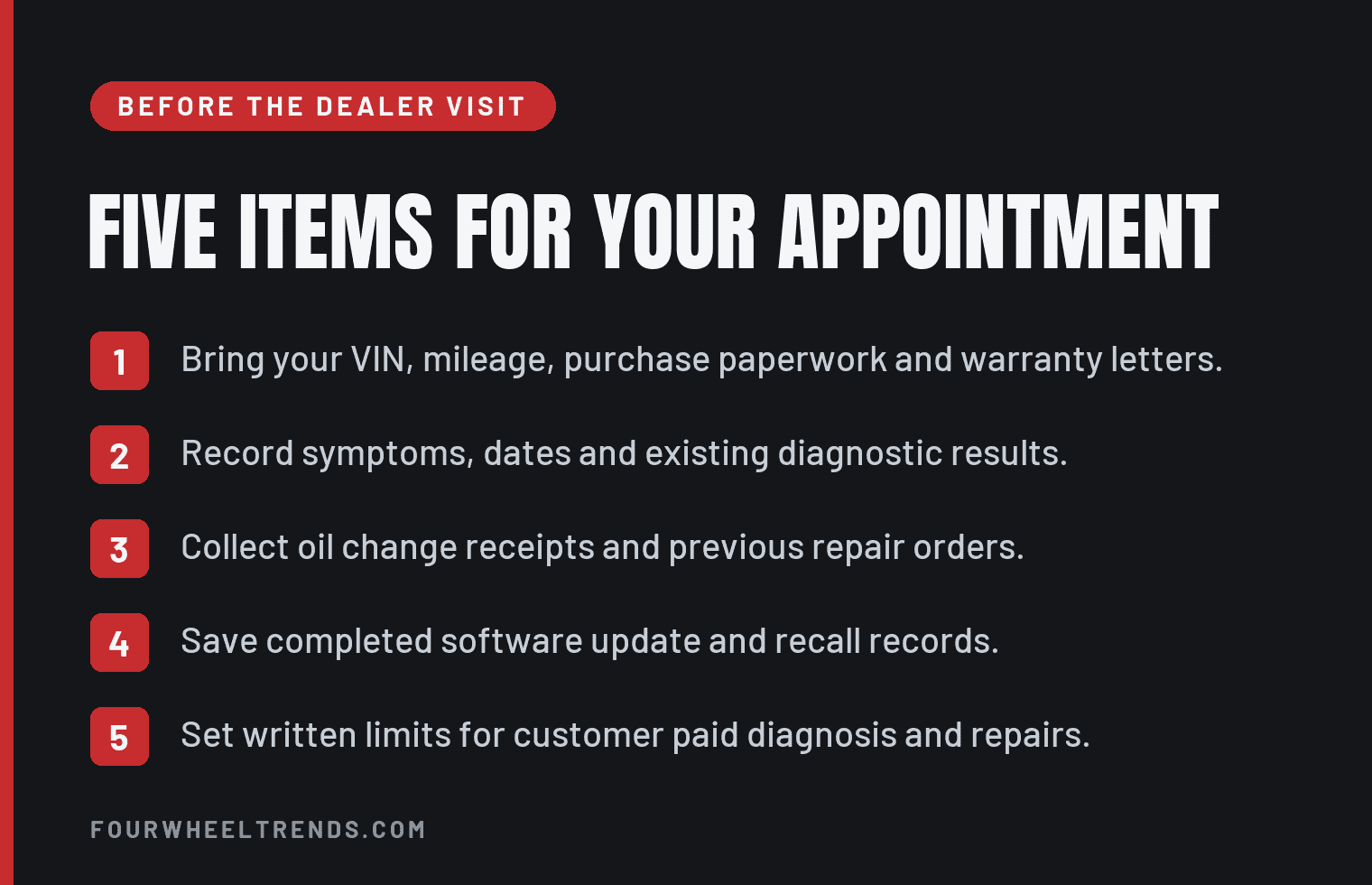
Build a small claim file. A folder on your phone is fine, provided you can share copies and keep the originals.
- VIN and mileage. Include purchase paperwork and any warranty-extension letter.
- Symptoms and dates. Record when knocking, warning lights, oil use, or loss of power began. Save existing photos, videos, and diagnostic reports.
- Service records. Collect oil-change invoices, receipts, and previous repair orders. Ask former shops for copies if your records have gaps.
- Campaign history. Save evidence of completed KSDS updates and engine recalls.
- Written authorization limits. Ask what diagnosis costs if coverage is denied, and require your approval before customer-paid teardown or repairs.
Hyundai encourages owners to retain maintenance records. A missing receipt should prompt a request for the program’s actual documentation requirements. Avoid assuming either that one missing invoice automatically defeats a claim or that maintenance history cannot matter.
At check-in, ask when the shop expects to diagnose the problem, whether Hyundai prior approval is required, and who will update you. Leave with a repair-order number and a named contact. “We’ll call you” is harder to follow up on when you have neither.
Does oil consumption qualify for a free replacement?
Oil consumption by itself does not establish a covered connecting rod bearing failure. The bearing programs described above have a specific scope, so the dealer’s diagnosis matters.
If the car is using oil, report the amount, mileage, and dates, and follow the model’s oil-level and maintenance instructions. Ask what testing is proposed, who pays for it, and which warranty or extension could cover the diagnosed condition. Do not treat an oil-consumption test as an engine-replacement approval.
Ordinary factory coverage may also matter. Hyundai’s U.S. warranty summary lists 10-year/100,000-mile powertrain protection for original owners of 2004 and newer vehicles under its conditions. Subsequent owners generally receive powertrain protection within the 5-year/60,000-mile New Vehicle Limited Warranty. Check the applicable handbook and any separate certified-used coverage or service contract.
A second owner should therefore have both ordinary coverage and the engine extensions checked. They have different eligibility rules.
How long does replacement take, and will you get a rental?
Get an estimate for your repair from the dealer. The TXXI guidance says the wait varies with inspection results, and a failed inspection requiring replacement means a longer wait. A national promise of three days or six weeks cannot tell you when your car will be ready.
Ask for a date on each of three milestones, which are diagnosis, coverage approval, and parts arrival. Then ask when installation can begin. An approved claim with no engine available is a different situation from a car already in a technician’s bay.
Our readers have described very different waits. In a November 17, 2023 comment, Sally Burch reported that her 2013 Santa Fe Sport sat for three months before inspection. She said Hyundai eventually approved an engine after requesting service records and photos, but she had not been offered a loaner or rental. On December 6, 2025, Donald Siler reported a two-week replacement over Thanksgiving for his 2013 vehicle, without identifying the model.
These are readers’ own accounts from the comments below. Nobody has independently verified them as repair records, and two reports are too few to show what is typical. They illustrate why I would ask separately about diagnosis, approval, installation, and getting to work while the car is at the shop.
Transportation deserves its own conversation. Hyundai’s July 2025 TXX8 guidance recommends a service rental when the vehicle must stay overnight, with other options if one is unavailable. Other programs have their own terms.
Before booking a rental yourself, confirm the approved arrangement, daily limit, covered dates, taxes and fees, and reimbursement paperwork. Keep towing and transportation receipts. Both official settlement sites identify repair-related benefits, but those benefits have claim rules and deadlines separate from the engine warranty. Ask about your particular expense and repair date before counting on reimbursement.
Can a covered replacement still come with a service estimate?
Reader Buyer31 reported in a December 2, 2023 comment that the dealer said Hyundai would replace the engine in a 2013 Sonata for free, and also handed over about $1,000 in recommended services. That comment does not establish whether the extra work was necessary. Ask the advisor to separate covered repair work, required customer-paid work, and optional maintenance on the estimate, with an explanation for each item.
What if Hyundai denies the engine replacement?
Request the diagnosis, test results, applicable program, and exact denial reason in writing. Hyundai’s TXXI dealer guidance calls for a specific explanation and proof of the failure or test results. A useful denial explains which condition or term was not met.
Then ask whether the claim was submitted to Hyundai for prior approval and whether any other engine coverage was checked. The TXXM and TXX8 documents call for prior-approval review of applicable symptomatic vehicles.
With that paperwork, contact Hyundai’s Customer Care Center at 855-671-3059 for engine recall and campaign concerns. Request a case number, send copies of the records, and ask what information would change the decision. For a settlement-related dispute, use the official settlement resources to establish the applicable review process.
An independent diagnosis can help you understand a disputed finding, but discuss evidence preservation before someone dismantles or disposes of the engine. Keep a written record of what is authorized and what parts or documentation will be retained.
What should you do before paying for an engine?
If coverage is unavailable after review, compare written quotes for the exact vehicle. Ask whether each engine is used, remanufactured, or new, what components are included, and what parts-and-labor warranty you get. Include diagnosis, installation, fluids, required additional parts, tax, and transportation in the comparison.
I would avoid choosing an engine from the advertised parts price alone. A cheaper assembly with a narrow warranty can be a very different proposition from an installed repair with clearly defined coverage.
Also have the rest of the car assessed before committing. An engine repair deserves a different decision when the transmission, body, and other major systems are healthy than when several expensive problems remain. Compare the repair and expected remaining needs with the full cost of a replacement vehicle, using actual quotes and offers.
This article provides general educational information. It is not personalized financial advice, and I do not know your financial situation, goals, or obligations. Ownership and resale estimates are not guarantees.
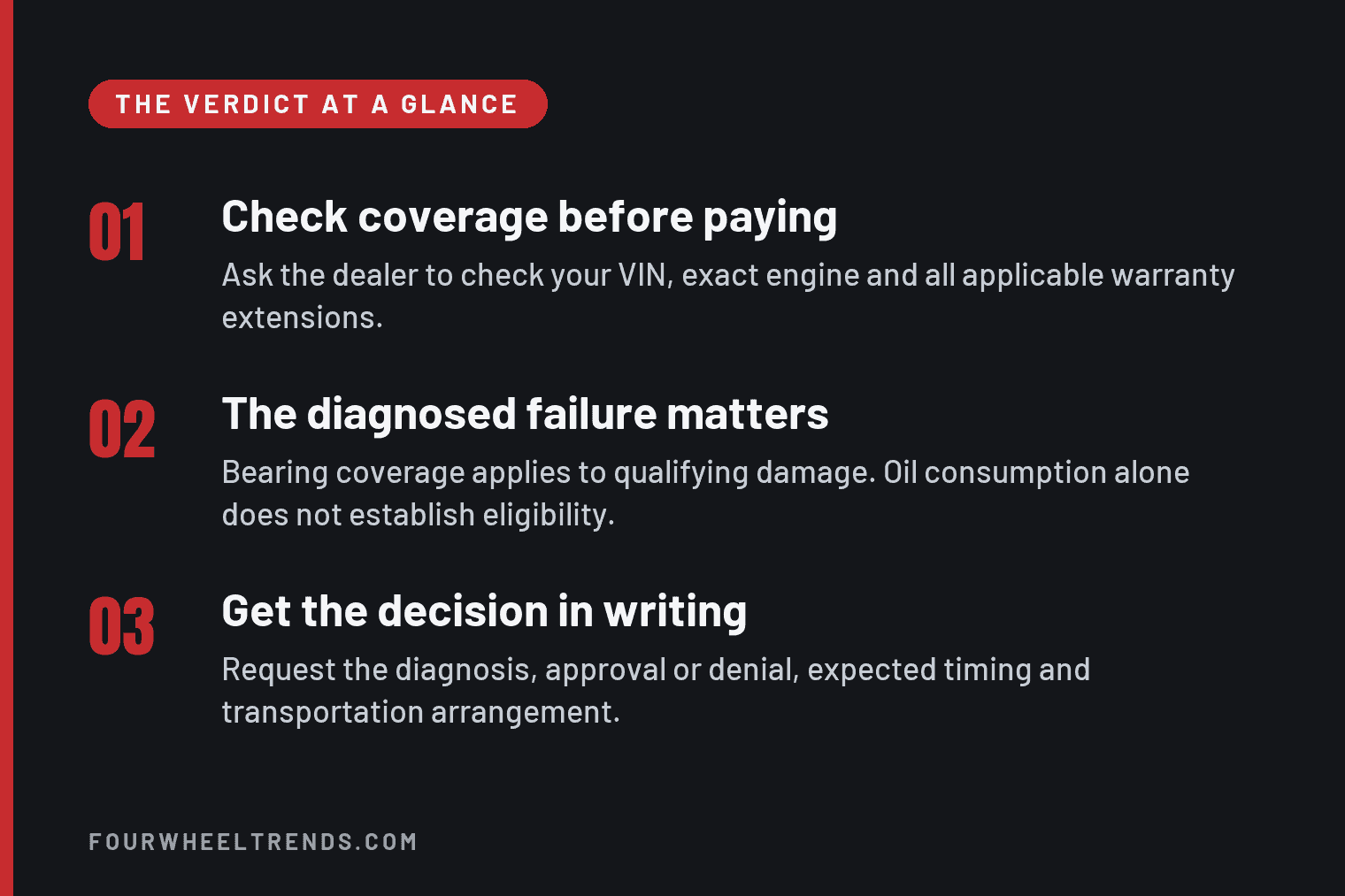
Start with the coverage check. Get the VIN eligibility, diagnosed failure, approval or denial, and transportation arrangement on paper. Those answers put you in a much better position to decide what happens next.
Sources and owner accounts
- Hyundai: engine information, campaign lookup instructions, and customer contact.
- Hyundai: TSB 22-EM-001H-1, TXXI limited lifetime engine warranty, April 2022.
- Court-authorized Theta engine settlement: coverage and conditions, final approval June 2021.
- Hyundai: TSB 22-EM-006H-2, TXXM engine warranty extension, November 2022.
- Court-authorized Engine II settlement: engine list and extended warranty conditions, final approval April 2024.
- Hyundai: TXX8 VIN eligibility and 3.3L Lambda II coverage.
- Hyundai: TXX8 inspection, prior approval, and transportation guidance, July 29, 2025.
- Hyundai: free KSDS software update for applicable vehicles.
- Hyundai: bearing-wear symptoms and engine protection mode.
- Hyundai U.S. Service: oil pressure and malfunction warning instructions.
- Hyundai U.S.: original and subsequent-owner warranty summary.
- Hyundai: TXXI dealer best practice, inspection, timing, and denial documentation, January 19, 2022.
- Four Wheel Trends reader comments on this page by Sally Burch (November 17, 2023), Buyer31 (December 2, 2023) and Donald Siler (December 6, 2025). Personal reports that nobody has independently verified.
While driving my 2013 Santa Fe sport 2.0, the engine suddenly cut off. The engine light was on and I had to coast to the next turn off. Hyundai dealership did not even look at my car for 3 months. It sat there until month 4, at which time they told me the engine was blown. They (Hyundai corporate) wanted every receipt of work done since the car was purchased, especially oil changes. They also wanted pictures of certain engine parts, which were taken and sent to Hyundai. They finally approved a new engine. I was never offered a loaner car, nor was I offered a rental. The engine took a week to come to the dealership. I am still waiting for them to put it in. A nightmare beyond words, has forced me to come to the decision that I can never, ever purchase another Hyundai.
Sally, what a terrible experience. I hate you had to go through this, but I greatly appreciate you sharing your experience so others can learn from it.
Hyundai makes you jump thru hoops to get a new engine. Have a 2017 Santa fe.
It always burned aĺot of oil. Checked and added oil every week. Always took it into
have oil changes. Had oil change and two weeks later blowm engine. Now Hyundai
want all records 7 years . First two year dealer out of business. Went to last dealer and
they won’t give me records. Worst part is daughter died in 2021. So I don’t know
where she had oil changes. They told me to just drive around to repair shop. They
know they had defected engine but they come up with impossible request so they
don’t pay.
I was driving my 2013 Hyundai Sonata to work at 5 am & half way there my car suddenly cut off and I pulled over while waiting 1 hour until I got towed to the dealership by a friend. My car has a clean record history of oil changes etc, @150k miles. I dropped off the Hyundai Car went to work and when I got off work I went to the dealership to find out my car Engine was blown/Limp mode. They told me Hyundai would replace the engine for free. But Gave me a List of of additional recommend services of a total of $1,000 ……. My car was working perfectly fine, do I really need a Belt and Hose replacement for $540? my car had no leaks and I had my belt replaced 4 months ago… like how many belts are there? I only seen one under the hood which I replaced. Let’s see how just replacing my engine turns out without any additional services . I can replace my light bulb , wiper blades & brake pads that’s 500$ off just saying those 3 .
2014 Santa Fe Sport 2.0 Turbo, 126,000. Regular oil changes, full synthetic. Engine started making a loud banging noise. Took it into the dealership, engine was blown. Request for engine replacement was denied. They said an engine knocking detection software update that was needed, had not be performed. I was unaware of any recall or needed software update.
While driving my 2013 Santa Fe Sport 2.0 the engine suddenly cut off at 79000 miles. After several weeks I was given a new engine from Hyundai and reimbursed any monies spent.
Fast forward to today. That new engine has 69000 miles on it and has now stopped working.
I am again without a vehicle and awaiting an answer from Hyundai as to
whether they will replace this engine. 2 engines, totaling 148000 miles, countless
hours of stress and misery. Regardless of the outcome of this second engine failure, I will never, ever buy another Hyundai and I strongly advise anyone who is reading this to NEVER BUY A HYUNDAI!!!
I have a 2020 palisade less than 45K miles that kept turning off at stop lights. I brought it into my local Hyundai dealership, and they charged me for an oil change to begin the consumption test. I do not drive very many miles, but my best friend works in the city, so we traded vehicles to get me the 1000 miles needed for the consumption test. once the miles were achieved, I brought the car back to the dealership who said that it was not consuming oil. I drove the car for another 2 weeks and checked the oil it was almost empty. Returned the car to the dealership with my complaint of no oil. Was told that they would need to clean engine and replace caps. Did that work and was provided with a loaner vehicle. Had to drive another 1000 miles for consumption test. told car is not burning oil faster than 1 liter every 1000 miles. Drover car for another month checking oil weekly and what do you know very low on oil again. Brought the car to dealership with the same concern and was told that my manufacturer’s warranty expires in a week. I was lucky and had an amazing service person who really wanted to help me. She did everything in her power to ensure that Hyundai corporate got what they needed to not deny my claim and to replace my engine which is not part of any recall or class action lawsuit. My car is currently with Hyundai, and I was informed that I can come get a loaner anytime. It takes a lot of time, proof, and patience to get these issues that are no fault of your own taken care of and it sucks when the company does not want to address them but our interactions with the people doing the work and/or advocating with corporate on our behalf is significant. I hope that all works out well for all of us having issues with this company’s vehicles.
Two and a half years since your first post, did they replace your second engine and what were the details.
Thank you…
My 2020 Elantra made noise from the day purchased. said it was fuel pump, don’t worry. At 29,000 loud tapping. called factory forcase number. At 30,00 factory not responding,at 31/32000 sent to other local dealer who refused warranty work. contacted factory, got new case number then no further contact. At 33,900 engine light coded. Dealer said to drive it in. I did. Engine replacement needed after all of this anguish. Several weeks went by finally they gave me a vehicle to drive. Finally Engine was replaced but is it new or rebuilt. Gas mileage terrible I must pay to have issue looked at. Engine now has 2,900 miles on it after 7 months, Dealer says new motor does not have the orginial warranty mileage on it.
I have a Hyundai sonata eco 2017 bought brand new at 7 miles. Transmission needed to be remanufactured at 50k miles. Literally almost died about 8 times because the dealership kept giving me the car back telling me there wasn’t a problem. After the 8ish time of almost dying, I took the care in and told them to keep the damn car because I don’t want to almost die anymore than I’ve already had. Lo’ and behold they found the problem the next day. Started burning excessive oil around 75k miles but wasn’t “a realistic concern,” until around 106k miles. Followed directions from the dealership that wouldn’t cover an oil consumption test because it was 6,000 miles outta warranty. More-so because CA has a lemon law stating if a car had warranty work more than twice, it’s grounds for a case. Super clever of them to deny it. Engine died at 126k miles. Now, currently in 2024, I get to spend the same amount of money for a used car with 80k miles that I did on a new car in 2017… This 2017 Sonata lasted a mere 7 years, not even 150k miles, not even 300k miles. Garbage product that Hyundai refuses to stand by, so here’s $23k and no more of my business or the thousands of people I tell to avoid Hyundai. But it’s a different engine than this class action lawsuit so I guess I’m completely f*d. Not like the other engines they produced could also be defective; that’s just completely crazy thinking that no more than two of their engine models could have problems…
i Ladonna Dvorak have a recall on my 2015 Hyundai Veloster they refuse to replace my engine want me to do oil consumption which i did ksds everything oil change every 5,000 miles, was call by Hyundai Corp saying my car is out of warranty when i have 20 year 200,00 miles and twenty thousand miles on recall extended warranty. my car uses oil, bad compression, trys to stall, knocks, hyundai cannot sell any car that is under recall so you are force to drive it until the engine fails on the road risking your life and prone to overheating which they won’t cover either. next question i have sent them to safety board da ga consumer division they told me to get a lawyer i have all my paperwork i guess i check with a lawyer next.
My 2017 Santa Fe has a cracked valve cover caused from the timing chain hitting it after it broke through a guide. I have been told it needs a new engine and it’s not covered under the recall. What do I now
i Ladonna Dvorak the is a lifetime warranty on affected cars as you stated and transportation up to 40.00 dollars a day with be provided for loaner car, so all cars are covered by this. i check with lemon law lawyers online because it was a manufacturer defect debris was put in the crankshaft thus causing the problem now. so when are you going to fix this or does it need a lawyer to do this
MY 2017 HYUNDAI BURNS OIL VERY BAD DEALER HAS DONE ALL OF THESE CHECKS AND IT STILL USES OIL,OIL PAN WAS REPLACED BECAUSE OF CRACK .I AM FIRST OWNER CHECK WITH YORK PA. HYUNDAI ITAKE CARE OFF MY CARAND USEING OIL IS NOTA GOOD THING
I purchased a 2017 Santa Fe Sport. Had no issues with the vehicle until I drove over 100k miles. Then the engine started burning oil. I consulted with numerous mechanics, which all told me my vehicle was known to burn oil but that there was a class action lawsuit and to take it to the dealership. After two years of dealing with Hyundai. Collecting past maintenance records. Paying for oil consumptions. Engine cleanings. Borrowing cars from family members because Hyundai never had loaners. Yet Hyundai kept denying my claim stating my mileage was over 100k and not covered under the power train warranty. My engine finally locked up and thankfully the mileage was under 150k, and I qualified for an engine replacement. My persistence finally paid off, but there were too many hoops I jumped to get there. I only hope this engine will last longer, but one can only hope. I will NEVER purchase another Hyundai/Kia!
Hyundai has been giving me the run around. I have a 2018 Sonata. It is not consuming oil. I have an engine combustion cleaning and replace spark plugs and it is still consuming oil. It is not past the 100,000 mile and they will not replace the engine even though this all started before the 100,000 miles. The oil light does not illuminate to indicate low oil level. So I never knew the oil was low.
We just got our 2013 back from dealer. Engine was replaced no questions asked. The job took two weeks over Thanksgiving and all recalls were applied.