Best Jeep Wranglers to Buy for Every Kind of Owner
When I want an easy top-down drive, I reach for my nearly stock 1993 YJ. When I want the Jeep I use most, I take my lifted 2006 Wrangler Unlimited, better known as the LJ. Those two Jeeps answer the word “best” in completely different ways.
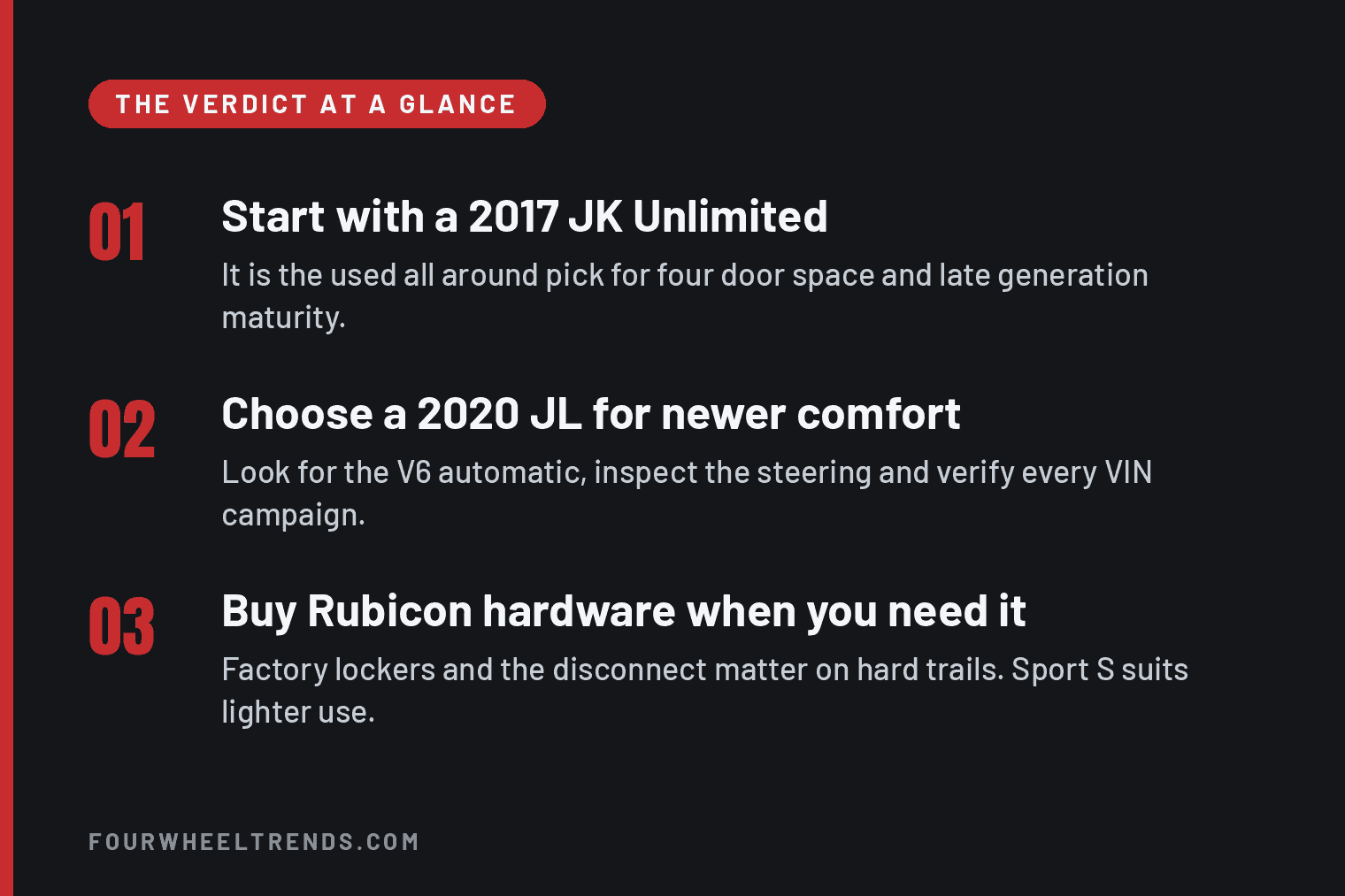
If you want one recommendation, my best used all-around Wrangler is a clean 2017 Wrangler Unlimited JK with the 3.6-liter V6. It gives you four-door usefulness, a late place in a long model run, and the simple appeal that still draws people to a Wrangler. For a newer cabin and better road manners, I would shop for a 2020 Wrangler Unlimited JL with the 3.6-liter V6 and eight-speed automatic. Condition, maintenance, modifications, rust, and recall completion can matter more than the model-year badge, so neither choice guarantees reliability.
The best new choice for most buyers is a 2026 Wrangler Sport S. The Rubicon earns its premium when you will use its factory lockers, low-range gearing, and electronic sway-bar disconnect. If those features sound like things you might use someday, keep the money in your pocket until your driving proves you need them.
What does “best Jeep Wrangler” actually mean?
A good Wrangler recommendation has to fit the owner. I would define “best” with five questions.
- Will this be your only vehicle? A daily driver needs different manners from a weekend Jeep.
- How many people and how much gear do you carry? Two doors feel playful. Four doors solve real family and cargo problems.
- How hard are the trails? Most owners do not need Rubicon hardware. Some absolutely do.
- Who will work on it? A simple older Jeep can be rewarding when you can handle repairs. Paying a shop changes the math.
- How long will you keep it? Purchase price is only one part of the cost. Financing, insurance, fuel, repairs, modifications, and resale all belong in the decision.
That last point matters with Wranglers because they have historically held value well as a model line. An iSeeCars study of roughly 950,000 five-year-old vehicles found average Wrangler depreciation of 32.4%, compared with 47.0% for midsize SUVs. That is a historical model average based on used listings. It does not forecast a particular trim or the amount you will receive for your Jeep. A high purchase price can still leave you with a high total cost even when the percentage loss looks favorable.
My picks at a glance
| Buyer | Wrangler to shop | Why it makes the list | Main caution |
|---|---|---|---|
| Most used buyers | 2017 Wrangler Unlimited JK, 3.6-liter V6 | Late JK production, four-door utility, familiar powertrain, and a huge supply of parts and knowledge | Previous modifications, rust, leaks, steering wear, and open recalls |
| Newer used daily driver | 2020 Wrangler Unlimited JL, 3.6-liter V6 with eight-speed automatic | More modern cabin and road manners without buying new | Steering condition and campaign history need a close look |
| Classic all-around enthusiast | 2004 Wrangler Unlimited LJ | Useful extra wheelbase and cargo room with TJ character | Age, rust, condition, and collector pricing dominate the decision |
| Technical trail buyer | 2005 or 2006 Wrangler Unlimited Rubicon | LJ proportions plus factory Rubicon trail equipment | Scarcity, modified examples, and high asking prices |
| Simple second vehicle | 1991 to 1995 YJ with the 4.0-liter engine | Old-school feel, fuel-injected inline-six, and approachable mechanicals | Little resemblance to a modern daily driver in comfort or safety |
| New buyer | 2026 Wrangler Sport S | Useful comfort and technology with room to build only what you need | New-vehicle depreciation, insurance, and option creep |
The list is a shopping order for different owners, and no reliability ranking sits behind it. I am giving late-production examples an edge where that makes sense, then asking the individual Jeep to earn the recommendation through its records and inspection.
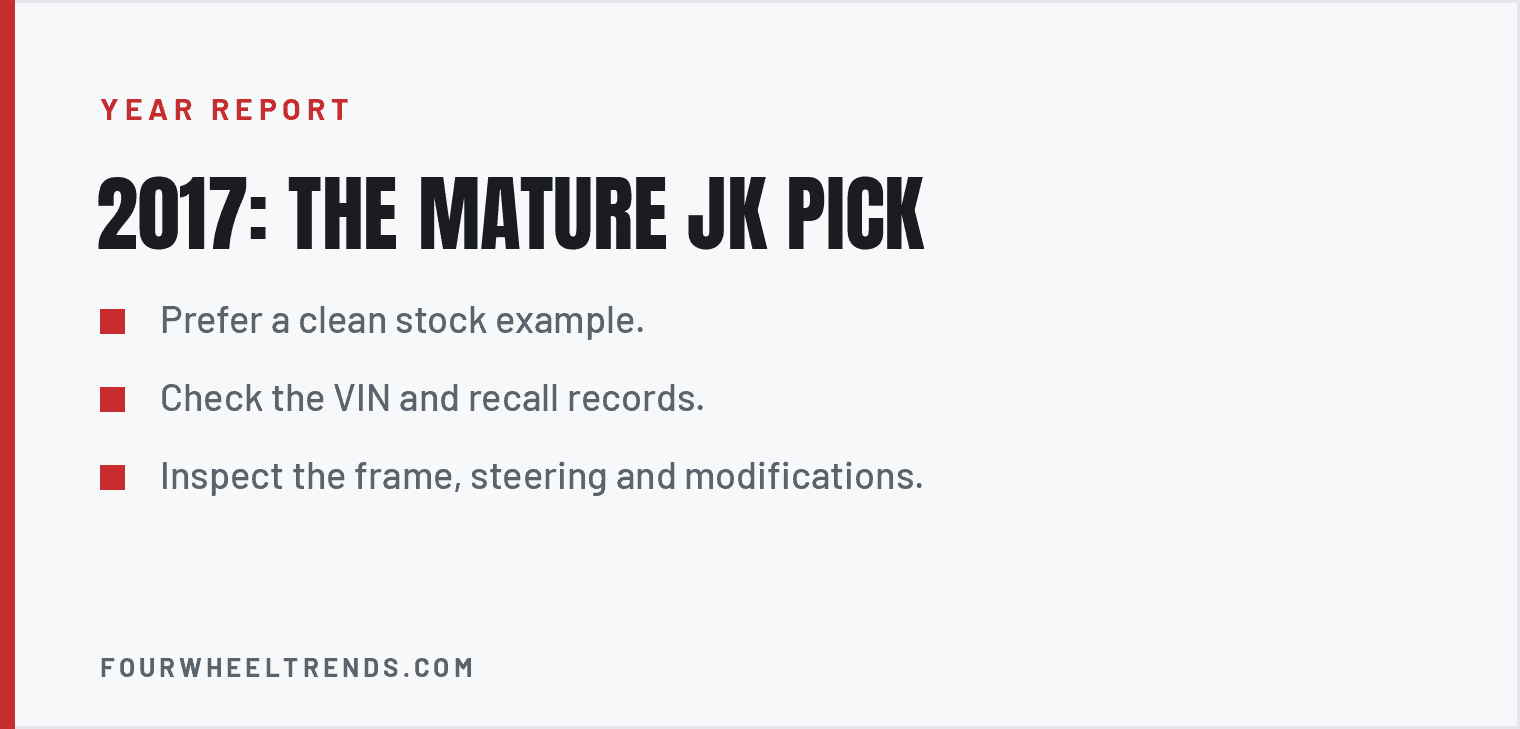
For a 2017 candidate, prefer a clean stock example. Check the VIN and recall records. Inspect the frame, steering, and modifications.
Why the 2017 Wrangler Unlimited JK is my used all-around pick
The four-door JK Unlimited changed the Wrangler from a fun second vehicle into something many families could actually use. Jeep dates the JK from 2007 through 2018, and its JL reveal brochure introduces the next generation as a 2018 model. By 2017, the JK had been in production for a decade.
A 2017 model has the 3.6-liter Pentastar V6 and a choice of six-speed manual or five-speed automatic, as EPA’s listings for the 2017 Wrangler Unlimited show. Jeep’s 2017 brochure documents the V6, the available automatic, and the Rubicon’s Rock-Trac transfer case, locking front and rear differentials, and electronic sway-bar disconnect.
I would begin with a stock or lightly modified Sport S or Sahara. Stock makes the inspection easier. It also gives you the chance to decide what the Jeep needs after you have lived with it. A lift, oversized tires, heavy bumpers, and changed gearing can be done well. They can also create steering, braking, driveline, and tire-wear problems that a buyer inherits.
Choose a Rubicon when your trails justify the equipment. A stock Rubicon has a combination of factory hardware that is hard to duplicate cleanly after the purchase. A commuter who takes forest roads a few times a year may be happier with the lower price and simpler tire replacement of a Sport S.
Why the 2020 Wrangler Unlimited JL is the newer used pick
The JL feels more modern without losing the removable roof, folding windshield, and solid-axle identity. For a used daily driver, I would look for a 2020 Unlimited with the 3.6-liter V6 and eight-speed automatic. The automatic choice also avoids the manual-clutch recall that covers certain 2018 through 2023 JL Wranglers equipped with a manual transmission.
There is one issue I would put near the top of the test drive. FCA US, now part of Stellantis, issued a technical service bulletin for certain 2018 through 2020 JL Wranglers addressing steering wander, lead or pull, and excessive play through a steering-gear replacement and software update. A service bulletin is repair guidance from the manufacturer. It sits outside the safety-recall process, and it does not establish how many vehicles will develop the condition.
Drive the Jeep on the kind of road you use every day. Pay attention to straight-line tracking, steering correction, vibration, and tire wear. Ask for repair orders if the steering gear was replaced, because only the paperwork shows what was actually done.
I would also check whether a 2018 or 2019 candidate received the V41 steering-damper work. FCA US classified V41 as a customer-satisfaction campaign, a separate category from a safety recall. The campaign notice describes sustained steering-wheel oscillation after hitting a bump at highway speed in cold temperatures and directs dealers to replace the damper. That history gives you an inspection question. It does not prove that every early JL has the problem.
Which older Wrangler has the most character?
2004 Wrangler Unlimited LJ for the sweet spot
Jeep introduced the longer-wheelbase Wrangler Unlimited during the 2004 model year. It kept the two-door TJ body style and added usable space behind the seats. In 2005, Jeep added the Rubicon Unlimited. Jeep’s own history places the TJ generation from 1997 through 2006 and records the 2003 Rubicon and later Unlimited introductions.
My 2006 LJ is lifted and modified, and it is the Jeep I drive most. The previous owner sold its hardtop and fitted a soft top, and I would have preferred to keep the hardtop because I rarely take that roof off. Jeep credited the longer wheelbase with 13 more inches of cargo room and better on-road comfort than the short TJ. Living with mine is one reason the LJ is my classic all-around choice.
The 2004 model is the simpler value target. The 2005 and 2006 Rubicon Unlimited models are the enthusiast prize when factory lockers and low-range gearing are part of the plan. At this age, I care more about rust, cooling-system care, drivetrain condition, crash repairs, and modification quality than a one-year difference.
1991 to 1995 YJ for simple fun
My 1993 YJ is close to stock, low mileage, and usually kept in the garage with the top down. It feels like a go-cart compared with modern vehicles. That is exactly why I enjoy it.
I would look at 1991 through 1995 YJs with the fuel-injected 4.0-liter inline-six. MotorTrend’s Jeep history dates the 4.0-liter engine’s arrival in the YJ to 1991. Buy one as an old vehicle that needs care. Do not expect modern crash protection, braking, quiet, climate control, or highway comfort.
Which model years need extra caution?
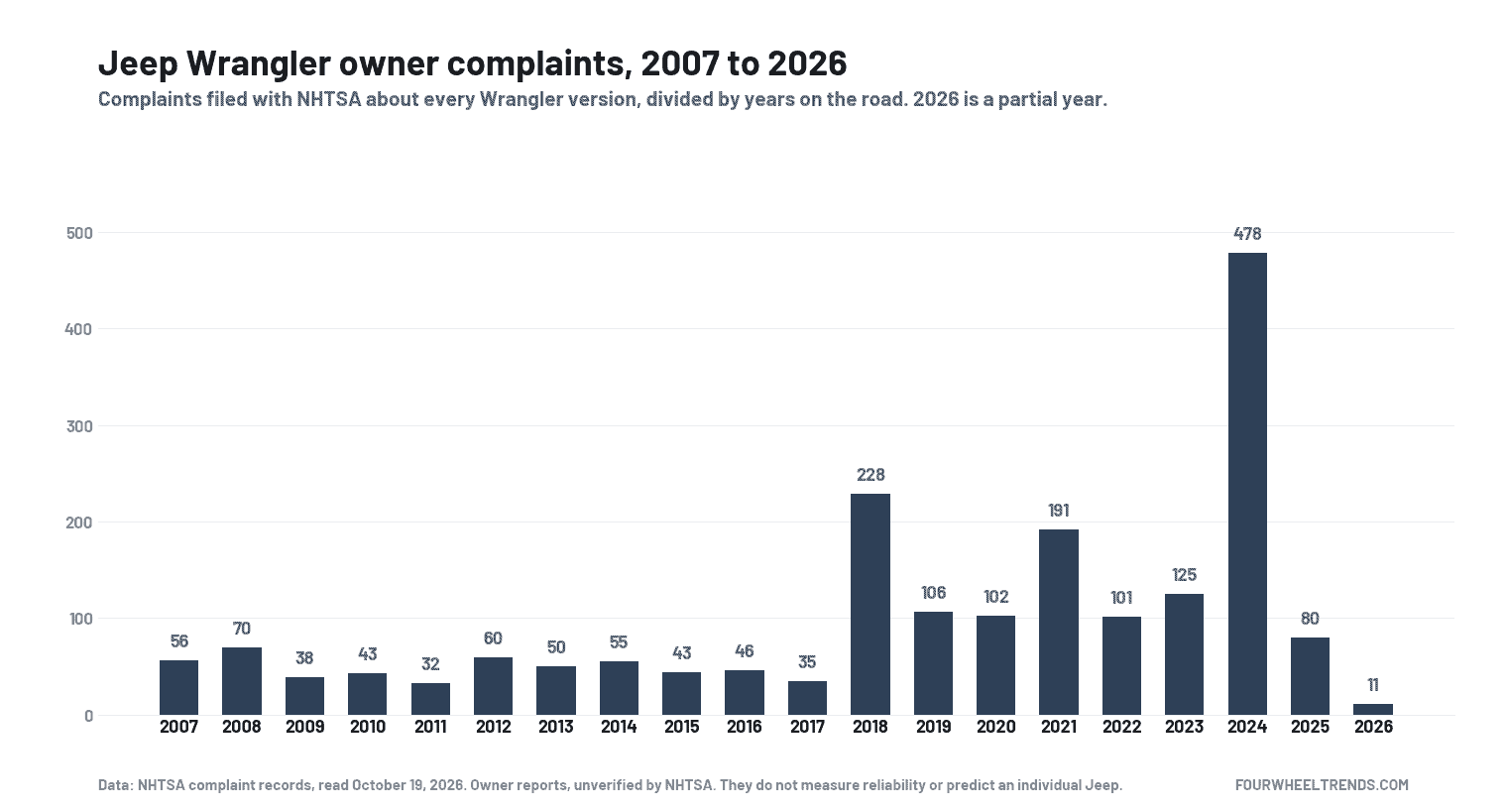
Owner complaint totals are reports, and they can reveal research leads. They do not measure the number of vehicles exposed, verify every diagnosis, rank reliability, or predict the risk for the Jeep in front of you. Recalls, investigations, service bulletins, warranty extensions, and owner complaints also mean different things.
2012 and 2013 Wrangler with the 3.6-liter V6
These years deserve an extra paperwork and engine check. A 2014 Chrysler Group warranty bulletin covers certain 2012 and 2013 JK Wranglers with the 3.6-liter engine for left-cylinder-head repairs after specific misfire codes and excessive leakage testing. This was a warranty extension and repair procedure for the vehicles the bulletin includes, separate from any safety recall.
Ask for service records, scan for stored codes, listen to a cold start, and have a qualified shop investigate any misfire. A Jeep with documented repair and good current test results can be a better purchase than a later Jeep with neglected maintenance.
2018 and 2019 Wrangler JL
The first JL years can still be good buys, and they carry more questions. The V41 customer-satisfaction campaign and the steering bulletin give you specific items to test and document. Remember that 2018 was also a crossover model year, so confirm whether the Jeep is a JK or JL before ordering parts or applying advice.
Wrangler 4xe
The plug-in hybrid can be a smart fit for someone who charges at home and makes frequent short trips. I leave it off my default used list today because the battery system, charging pattern, insurance, repair access, and recall history add decisions that the gasoline models avoid.
NHTSA recall 25V-741 covers certain 2020 through 2025 Wrangler 4xe vehicles for a high-voltage battery fire risk. The November 2025 recall notice said owners should park outside and avoid charging while a remedy was being developed. FCA US later mailed remedy letters to owners describing a dealer software update followed by a battery replacement if needed. The letter still advises owners to avoid recharging and to park away from structures until the repair is done, and NHTSA’s recall record carried the same advice in October 2026. Check the VIN and current instructions before you test drive, charge, park, or buy one, and ask for the repair order that shows the recall work.
Should you buy a new Sport S or Rubicon?
For most buyers, I would start with the 2026 Sport S. Jeep’s current specifications list the 3.6-liter V6 at 285 horsepower and 260 pound-feet of torque. The 2.0-liter turbo makes 270 horsepower and 295 pound-feet. The current capability guide pairs the turbo with an automatic and offers manual or automatic availability with the V6 depending on trim. Confirm the exact configuration on the window sticker because availability and packages can change. Jeep now also lists the 2027 Wrangler with the same published engine outputs and the same V6 manual or automatic choice on the Sport S, so this advice carries over if your dealer has 2027 stock.
The Rubicon earns its place on difficult trails. Jeep’s trim guide lists front and rear lockers, an electronic sway-bar disconnect, rock rails, and off-road tires among its defining equipment. Those parts have real value to a driver who needs them.
They do not make every drive better. More aggressive tires can cost more and change road feel. The purchase premium also ties up money before you know whether your use demands the hardware. People I know with Sport S models rarely leave them stock, and modifying a Jeep is part of the fun. I still would not assume that accessory spending comes back at resale. A stock Rubicon presents factory equipment that a future buyer can identify. A personalized Sport may be worth more to you than to the next owner.
How much should retained value change the decision?
Retained value can narrow the real gap between trims. It rarely erases it. In our Bronco and Wrangler ownership-cost comparison, a fixed Edmunds snapshot for Raleigh, North Carolina, on October 7, 2026 estimated five-year costs of $55,543 for a four-door V6 manual Wrangler Sport S and $60,280 for a comparable Rubicon. The Rubicon’s modeled resale made back much of its higher purchase price. The total five-year gap still came to $4,737.
That was one location, date, mileage assumption, financing profile, and source model, so treat it as an estimate with no quote or promise behind it. Run the numbers for the Jeep you are considering. Include taxes, financing, insurance, fuel, tires, repairs, accessories, and a conservative resale estimate. For an older LJ or YJ, leave room for age-related repairs even if the vehicle’s market value has been strong.
This article provides general educational information, not personalized financial advice. I do not know your financial situation, goals, or obligations. Ownership and resale estimates are not guarantees.
What belongs on your used Wrangler checklist?
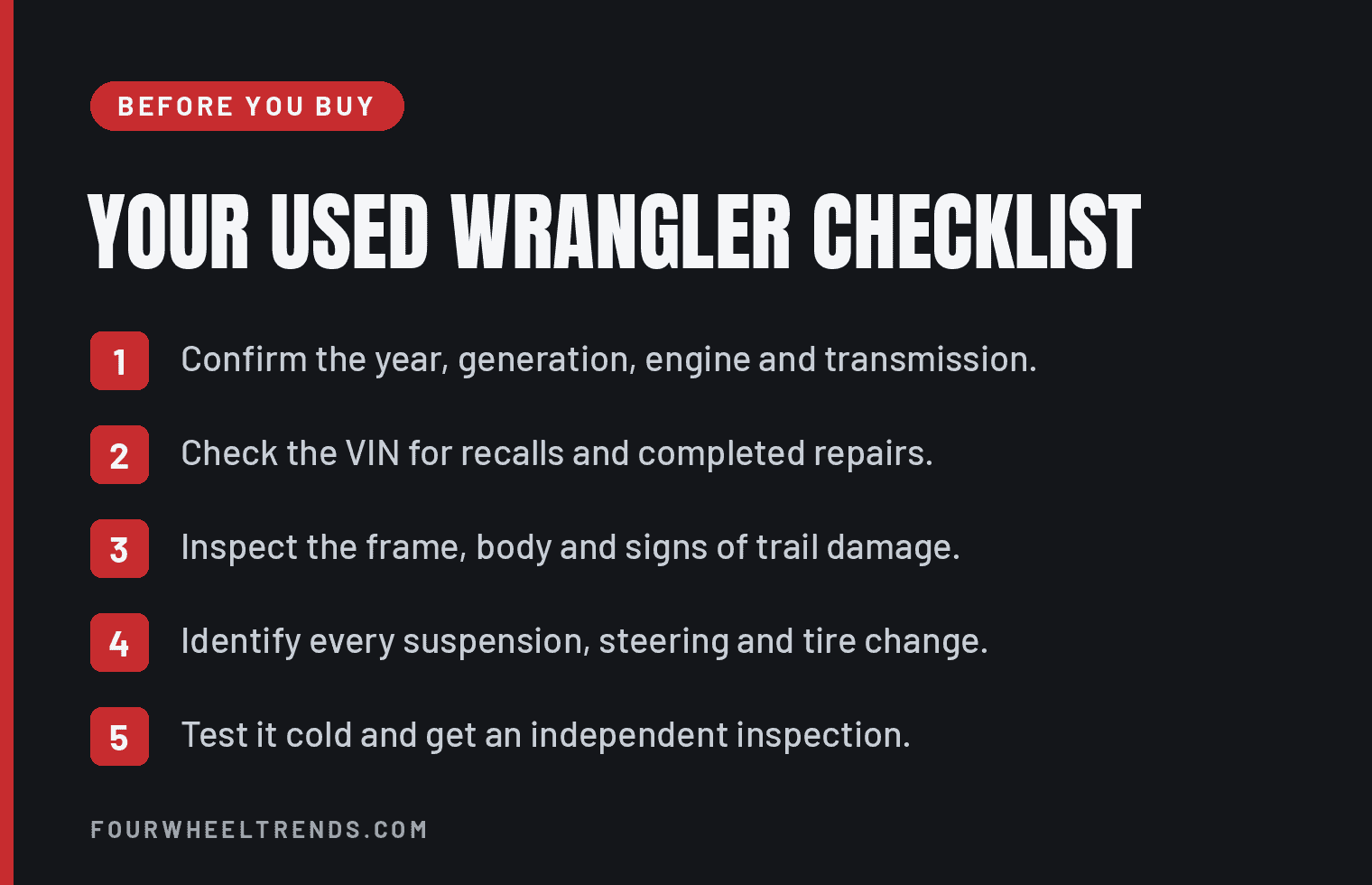
- Decode the exact Jeep. Confirm year, generation, trim, engine, transmission, axle ratio, and factory packages from the VIN and original equipment record.
- Run the VIN for recalls. Use the NHTSA recall lookup and ask for repair records. A model-year list cannot tell you whether a particular Jeep is included or repaired.
- Inspect the frame and body. Look for corrosion, crash repair, trail damage, water leaks, and signs of poor top or door fit.
- Audit every modification. Identify the lift, tires, wheels, steering parts, gearing, bumpers, wiring, and calibration. Ask who installed them and how the change was documented.
- Test it cold and at speed. Check starting, warning lights, shifting, four-wheel drive, steering, braking, vibration, temperature, and roof or wind noise.
- Pay for an independent inspection. Choose a shop that understands solid-axle Jeeps and is working for you.
Our used Wrangler inspection guide expands on the walkaround. If you are still sorting out YJ, TJ, LJ, JK, and JL, use our Wrangler generation comparison as the next step.
The strongest case against my picks
The strongest argument against a 2017 JK is that the JL is a better everyday vehicle. Its cabin, automatic transmission, steering revisions, and available technology make it easier to live with. If the test drive and service history are good, paying more for a 2020 JL can make complete sense.
The strongest argument against buying any older Wrangler is that age and previous owners can overwhelm a good design. A clean, documented Jeep from a supposedly weaker year may be the wiser purchase. A neglected 2017 with a cheap lift may be a money pit.
There is also a reasonable case for skipping the Wrangler. I went to a dealer intending to buy a loaded JL Unlimited Rubicon. My overall impression of the modern Jeep was good. I went in planning to buy a manual, but the feedback to the driver felt lacking, the view felt more restricted than in my older Jeeps, and the price was approaching $60,000. I started thinking I would buy the automatic, which hurt my soul as a die-hard manual Jeep guy. I ended up seeing more value in a Lexus GX 460 for comfort, practicality, and expected reliability.
The Wrangler is still a good choice for a specific kind of owner. Buy it because the removable roof, doors, trail ability, community, and character matter enough to accept the compromises.
So, which Jeep Wrangler should you buy?
Start with a clean 2017 Wrangler Unlimited JK if you want the best all-around used value. Move to a 2020 Unlimited JL with the V6 and automatic when daily comfort matters more and the inspection supports it. Choose an LJ because you want an older Jeep with character and useful space. Choose a YJ because simple top-down fun is the point. Buy a new Sport S when you want warranty coverage and a blank canvas. Pay for a Rubicon when your trails can answer exactly why you need it.
The badge on the fender is only the beginning. The best Wrangler is the one whose condition, equipment, records, and total cost fit the life you will actually give it.
Sources
- Jeep: current Wrangler engines, capability, and Rubicon equipment.
- Jeep: 2026 Wrangler engine specifications.
- Jeep: current Wrangler trim guide.
- Jeep: 2027 Wrangler engines and transmissions.
- Jeep: 2017 Wrangler brochure.
- EPA: 2017 Wrangler Unlimited V6 manual and automatic listings.
- Jeep: TJ, Rubicon, and Wrangler Unlimited history.
- Jeep: JK and Wrangler Unlimited history.
- Jeep: 2018 JL reveal brochure.
- MotorTrend: YJ history and 4.0-liter engine introduction.
- Chrysler Group: bulletin 09-002-14, 2012 and 2013 Wrangler left-cylinder-head warranty extension.
- FCA US: V41 steering-damper customer-satisfaction notice.
- FCA US: bulletin 08-003-21, JL steering-gear technical service bulletin.
- FCA US: recall 23V-116 manual-transmission clutch dealer instructions.
- NHTSA: recall 25V-741 Wrangler 4xe battery notice, November 2025.
- FCA US: recall 25V-741 remedy letter to Wrangler 4xe owners.
- NHTSA: VIN recall lookup and recall information.
- iSeeCars: 2026 vehicle depreciation study and methodology.