
The Best Compact Crossovers for Real Life in 2026
A compact crossover starts making sense when one vehicle has to cover three different lives. It needs to slip into a crowded parking space on Monday, swallow groceries and a stroller on Wednesday, and carry people and luggage out of town on Friday. That sounds simple until five good choices are sitting in front of you.
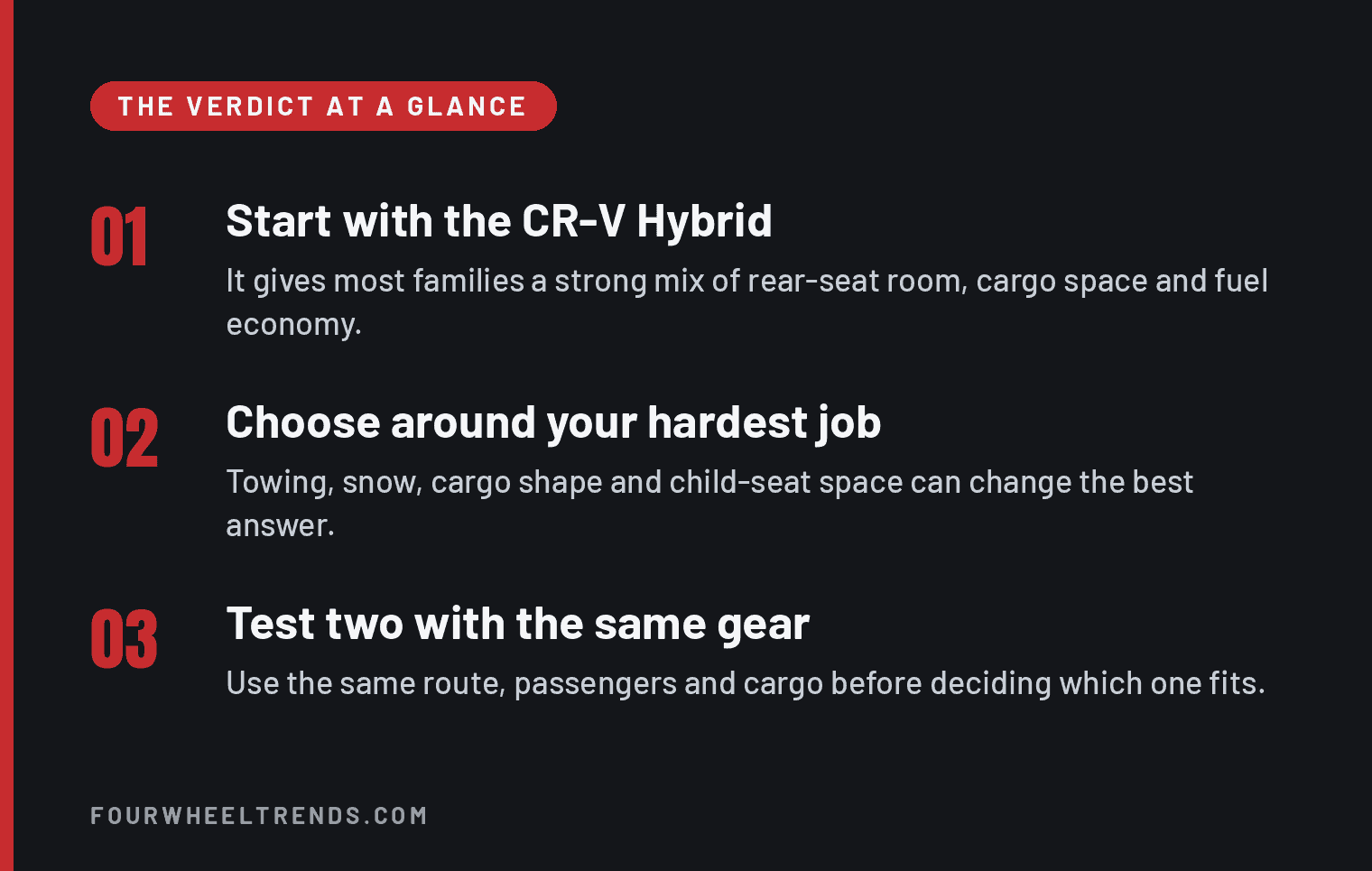
If a friend asked me where to start in October 2026, I would put the 2026 Honda CR-V Sport Hybrid at the top of the first test-drive list. It combines a genuinely useful back seat, up to 71.8 cubic feet of cargo room, and an EPA rating of 40 mpg combined with front-wheel drive. The CR-V is my best all-around starting point. A few buyers need something else. The 2026 Toyota RAV4 offers a wider range of hybrid capability, the Hyundai Tucson Hybrid makes a strong value and space case, the Subaru Forester Hybrid gives you standard all-wheel drive and an airy cabin, and the Mazda CX-50 gives up some cargo volume for a lower, more driver-focused shape.
The smart move is to choose the limitation you refuse to live with, then shop around it. A family that cannot fit a rear-facing seat comfortably has a different best crossover from a driver who tows a small camper or deals with snow every winter.
What counts as a compact crossover?
There is no single boundary that every automaker, insurer, and shopping guide uses. The Insurance Institute for Highway Safety places vehicles as different in size as the Mazda CX-30, Honda CR-V, and Hyundai Tucson in its broad small SUV class. Toyota calls the RAV4 a small SUV. Mazda describes the CX-50 as a crossover SUV. Those labels help, but they do not create a universal definition.
For this guide, a compact crossover is a mainstream, two-row, five-seat utility vehicle around the size of a CR-V, RAV4, Tucson, Forester, or CX-50. These models use unibody construction and are designed mainly for everyday road use. I left smaller choices such as the Honda HR-V and Mazda CX-30 out of the main comparison. I also left out three-row midsize SUVs, luxury models, and battery-electric vehicles. Each of those groups creates a different shopping decision.
That scope matters more than the badge on the liftgate. A compact crossover should give you enough passenger and cargo room to replace a family sedan without asking you to park and fuel a much larger vehicle.
How the five 2026 choices compare
The figures below use specific U.S. configurations. A different trim, drivetrain, roof, wheel package, or powertrain can change the price, fuel economy, cargo figure, ride, and towing limit. Starting MSRPs exclude destination or freight, taxes, registration, options, and dealer charges.
| 2026 model and trim | Starting MSRP | Drivetrain and EPA economy | Cargo, rear seat up / folded | Best reason to try it |
|---|---|---|---|---|
| Honda CR-V Sport Hybrid | $35,630 | FWD, 40 mpg combined | 36.3 / 71.8 cu. ft. | Best all-around family starting point |
| Toyota RAV4 LE Hybrid | $31,900 | FWD, 43 mpg combined | 37.8 / 69.8 cu. ft. | Efficiency and a broad range of capability |
| Hyundai Tucson Hybrid SE | $31,300 | FWD or AWD, 38 mpg combined | 38.7 / 74.5 cu. ft. SAE | Space and equipment for the price |
| Subaru Forester Premium Hybrid | $34,730 | Standard AWD, 35 city / 34 highway mpg | 27.5 / 69.1 cu. ft. | Visibility, standard AWD, and easy access |
| Mazda CX-50 Hybrid Preferred | $34,750 | Standard electronic AWD, 38 mpg combined | 29.2 / 56.3 cu. ft. | A lower, more car-like alternative |
Manufacturer cargo measurements are useful within a model line, but the shape of the opening and floor can matter as much as the published volume. Bring the stroller, wheelchair, dog crate, golf clubs, or cooler you actually use. A number on a screen cannot show whether that item clears the hatch.
Which compact crossover is the best all-around choice?
The 2026 Honda CR-V Sport Hybrid is my default recommendation for a buyer who wants one compact crossover to handle commuting, family duty, and road trips. Honda lists 204 total system horsepower, 41 inches of second-row legroom, and 36.3 cubic feet of cargo space behind the second row. The front-wheel-drive Sport Hybrid is EPA-rated at 40 mpg combined, while the comparable AWD hybrid rating is 37 mpg combined.
Honda has since put the 2027 CR-V on sale with the same specifications and higher prices. The 2027 Sport Hybrid starts at $36,030 before a $1,550 destination charge, with the same 40 mpg combined rating, so this recommendation covers either model year.
That combination is easy to understand. You get generous passenger space, useful cargo room, and strong fuel economy without plugging in. Honda’s 2026 CR-V specification sheet also shows why the exact trim matters. Hybrid cargo volume is lower than the 39.3 cubic feet Honda lists for several gas trims, and the Sport Touring Hybrid drops to 34.7 cubic feet behind the second row.
The CR-V loses its lead if your main job is towing. Honda rates the 2026 CR-V at up to 1,500 pounds on gas models and 1,000 pounds on hybrid models when properly equipped. Buyers with even a modest trailer should calculate the loaded trailer, passengers, and cargo before assuming a compact crossover can do the job.
When is the 2026 Toyota RAV4 the better choice?
Choose the RAV4 when you want the broadest range of electrified capability in this group. The redesigned 2026 model is hybrid-only in the United States, with front-wheel drive or all-wheel drive on hybrid trims and standard all-wheel drive on plug-in hybrid trims. Toyota lists 226 system horsepower for the front-wheel-drive hybrid and 236 horsepower for the AWD version.
The RAV4 LE Hybrid’s 43 mpg combined rating gives it an efficiency edge over the specific CR-V, Tucson, Forester, and CX-50 configurations in the table. Select AWD hybrid and plug-in hybrid trims are also rated to tow up to 3,500 pounds when properly equipped. The LE AWD and all front-wheel-drive versions have a lower 1,750-pound rating, so the badge alone does not tell you the limit.
The plug-in hybrid adds another decision. Toyota estimates up to 52 miles of electric range for the SE and XSE versions. That can be a useful setup for a driver who can charge at home and complete much of a normal day within the electric range. A buyer without dependable charging may get more value from the regular hybrid.
Toyota’s 2026 RAV4 model release explains the powertrain, fuel-economy, trim, and towing differences. Check the window sticker and owner’s documentation for the exact vehicle because the lineup has meaningful configuration changes.
Why should value shoppers drive the Tucson Hybrid?
The 2026 Hyundai Tucson Hybrid SE deserves a place on the same shopping list. Its $31,300 starting MSRP sits well below the CR-V Sport Hybrid, Forester Premium Hybrid, and CX-50 Hybrid Preferred prices in this comparison. Hyundai gives it a 231-horsepower hybrid system, a conventional six-speed automatic, available all-wheel drive, and a 38 mpg combined rating in both the SE FWD and SE AWD configurations.
It also makes a strong space case. Hyundai publishes SAE cargo figures of 38.7 cubic feet behind the rear seat and 74.5 cubic feet with it folded. The company also shows larger maximum measurements, which is a good reminder to compare like with like. The 2026 Tucson Hybrid specifications identify both sets.
The low entry price is only one part of total value. Compare the exact equipment, destination charge, insurance quote, financing, warranty terms, and likely resale for the two vehicles you would actually buy. A loaded Tucson and a base RAV4 are different purchases even when both appear under the same model heading.
Who should put the Forester Hybrid first?
The Forester Hybrid is the easy first drive for a buyer who wants standard all-wheel drive, a tall and open-feeling cabin, and simple access. Subaru lists 106.6 cubic feet of passenger volume, up to 69.1 cubic feet of cargo volume with the rear seat folded, and 8.7 inches of ground clearance for the regular Forester line.
Its shape is the selling point. Large windows and a relatively upright roof can make the vehicle feel easier to place in traffic and easier to load than a sleeker crossover. That advantage needs a real test with the driver’s seat, mirrors, and child seats adjusted for your family.
The hybrid’s official fuel-economy figures are 35 mpg city and 34 mpg highway, with a listed range of up to 581 miles. Standard AWD is valuable when your roads and weather call for it. Drivers in milder climates should compare its purchase price and economy with front-wheel-drive alternatives before paying for capability they rarely use. Subaru’s 2026 Forester trim comparison lays out the gas, hybrid, and Wilderness differences.
Why consider the Mazda CX-50?
The CX-50 is the choice for someone who wants a compact crossover to feel a little less like a tall family appliance. The 2026 Hybrid Preferred starts at $34,750, uses standard electronic all-wheel drive, and is EPA-rated at 38 mpg combined. Its 29.2 cubic feet behind the rear seat and 56.3 cubic feet with the seat folded trail the roomier choices here.
That cargo tradeoff is worth accepting only if you prefer the Mazda’s proportions, seating position, and road manners after driving it. A buyer who regularly fills the cargo area should take the numbers seriously.
Mazda also offers a different answer for towing. The 2.5 Turbo models can tow up to 3,500 pounds with the required Mazda accessories, while the hybrid is rated at 1,500 pounds. The turbo produces 256 horsepower on premium fuel or 227 horsepower on regular. Those are very different vehicles under the same CX-50 name. Mazda’s 2026 CX-50 pricing and packaging release spells out the powertrain and towing differences.
Should you buy a hybrid, gas model, or plug-in hybrid?
A conventional hybrid is the strongest default for many compact-crossover buyers because it improves city fuel economy without requiring a charging routine. The price still has to work. Calculate annual fuel use for the exact versions you are comparing with this formula.
Annual gallons = annual miles divided by your realistic mpg.
Multiply the difference in gallons by the fuel price you expect to pay. Then compare that annual saving with the actual out-the-door price difference, financing cost, insurance, and the time you expect to keep the vehicle. Do not treat the gap between two base MSRPs as a clean hybrid premium because trim equipment and drivetrain may also change.
A plug-in hybrid makes its best case when you can charge where the vehicle normally parks and your routine uses the electric range often. A gas model can still be the sensible lower-cost choice when annual mileage is modest or the hybrid trim forces you to buy equipment you do not value.
This article provides general educational information. It does not provide personalized financial advice. I do not know your financial situation, goals, or obligations. Ownership and resale estimates are not guarantees.
When should you move up or down a size?
Move down to a subcompact crossover when parking space, purchase price, and easy city use matter more than rear-seat and cargo room. Models such as the Honda HR-V, Mazda CX-30, Toyota Corolla Cross, and Hyundai Kona can be enough for one or two people. Bring regular passengers before deciding because the smaller footprint usually shows up in the back seat or cargo area.
Move up to a midsize SUV or minivan when you routinely carry five people, need a third row, tow beyond the compact model’s exact rating, or fill the cargo area to the roof. A compact crossover can handle an occasional crowded trip. It becomes a frustrating purchase when every normal trip requires folding seats or leaving gear behind.
A wagon or roomy hatchback also deserves a look if you want cargo flexibility and have no need for extra ground clearance or an elevated seating position. The best compact crossover can still be the wrong vehicle type.
Five checks before you sign
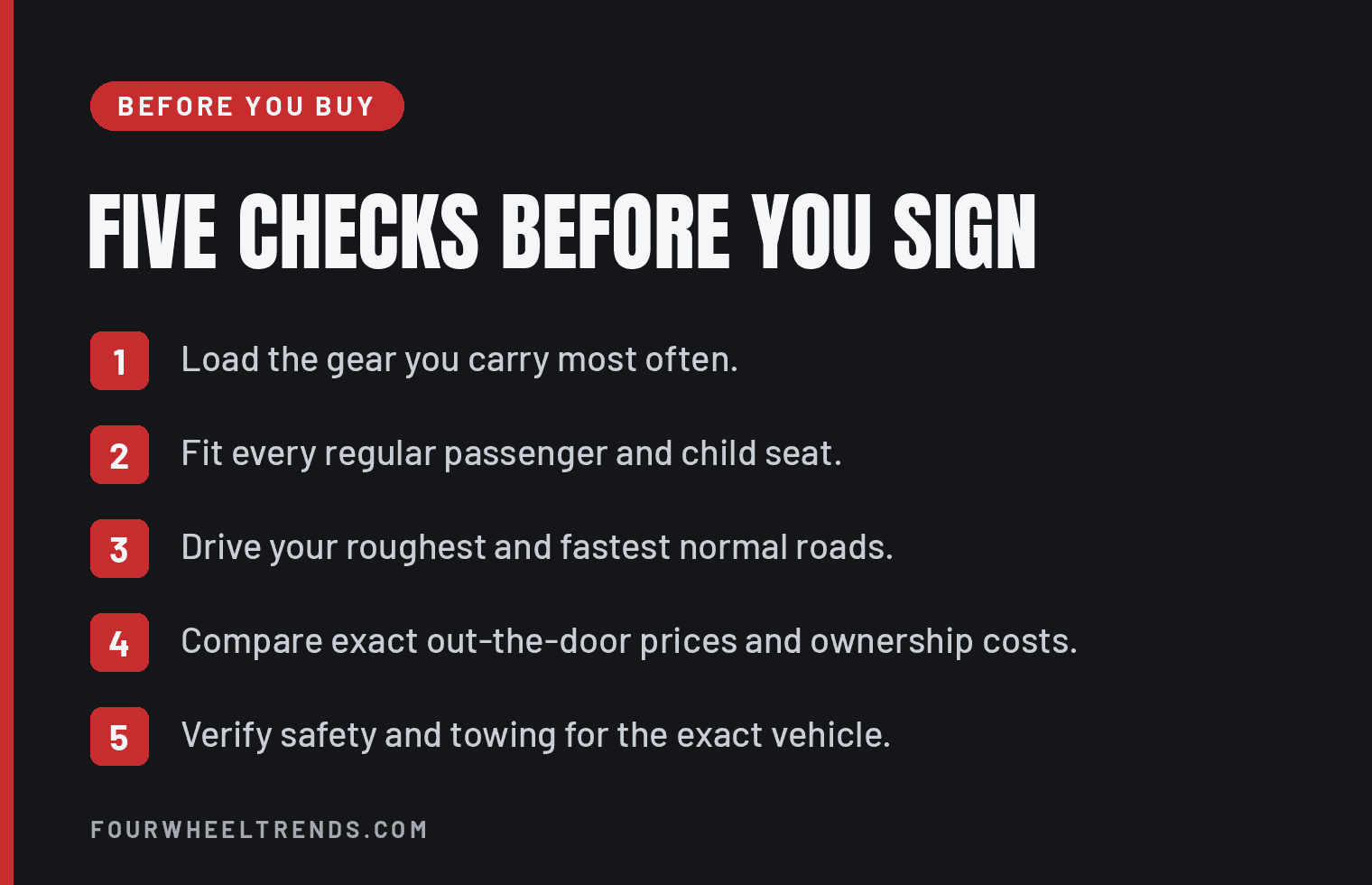
- Load your real gear. Test the stroller, crate, chair, clubs, or luggage through the hatch. Look at floor height and opening shape along with published volume.
- Fit every passenger. Install the child seat, set the front seats for the adults who use them, and check entry, knee room, vents, and door opening.
- Drive your worst routine. Include highway merging, broken pavement, a tight parking maneuver, and a hill if those are part of your life. Turn the audio off for part of the drive.
- Price the exact configuration. Compare out-the-door totals, insurance quotes, financing, warranty coverage, fuel, tires, and maintenance. Check whether AWD or a premium wheel package changes economy and replacement-tire cost.
- Verify safety and towing by year and build. IIHS awards can depend on build date, and towing ratings change by powertrain and equipment. Read the label, manual, and hitch requirements for the vehicle you are buying.
If one of these checks exposes a daily annoyance, listen to it. A few extra mpg or a nicer dashboard will not make a cramped child-seat installation or undersized cargo opening disappear.
The compact crossover I would start with
Start with the 2026 Honda CR-V Sport Hybrid if you want the broadest balance of space, efficiency, and everyday ease. Drive the RAV4 next when fuel economy, plug-in range, or higher towing capacity matters. Add the Tucson Hybrid for value and room, the Forester Hybrid for standard AWD and visibility, and the CX-50 when driving feel matters enough to accept less cargo space.
Do not pick from the table alone. Take the two strongest candidates through the same route with the same people and gear. The better compact crossover is the one that clears your hardest daily test without making you pay for capability you will never use.
Sources
- Honda News: 2026 Honda CR-V pricing and EPA ratings, May 21, 2025
- Honda News: 2027 Honda CR-V pricing and EPA ratings, September 9, 2026
- Honda News: 2026 Honda CR-V specifications and features, updated August 25, 2025
- Toyota USA Newsroom: 2026 RAV4 model, powertrain, economy, and towing details, October 22, 2025
- Toyota: 2026 RAV4 dimensions and cargo comparison
- Hyundai USA: 2026 Tucson Hybrid trim and specification comparison
- Subaru: 2026 Forester trim, price, drivetrain, and fuel-economy comparison
- Mazda USA: 2026 CX-50 Hybrid trim and cargo specifications
- Mazda USA News: 2026 CX-50 pricing, powertrain, and towing details, September 16, 2025
- Insurance Institute for Highway Safety: current small SUV ratings and 2026 award criteria