
How Long Do Toyota 4Runner Engines Last?
A used 4Runner with 180,000 miles can create a strange moment. The odometer says the 4Runner is old, while the asking price says the seller expects another life out of it. That leaves you wondering whether you are buying years of travel or somebody else’s repair bill.
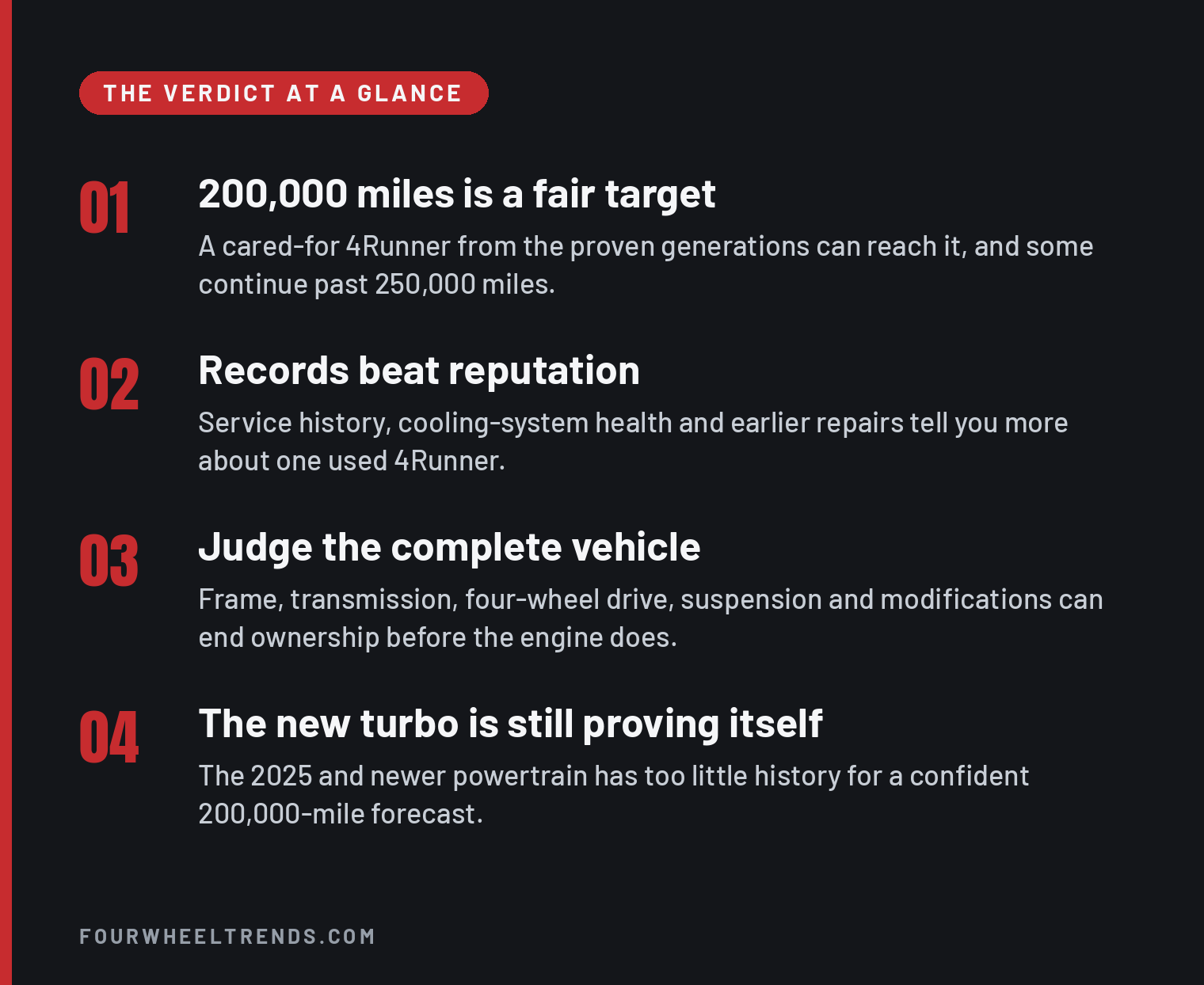
For a well-maintained 4Runner from the proven 2003 to 2024 generations, 200,000 miles is a reasonable target, and 250,000 miles is possible. No engine gets a guaranteed expiration date. Maintenance history, heat, rust, use, and earlier repairs matter more than the Toyota badge once the mileage gets high.
What does the mileage evidence actually show?
The best current model-wide evidence supports optimism with a healthy limit. The 2026 iSeeCars longevity study analyzed more than 395 million vehicles and estimated that the Toyota 4Runner has a 33.1% chance of reaching 250,000 miles. It ranked third among the vehicles in that study.
That 33.1% figure is a statistical estimate for the entire 4Runner nameplate. The model groups engines, generations, maintenance histories, and types of driving.
A one-in-three estimated chance also makes 250,000 miles an exceptional outcome, even for a 4Runner. Use it as evidence of strong potential. The 4Runner in front of you still has to prove itself with records and an inspection.
A practical lifespan range looks like this:
- Under 150,000 miles: start with condition and records because mileage alone tells an incomplete story.
- 150,000 to 200,000 miles: inspect the whole vehicle carefully and budget for age-related work.
- 200,000 to 250,000 miles: achievable territory for a cared-for 4Runner, with a greater chance of expensive repairs outside the engine.
- Beyond 250,000 miles: possible and impressive. Buy on documented condition because every example has lived a different life.
Which 4Runner engines have earned the most confidence?
The 4.0-liter V6 offered across the fourth- and fifth-generation years has the longest useful history for today’s mainstream used buyer. Toyota identifies those generations as 2003 to 2009 and 2010 to 2024, and its 2024 specifications confirm the fifth generation finished with that V6.
The optional 4.7-liter V8 in the 2003 to 2009 generation can also be a long-lived engine. Its maintenance history needs one specific receipt. Toyota’s 2009 4Runner guide calls for the timing belt every 90,000 miles or 108 months. When documentation is missing, price the service before you buy.
Third-generation 1996 to 2002 4Runners have their own loyal following, while first- and second-generation examples are now genuine old vehicles. At those ages, a broad engine reputation tells you less than cooling-system condition, oil use, prior overheating, repairs, corrosion, and the quality of any modifications.
What about the turbo engine in the 2025 and newer 4Runner?
Toyota replaced the long-running V6 with a turbocharged 2.4-liter four-cylinder for the sixth generation. The standard i-FORCE version makes 278 horsepower and 317 lb-ft of torque. Toyota’s current 4Runner specifications also list an available i-FORCE MAX hybrid version.
The sixth-generation engines have had too little time in 4Runners to build a 200,000-mile record comparable with the 4.0-liter V6. The turbo and hybrid powertrains need to build their own history. A 2025 or 2026 buyer has factory specifications and warranty coverage, plus only a short real-world record.
An honest lifespan answer for the new engines remains open. Compare the powertrain, warranty coverage, maintenance schedule, and price of the exact model year and trim you are considering.
What matters more than the number on the odometer?
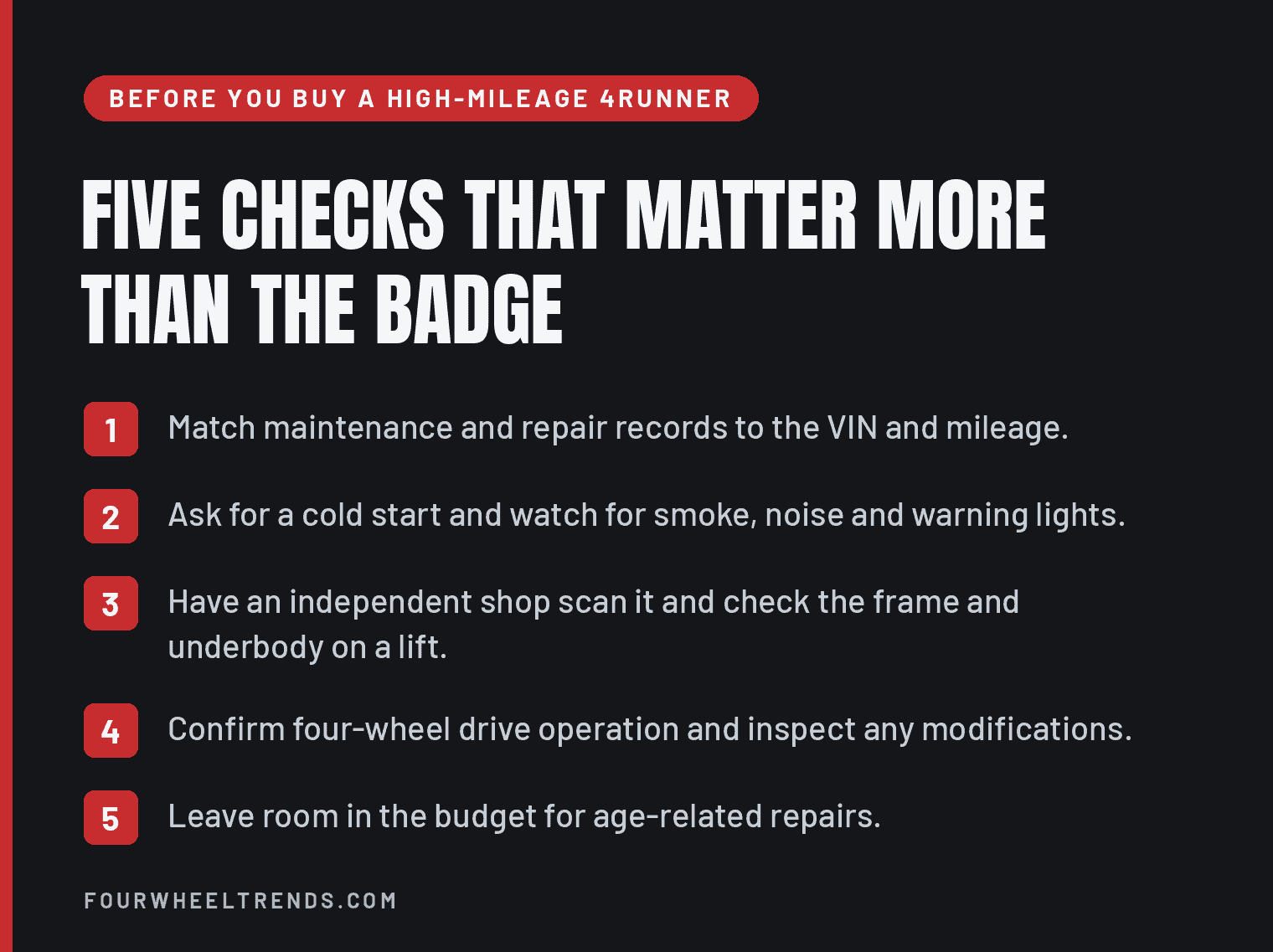
Service records come first. A thick folder of dated maintenance and repair invoices is more useful than a seller saying the 4Runner was “babied.” Match the vehicle identification number, dates, and mileage. Look for long gaps, repeated cooling work, recurring warning lights, and repairs that were recommended but never completed.
Then inspect the complete vehicle. An engine can still run well while frame corrosion, transmission trouble, four-wheel-drive faults, worn suspension, or accident damage makes the vehicle a poor purchase. A modified off-road 4Runner deserves extra attention around the underbody, suspension mounting points, wiring, and tire wear.
Ask for a cold start. Watch for warning lights, smoke, rough running, unusual noise, and fluid leaks.
A qualified independent shop should scan the vehicle, inspect it on a lift, evaluate the cooling system, and decide whether symptoms justify deeper engine testing. EPA guidance explains that recently cleared codes can leave emissions readiness monitors unset.
How do you help a 4Runner engine last?
Follow the maintenance schedule for the exact model year and the way the vehicle is used. Toyota’s 2025 Warranty and Maintenance Guide sets service visits at 5,000 miles or six months. It calls for checking the oil level monthly and warns that oil starvation or oil gelling can cause severe damage.
For the 2025 model, Toyota says to replace the engine oil and filter by 10,000 miles or 12 months. The guide shortens that to 5,000 miles or six months when the vehicle is mainly driven on dirt or dusty roads. Your older 4Runner may have a different schedule, so use its own guide.
Heat deserves immediate attention. If the temperature rises, coolant disappears, or the exhaust develops persistent white smoke, stop driving it like everything is normal. Diagnose the cause before a small leak or cooling problem becomes an engine repair.
Off-road use adds inspection work too. Dirt, water, impacts, and heavy loads affect filters, fluids, driveline parts, and the underbody. Toyota’s current guide includes additional service items for dusty roads, towing, heavy loading, extensive idling, rough roads, mud, snowmelt, and road salt.
Is a 4Runner with 200,000 miles worth buying?
It can be. I would consider one with consistent records, a clean cold start, a sound frame and underbody, working four-wheel drive, and a good independent inspection. I would walk away from a lower-mile 4Runner with overheating evidence, serious corrosion, hidden warning lights, or a seller who blocks an inspection.
The purchase price needs room for repairs. High mileage can bring cooling-system, suspension, steering, driveline, seal, sensor, and accessory work even when the engine itself remains healthy. Compare the inspected 4Runner with other available 4Runners and keep a repair reserve that fits your budget.
The short answer is encouraging. Proven 4Runner engines can deliver 200,000 miles and more. The better buying question is whether this particular 4Runner has been cared for well enough to make the next 50,000 miles enjoyable. Records and an inspection give you that answer.
Sources
- iSeeCars, 2026 longest-lasting vehicles study and methodology, checked November 9, 2026.
- Toyota, 2025 4Runner Warranty and Maintenance Guide, checked November 9, 2026.
- Toyota, 2009 4Runner Scheduled Maintenance Guide, checked November 9, 2026.
- Toyota, third- and fourth-generation 4Runner history, checked November 9, 2026.
- Toyota, fifth- and sixth-generation 4Runner history, checked November 9, 2026.
- Toyota, 2024 4Runner V6 specification, checked November 9, 2026.
- Toyota, current 4Runner powertrain specifications, checked November 9, 2026.
- U.S. EPA, onboard diagnostics and readiness-code guidance, checked November 9, 2026.