
Jeep Wrangler JK Models Explained: Sport, Sahara, Rubicon, and More
I have driven JK and JKU Wranglers more times than I can count, although I have never owned one. Even with that familiarity, used listings can make the lineup look more complicated than it is. One seller calls a Jeep an Unlimited, another leads with Willys, and a third treats JK like a trim level.
JK identifies the 2007 through 2018 Wrangler generation. The regular Wrangler has two doors, while the Wrangler Unlimited has four doors and is commonly called the JKU. The core trim ladder was X or Sport at the bottom, Sahara in the comfort-and-style lane, and Rubicon for the most factory trail hardware. Sport S and the many special editions add another layer, but they do not change the generation.
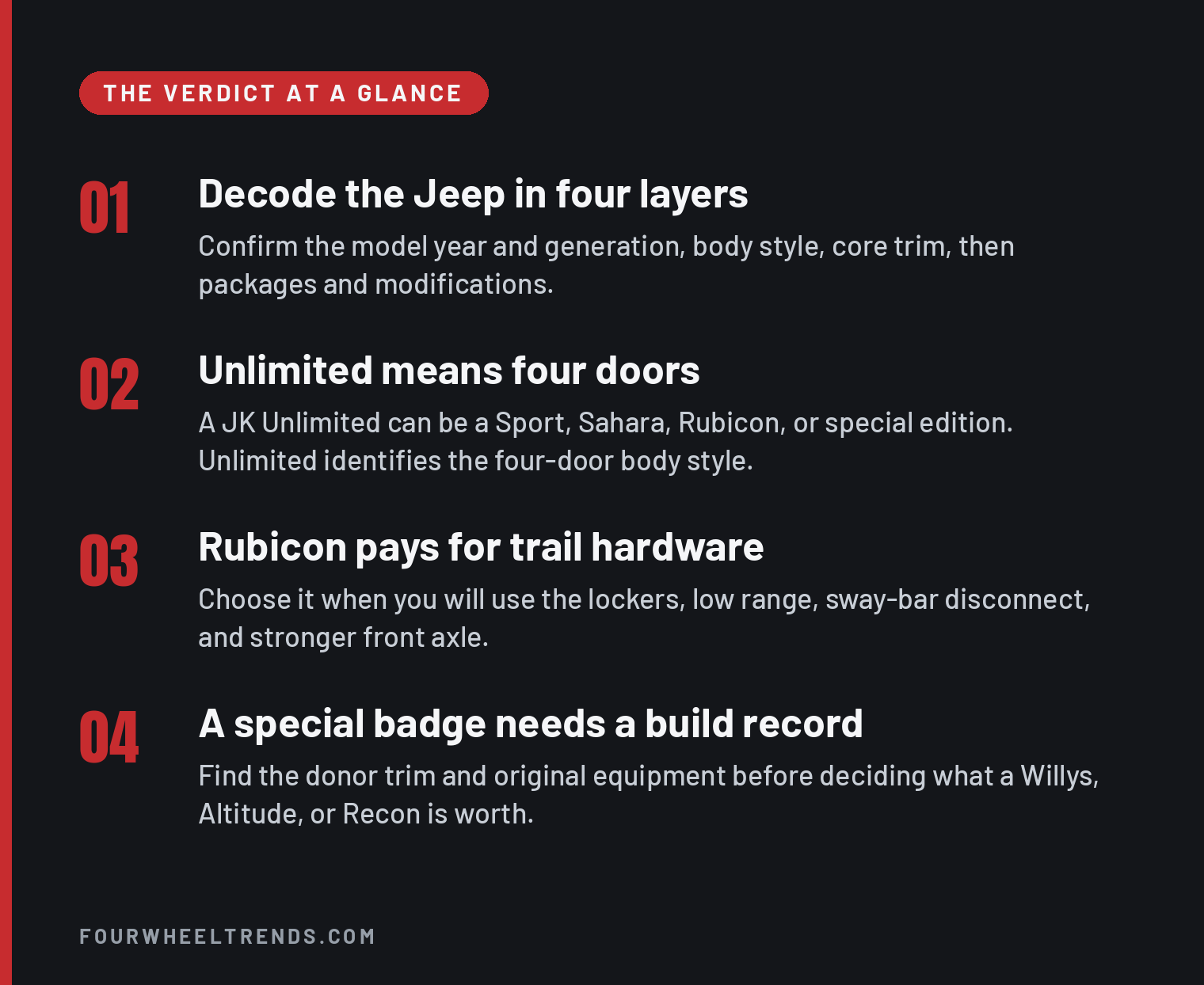
If you are shopping for one, decode it in this order. Start with the year and generation, then two-door or Unlimited, then the core trim, then packages and modifications. That keeps a clever badge or a set of wheels from deciding what the Jeep is worth.
What does JK mean on a Jeep Wrangler?
JK is the code for the third Wrangler generation, introduced for the 2007 model year. Jeep sold it as the two-door Wrangler and the four-door Wrangler Unlimited. The four-door was the big change. Jeep’s own history calls the four-door JK the first Wrangler with room for five adults, and that extra usefulness helped turn the Wrangler into a realistic daily vehicle for many more people.
Enthusiasts commonly use JKU as shorthand for a four-door JK Unlimited. You may not see JKU printed as the formal model name on the original window sticker, but the shorthand is useful when you are shopping for tops, suspension parts, doors, or other body-specific equipment.
| Name in a listing | What it tells you | What it does not settle |
|---|---|---|
| JK | 2007 through 2018 Wrangler generation | Door count, trim, engine, or equipment |
| Wrangler | Usually the two-door body in JK-era factory material | Trim or roof configuration |
| Wrangler Unlimited | Four-door body with the longer wheelbase | Trim or trail equipment |
| JKU | Common enthusiast shorthand for a JK Unlimited | A separate factory trim |
| Sport, Sahara, Rubicon | The Jeep’s core equipment lane | Every option or later modification |
| Willys, Altitude, Recon, or another edition | A year-specific package built from a core trim | The donor trim and exact equipment without checking records |
Is Unlimited a trim level?
No. Unlimited identifies the four-door body style in the JK generation. A JK Unlimited can be a Sport, Sahara, Rubicon, or one of several special editions. A two-door JK can also carry many of those same trim names.
This distinction matters more than the badge collection on the fender. The four-door gives you easier rear-seat access and more room for people and gear. The two-door has the compact feel many of us associate with an older Wrangler. Decide which body fits your life before you pay extra for a trim.
What were the main Jeep Wrangler JK trims?
The JK spent a long time in production, so the names and standard equipment moved around. The basic ladder stayed easy to understand.
X and Sport: the straightforward starting point
Jeep launched the 2007 Wrangler in X, Sahara, and Rubicon trims. The X was the entry point. By 2010, Jeep was using Sport for that position. Early X and later Sport listings therefore belong in the same general shopping lane, although their engines, transmissions, options, and standard features depend on model year.
A base Sport can be very simple. The 2018 JK brochure lists a 3.6-liter V6, six-speed manual, Command-Trac four-wheel drive, Dana 30 front axle, Dana 44 rear axle, steel wheels, removable doors, a soft top, and a wash-out interior among its standard equipment. Air conditioning was standard on the four-door and optional on the two-door in that brochure.
This is the JK I would start with if the price and condition are strong and you already know what you want to build. Add the full cost of planned tires, gearing, suspension, armor, and installation before calling it the bargain. Those aftermarket parts can easily erase the original price advantage.
Sport S: the useful convenience step
Sport S is the practical middle step for someone who wants the Sport’s basic mechanical package with more everyday convenience. Jeep Canada’s 2012 product guide lists 17-inch aluminum wheels, deep-tinted sunscreen glass, and other upgrades over the base Sport. By 2018, Jeep’s U.S. brochure lists air conditioning and 17-inch aluminum wheels for Sport S, and its Power Convenience Group adds power locks, windows, heated mirrors, and remote entry.
The exact bundle changed, and some listings use Sport S as though it were a completely separate mechanical model. Read the original equipment record. For many daily drivers, a stock Sport S is the sweet spot because it avoids paying for Rubicon hardware while retaining the features you touch every day.
Sahara: comfort, appearance, and daily use
Sahara sits above Sport S as the more polished JK. Depending on the year, Jeep bundled items such as power windows and locks, upgraded audio, larger wheels, side steps, body-color fender flares, and a hardtop. Jeep Canada’s 2012 product guide, for example, lists a three-piece Freedom Top hardtop, 18-inch aluminum wheels, automatic headlamps, power heated mirrors, tubular side steps, and Infinity speakers as Sahara upgrades over Sport S.
Sahara is my first stop for a mostly road-driven JK when the equipment is original and the price makes sense. It does not carry the Rubicon’s full trail package, and larger appearance-oriented wheels are not automatically an off-road advantage. You are buying a nicer factory specification, so confirm that the features you care about are still present and working.
Rubicon: factory hardware for harder trails
Rubicon is the mechanically distinct trim. Across the JK source material, its defining equipment includes a Rock-Trac transfer case with a 4:1 low range, selectable front and rear Tru-Lok locking differentials, an electronic front sway-bar disconnect, rock rails, and a stronger front axle than the Sport and Sahara used.
That equipment is valuable when your trails call for it. It also makes a stock Rubicon easier for a later buyer to understand. You can build a Sport into an extremely capable Jeep, and the work can be rewarding. The sale price may not return what you spent, especially when the next buyer has different preferences or questions the installation.
If your driving is mostly pavement, beaches, forest roads, and mild trails, a Rubicon may solve problems you do not have. If you already know why you want front and rear lockers, the low-range gearing, and the disconnecting sway bar, price a stock Rubicon against the complete Sport build you would otherwise create.
How did the JK lineup change by model year?
| Model years | Core names | Powertrain and shopping note |
|---|---|---|
| 2007 to 2009 | X, Sahara, Rubicon | 3.8-liter V6 with a six-speed manual or four-speed automatic. Unlimited means four doors. |
| 2010 to 2011 | Sport, Sahara, Rubicon, with Sport S by 2011 | Sport replaced X in the lineup. The 3.8-liter V6 and four-speed automatic remained. |
| 2012 to 2017 | Sport, Sport S, Sahara, Rubicon, plus special editions | 3.6-liter Pentastar V6 rated at 285 horsepower and 260 pound-feet, with a six-speed manual or five-speed automatic. |
| 2018 | Outgoing Wrangler JK lineup and special editions | JK and the redesigned JL overlapped in the same model year. Confirm the generation before ordering parts or applying specifications. |
The 2012 powertrain change is important because it cuts the generation into two broad mechanical eras. Jeep replaced the 3.8-liter V6 and four-speed automatic with the 3.6-liter Pentastar and a five-speed automatic. The six-speed manual continued. That change has nothing to do with Sport, Sahara, or Rubicon, so compare year and powertrain before trim.
The 2018 overlap deserves special attention. The Insurance Institute for Highway Safety identifies the older vehicle as the 2018 Wrangler JK because Jeep built it alongside the redesigned 2018 Wrangler. A listing that says only “2018 Wrangler” has left out information you need.
What do the JK special editions mean?
Special editions are where the simple trim ladder gets noisy. Jeep used names such as Willys Wheeler, Freedom Edition, Golden Eagle, Altitude, and Rubicon Recon during the later JK years. The name can represent useful hardware, appearance changes, convenience features, or a combination of all three.
The donor trim is the key. Jeep’s 2018 brochure describes the Willys Wheeler as Sport-based, the Altitude as Sahara-based, and the Rubicon Recon as Rubicon-based. That tells you far more than ranking the names by asking price.
- Willys Wheeler: a Sport-based edition with off-road tires, rock rails, Rubicon-style wheels, and other year-specific equipment. The 2018 brochure offered a rear Tru-Lok locker, but Willys was not a Rubicon with the complete front-and-rear Rubicon system.
- Altitude: a Sahara-based appearance and comfort package with black exterior details, a body-color hardtop, and heated leather-trimmed seats in the 2018 brochure.
- Rubicon Recon: a Rubicon-based package that kept the core Rubicon hardware and added equipment such as upgraded axle components, steel bumpers, rock rails, and distinct trim for 2018.
Equipment and availability changed from one year to another. Use the edition name as a research prompt. Then check the original window sticker, VIN-specific equipment record, and the parts that remain on the Jeep.
Which Wrangler JK model should you buy?
Choose a two-door Sport or Sport S if you want the compact Wrangler experience, usually carry one or two people, and prefer to choose your own upgrades. A clean stock Jeep is easier to evaluate than a heavily modified bargain.
Choose an Unlimited Sport S if the Jeep needs to handle daily life, rear passengers, and gear while keeping the purchase focused on the basics. This is the value starting point I would show a friend who likes the JK but does not need factory lockers.
Choose a Sahara if road use, a hardtop, power features, and factory appearance matter more than technical trail hardware. Check the actual options because a well-equipped Sport S can overlap with a Sahara.
Choose a Rubicon if your trails justify its lockers, transfer case, sway-bar disconnect, and axle hardware, or if you specifically want that recognizable factory package. Compare the premium with the full installed cost of building another trim to the same goal.
Choose a special edition when its equipment and condition suit you. The badge alone does not make it rarer, more capable, or more valuable.
A stock Willys can be a smart middle ground. An Altitude can be the right road-focused Jeep. A Recon can make sense for someone already shopping for a Rubicon.
Five checks before you buy
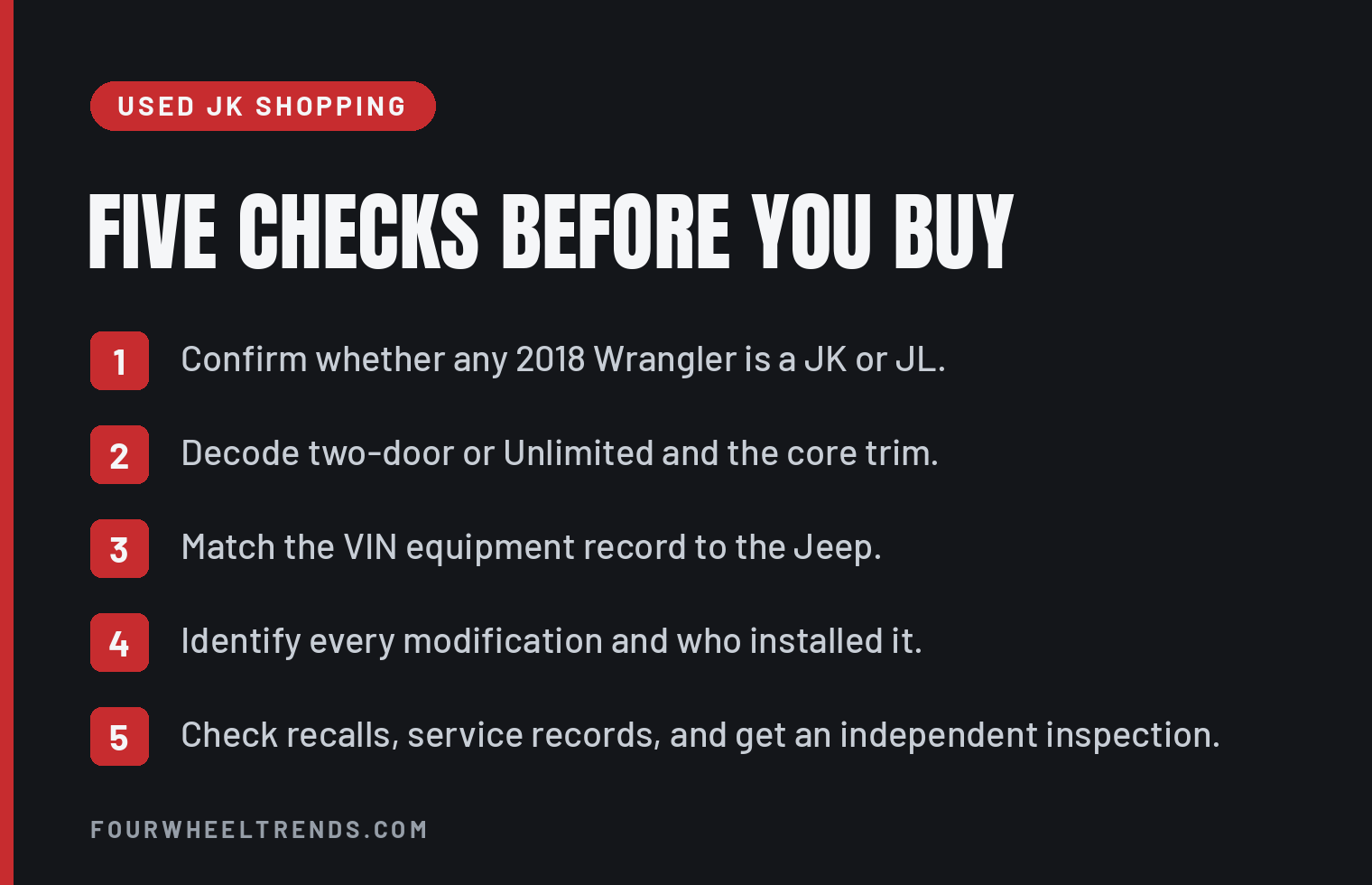
- Confirm JK or JL. Treat every 2018 listing as unresolved until the VIN, build record, and vehicle itself agree on the generation.
- Decode the body and core trim. Write down two-door or Unlimited, then X, Sport, Sport S, Sahara, or Rubicon before considering an edition badge.
- Verify factory equipment. Get the original window sticker or VIN-specific equipment record. Check the engine, transmission, axle ratio, roof, convenience groups, and special-edition package.
- Audit the modifications. Identify the lift, tires, wheels, steering parts, gearing, armor, wiring, and programming. Ask who installed each item and request receipts.
- Inspect the Jeep you are buying. Check recall status by VIN through the NHTSA recall lookup, review service records, test every feature, and pay a Jeep-knowledgeable shop for an independent inspection.
Once you separate generation, body, trim, and edition, the alphabet soup disappears. The right JK is the one whose original hardware, current condition, and previous modifications match the driving you will actually do.
Sources
- Chrysler Media, 2007 Jeep Wrangler feature availability, X, Sahara, and Rubicon equipment, checked November 9, 2026.
- Jeep, 2010 Wrangler and Wrangler Unlimited press pack, Sport, Sahara, Rubicon, and body-style naming, checked November 9, 2026.
- Jeep, 2011 U.S. Wrangler brochure, Sport, Sahara, Rubicon, and 3.8-liter powertrain, checked November 9, 2026.
- Chrysler Media, 2012 Jeep Wrangler and Wrangler Unlimited overview, four-model lineup and new powertrain, checked November 9, 2026.
- Jeep, 2018 Wrangler JK brochure, core trims, special editions, and specifications, checked November 9, 2026.
- Insurance Institute for Highway Safety, 2018 Jeep Wrangler JK, 2007 redesign and 2018 JK/JL overlap, checked November 9, 2026.
- Stellantis Media, Jeep history, JK four-door and five-passenger description, checked November 9, 2026.
- Jeep Canada, 2012 Wrangler product guide (dealer-hosted copy), Sport S, Sahara and Rubicon equipment, checked November 9, 2026.