
Which SUVs Hold Their Value Best? 2026 Data and the Cost Behind It
You are five years into owning an SUV when the expensive part finally becomes visible. The dealer looks it over, checks the mileage, and writes down a trade value. That one number can make a slightly higher payment look smart or turn a bargain into an expensive lesson.
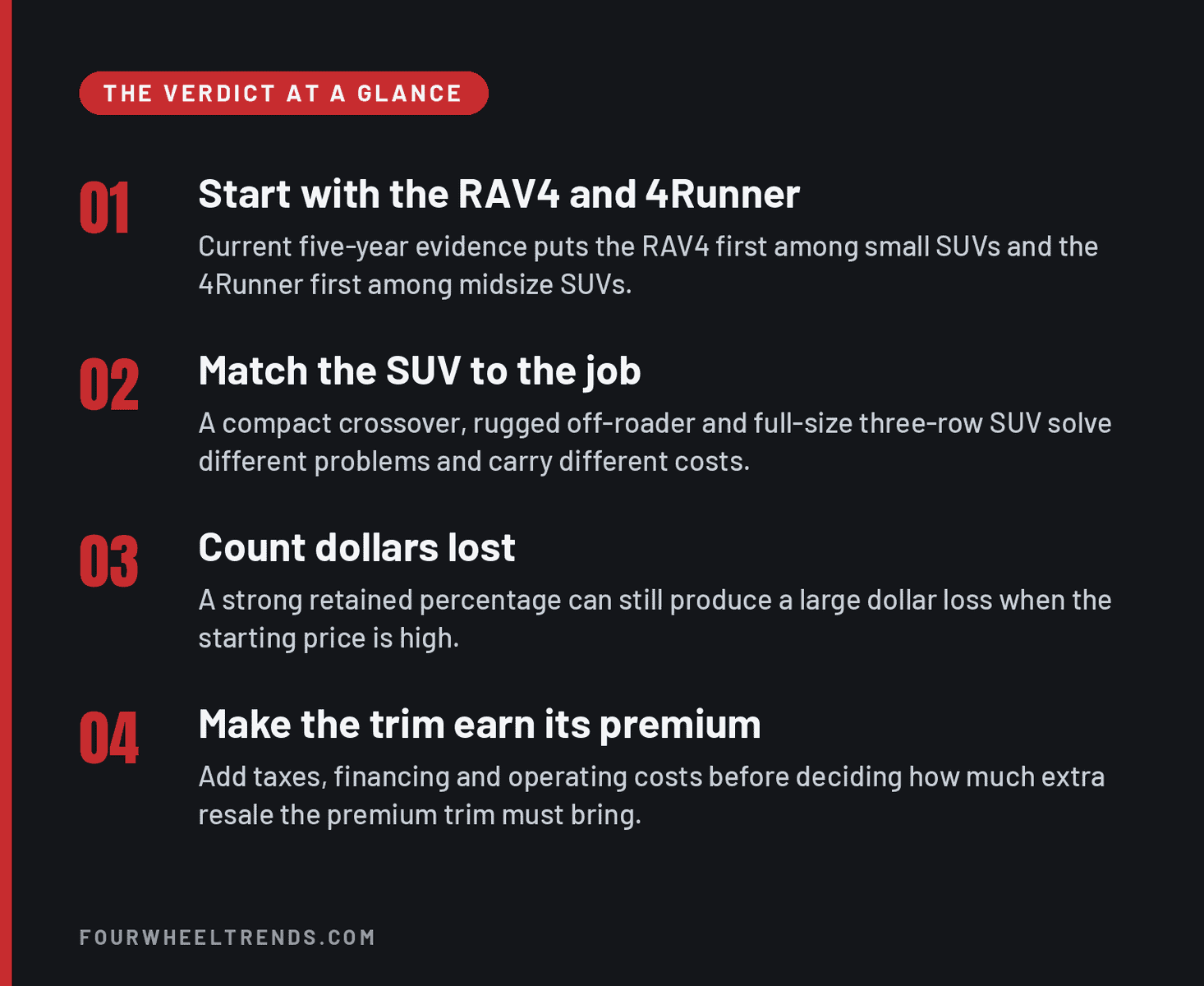
For most buyers, the Toyota RAV4 is the strongest all-around answer among SUVs with proven resale strength. The Toyota 4Runner is the standout rugged midsize choice. Honda’s HR-V and CR-V, the Subaru Crosstrek, Jeep Wrangler, Lexus RX 350, and Toyota Highlander also performed well in a current five-year study. If you are shopping for a new 2026 SUV, forecasts add the Toyota Sequoia and Grand Highlander to the conversation.
I would use those names to build a shortlist. I would not let a resale ranking choose the SUV for me. A vehicle that holds 70% of its value can still cost more to own than a less expensive SUV that loses a larger percentage. Purchase price, financing, fuel, insurance, maintenance, repairs, condition, mileage, and the number of years you keep it all count.
Which SUVs have the best five-year resale record?
The clearest current historical comparison comes from iSeeCars’ 2026 depreciation study. It analyzed more than 950,000 five-year-old used vehicles sold from March 2025 through February 2026 in the United States. The study compared inflation-adjusted original MSRP with mathematically modeled used asking prices.
That last phrase matters. These are model-level estimates built from asking prices. They are not the amount every owner received in a private sale or trade, and they do not predict what a new 2026 SUV will bring five years from now.
| SUV | Five-year depreciation | Value retained | Average difference from MSRP |
|---|---|---|---|
| Toyota RAV4 and RAV4 Hybrid combined | 25.2% | 74.8% | $7,731 |
| Toyota 4Runner | 25.5% | 74.5% | $10,697 |
| Honda HR-V | 28.8% | 71.2% | $7,645 |
| Honda CR-V | 28.9% | 71.1% | $8,946 |
| Subaru Crosstrek | 29.1% | 70.9% | $7,867 |
| Jeep Wrangler | 32.4% | 67.6% | $11,517 |
| Subaru Forester | 32.6% | 67.4% | $9,766 |
| Lexus RX 350 | 32.8% | 67.2% | $16,584 |
| Toyota Highlander and Highlander Hybrid combined | 36.0% | 64.0% | $16,543 |
| Ford Bronco | 39.9% | 60.1% | $16,158 |
I calculated retained value as 100% minus the study’s depreciation percentage. The table keeps the study’s combined RAV4 and RAV4 Hybrid row and its combined Highlander and Highlander Hybrid row. It does not turn those model averages into trim-level results.
The broad pattern is useful. Practical compact SUVs with large buyer pools did very well, and so did distinctive off-road models. The RAV4 lost an estimated $7,731 on this measure, while the 4Runner lost $10,697 even though their retained percentages were nearly identical. Percentage retention and dollars lost tell different parts of the story.
What do actual transactions say?
A second study asked a shorter-term question. Edmunds analyzed transaction data for used 2023 model-year SUVs and compared their average 2026 transaction prices with original MSRP. An April 2026 Associated Press report on that Edmunds analysis identified the Toyota Corolla Cross, RAV4 Hybrid, 4Runner, Highlander Hybrid, and Sequoia as the leaders in five size groups.
The 4Runner retained 83% of original value after three years in that analysis. The Corolla Cross retained 81.7%, the RAV4 Hybrid 81.4%, the Sequoia 80%, and the Highlander Hybrid 77%. These figures describe 2023 vehicles that had reached the used market. They are transactions, but they still compare an average used price with original MSRP. A buyer who paid above or below MSRP had a different personal result.
Two studies using different periods and methods still point toward the RAV4 and 4Runner. That agreement earns my attention. The exact percentages should stay in their own lanes because three-year transactions and five-year modeled asking prices are not interchangeable.
Which new 2026 SUVs are forecast to hold their value?
Historical evidence cannot tell us exactly what a new design or a new powertrain will be worth in the future. Forecasts can help, as long as we call them forecasts.
Kelley Blue Book’s 2026 Best Resale Value Awards project five-year auction values for 2026 model-year vehicles in average condition with 75,000 miles. KBB named the Honda HR-V, Honda CR-V, Toyota 4Runner, Toyota Grand Highlander, Toyota Sequoia, Lexus UX, Lexus NX, Lexus RX, Mercedes-Benz G-Class, and Rivian R1S as SUV category winners. Its 4Runner and G-Class also made the overall top 10.
J.D. Power’s 2026 U.S. ALG awards use a different target: projected wholesale value after three years. The model averages are sales-weighted across trims. SUV winners included the Sequoia, Lexus NX, RX, and LX, Subaru Crosstrek and Solterra, Tesla Model Y, Ford Bronco, and Jeep Wrangler.
The Toyota Sequoia appears in both 2026 forecast programs, so it deserves a close look if you need a new full-size SUV. That still does not make it the lowest-cost full-size SUV for every owner. Fuel, insurance, purchase price, and the cost of equipment you add can outweigh a resale advantage.
Which SUV would I choose for each kind of buyer?
Toyota RAV4 for the broadest everyday fit
The RAV4 is where I would start if you need a practical compact SUV and care about resale. It finished first among small SUVs in the five-year iSeeCars study, and the 2023 RAV4 Hybrid led the small-SUV group in Edmunds’ three-year transaction analysis.
Compare the gas and hybrid versions on purchase price, fuel use, insurance, and your expected mileage. The five-year historical study combines them in one row, so it cannot prove which current powertrain will produce the lower total cost for you.
Toyota 4Runner for a rugged midsize SUV
The 4Runner has the strongest repeated case in the rugged group. It led midsize SUVs in both the five-year iSeeCars data and the three-year Edmunds analysis, and KBB named it the 2026 off-road SUV winner.
That popularity can work against a used buyer because strong resale means you may pay a stubbornly high price for an older one. Check the condition, history, corrosion, modifications, and actual equipment. A high-ranking badge does not make a hard-used example a good value.
Honda HR-V or CR-V for a practical alternative
The HR-V and CR-V landed within one tenth of a percentage point of each other in the five-year study, at 28.8% and 28.9% depreciation. KBB also chose each as a 2026 category winner. I would let space, comfort, power, fuel cost, insurance quotes, and the purchase price settle this choice.
Subaru Crosstrek for a smaller all-weather choice
The Crosstrek retained an estimated 70.9% over five years in the iSeeCars study. J.D. Power also selected it in its three-year 2026 forecast. The Forester gives you more room and also made the historical table, with a somewhat larger 32.6% depreciation estimate.
Jeep Wrangler or Ford Bronco for open-air off-road appeal
The Wrangler’s five-year historical result was stronger, with 32.4% depreciation against the Bronco’s 39.9%. Both won their respective segments in J.D. Power’s 2026 forecast. Buy the one whose driving experience and equipment you actually want, then compare the exact trims. Model-wide results cannot tell you whether a Rubicon, Badlands, or another grade recovers its premium.
Lexus RX 350 for a luxury SUV
The RX 350’s 32.8% five-year depreciation estimate put it just behind the Wrangler and Forester in the historical study. Lexus also won KBB’s 2026 luxury-brand award, while the RX appears among the 2026 winners from both KBB and J.D. Power. Its $16,584 average dollar loss is the reminder I would keep in view: a strong percentage on a more expensive SUV can still mean more money lost.
Toyota Highlander or Sequoia when you need three rows
The Highlander and Highlander Hybrid combined for a 36% five-year depreciation estimate, and the 2023 Highlander Hybrid retained 77% in Edmunds’ three-year transaction analysis. The Sequoia has the stronger new-vehicle forecast, winning its category with both KBB and J.D. Power for 2026.
Choose between them by the job. The Sequoia’s size, capability, purchase price, and running costs belong in the calculation. Paying for a full-size SUV to protect resale makes little sense when a less expensive three-row vehicle meets your needs.
Can a premium trim pay for itself at resale?
Sometimes it can recover much of its premium. You need trim-level resale evidence to prove that. A model-wide 4Runner percentage says nothing about the exact difference between an SR5 and a TRD Off-Road.
The current U.S. 2026 Toyota 4Runner lineup, checked October 15, 2026, lists the SR5 at $42,270 and the TRD Off-Road at $50,690 before options, destination, taxes, and fees. The starting premium is $8,420. Toyota lists 18-inch wheels with 33-inch all-terrain tires, Bilstein shocks, Multi-Terrain Select, and Crawl Control among the TRD Off-Road’s equipment.
Here is the break-even test:
Additional resale needed = trim premium + extra taxes and fees + extra financing cost + extra insurance, fuel, maintenance, and repair cost.
If the $8,420 premium were fully financed for 60 months at an illustrative fixed 6% APR, the payment on that premium alone would be $162.78 a month. Total payments would be $9,766.93, including $1,346.93 of interest. Before counting any tax or operating-cost difference, the TRD Off-Road would need to bring $9,766.93 more at sale to recover the financed premium.
| Input or result | Amount |
|---|---|
| TRD Off-Road MSRP minus SR5 MSRP | $50,690 - $42,270 = $8,420 |
| Illustrative loan | $8,420 at 6% APR for 60 months |
| Monthly payment on premium | $162.78 |
| Total interest on premium | $1,346.93 |
| Minimum incremental resale needed before other differences | $9,766.93 |
The formula uses a standard amortizing loan with a monthly rate of 0.06 divided by 12 and 60 payments. The 6% APR is an illustration. It is not a current offer or a rate available to every buyer. The Consumer Financial Protection Bureau’s auto-loan guide explains that APR includes the cost of borrowing and fees, and that longer terms can lower the payment while increasing total loan cost.
This calculation also leaves taxes, insurance, fuel, maintenance, repairs, discounts, options, and sale expenses unknown. They are not zero. Replace them with written quotes and your intended ownership period. If you want the TRD equipment and will use it, enjoyment and capability can justify an added cost. The resale math should clarify what that choice costs while leaving the final decision with you.
How should you compare total ownership cost?
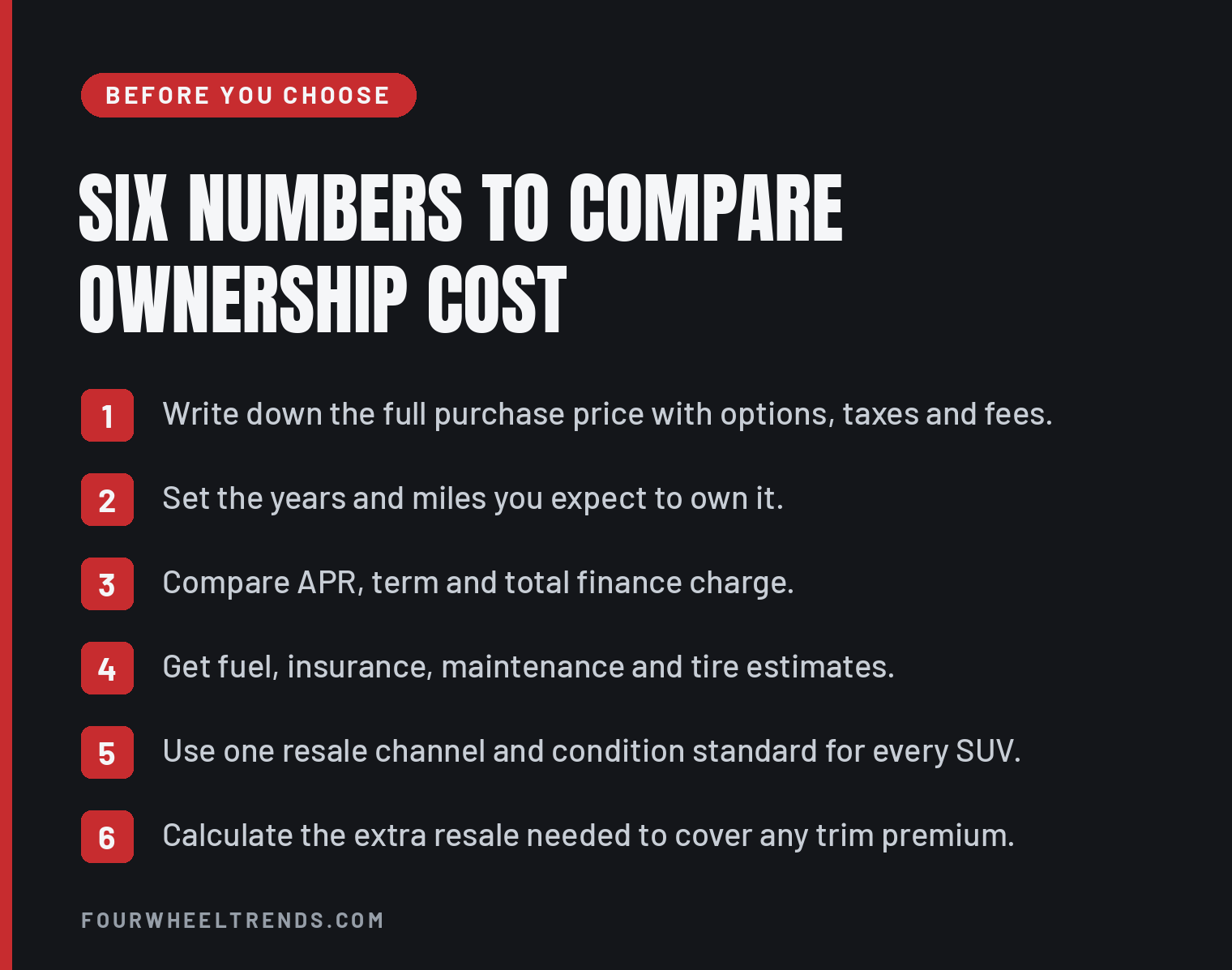
Start with the number of years and miles you expect to keep the SUV. Three years, five years, and eight years are different decisions. A five-year ranking cannot be stretched into an eight-year forecast with straight-line math.
For each SUV, collect these inputs:
- The written purchase price, destination, options, taxes, and fees
- The down payment, amount financed, APR, loan term, and total finance charge
- Fuel or charging cost for your expected mileage
- Insurance quotes for the exact VIN or configuration
- Registration, maintenance, tires, coverage, and a clearly labeled repair allowance
- An exit value from the same channel for every vehicle, such as trade, private sale, or wholesale
Estimated ownership cost equals purchase price, taxes and fees, financing cost, and operating costs, minus expected net resale proceeds. Loan principal is already represented by the purchase price, so do not add principal payments a second time. If you show depreciation as purchase price minus resale, do not add the full purchase price again.
For more model-year and shopping research, use the Four Wheel Trends buyer’s guide. Keep the final comparison on one page or spreadsheet with the same years, miles, location, condition, and sale method for every SUV.
What can change your SUV’s resale value?
A model ranking is the starting point. Your vehicle’s story determines the offer.
- Mileage and holding period: KBB’s 2026 forecasts assume 75,000 miles after five years. Your result will move with actual age and mileage.
- Condition and history: Accident history, corrosion, worn interiors, mechanical problems, and poor repairs can overwhelm a model’s average advantage.
- Equipment: Useful factory equipment can attract future buyers. Its value depends on the model, market, and trim. An expensive option rarely returns every dollar automatically.
- Modifications: Build the SUV you want, but do not assume a buyer will reimburse retail parts and labor. Keep the original parts and documentation when practical.
- Sale channel: A dealer retail asking price, trade offer, private transaction, and wholesale auction value describe different amounts.
- Market conditions: Incentives, used supply, fuel prices, interest rates, and buyer preferences can change before you sell.
My bottom line
I would put the RAV4 and 4Runner at the top of the first research list, then choose the size and purpose before chasing a ranking. The HR-V, CR-V, Crosstrek, Wrangler, RX 350, and Highlander give you several strong alternatives. For a new full-size SUV, the Sequoia has support from two independent 2026 forecast programs.
The best financial choice is the SUV that fits your life, can be bought on good terms, and still has a sensible ownership cost after you account for the money coming back at sale. Past retained value improves the odds. It never guarantees your result.
This article provides general educational information. It does not provide personalized financial advice. I do not know your financial situation, goals, or obligations. Ownership and resale estimates are not guarantees.
Sources
- iSeeCars: 2026 five-year depreciation study and methodology.
- Associated Press and Edmunds: three-year SUV transaction analysis, April 2026.
- Kelley Blue Book: 2026 Best Resale Value Awards and five-year forecast method.
- J.D. Power: 2026 U.S. ALG Residual Value Awards and three-year wholesale forecast method.
- Toyota: U.S. 2026 4Runner trims, prices, and equipment.
- Consumer Financial Protection Bureau: auto-loan key terms.